
Liber OZ is my favorite work by Aleister Crowley. It is a “book” which is actually only a single page.
A lot has been written about OZ, and you can find some good links on it here, here, here and here. Since all of Crowley’s works are dense, esoteric and self-referential– even this deceptively monosyllabic and straightforward pamphlet!– I won’t pretend to have successfully unpacked what the self-styled Great Beast intended by it.
Instead, this is my personal commentary on Liber OZ and how I use it in my life and practice– also how I personally deal with some of its more unlovely aspects.
Liber LXXVII
 |
|
||||||||||||
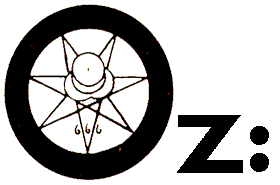
| Right off the bat we have a shit-ton to unpack. The symbol inside the O of Oz is Crowley’s Mark of the Beast sigil combined with a downward pointing septagram. Interesting to combine the numerals 666 with a star of 7 points, 7 being a number associated with the Christian God. I’m sure there’s some deep Kabbalistic meaning in that that I’m missing.
“Oz” has multiple meanings. One of them is “might” or “strength.” Another is “refuge.” Another is “she-goat.” Hail. This is said to be “the law of the strong.” Is that some Nietzschean Ubermensch bullshit I smell? (It smells like Axe body spray, for the record.) Probably, yeah, but once you read the rest of the document it makes sense outside of that context as well. This is a set of principles for self-governing, self-willed individuals. A blueprint for spiritual and literal anarchism. Making your own decisions and living by your own Will does take a certain type of strength… not necessarily brute, stereotypically masculine strength, although that can come in handy. More like the type of Strength shown on the Rider-Waite Smith tarot card, in which a woman calms a lion. 93 is the numerological equivalent of the words “Thelema” and “Agape,” Will and Love in Greek. What more perfect image of Love and Will, and Love Under Will, could there be than the Lady and the Lion? You’ll need a type of strength that is resilient and compassionate to live by this law… a strength that weathers storms. Remember that Crowley’s magical name was “Perdurabo”– I endure. Not conquer, not dominate. Endure. “Do what thou wilt shall be the whole of the Law.” —AL. I. 40. OK, so let’s get this out of the way– “do what thou wilt” does not mean “do what you want.” There’s this idea of the True Will, one’s own deepest purpose. Thelema means finding and pursuing that Will with singular, passionate focus. (A.L. stands for Liber AL vel Legis, The Book of the Law, for those who are wondering what those little citations are.) “thou hast no right but to do thy will. Do that, and no OK, so in the context of “Will” not meaning “want,” this makes a lot more sense. “You have no right but to do whatever you want” is a paradoxical and content-free statement. “You have no right but to fulfill your singular purpose, and from this right all your other rights derive” is something we can work with. “Every man and every woman is a star.” —AL. I. 3. Yeah, yeah, gender binary, BUT… what Crowley is saying here is that every single human is a unique and sacred entity with their own Will, which they have the absolute right to carry out. (Crowley’s relationship to gender wasn’t really binary anyway, as we’ll see later.) So, ya know. Doing your Will is great and all, but everyone else has a right to do theirs, too. You’re not better than anyone else, and you don’t get to step on other people’s Wills. There is no god but man. Honestly I have no idea. Crowley’s theism versus his atheism is a tangled question that I do not have the time for right now. He seems to have gone back and forth on it. But, for our purposes, I think it’s safe to assume that at least part of what Crowley is trying to say is this: there is no God more important than human Will that should be obeyed in its place. OK! Here comes the good stuff. A final note before I unpack the below– Crowley can be interpreted as very left-wing, or very right-wing. As far as I can tell, this is largely in the eye of the interpreter’s own politics. I’m a big lefty, so I’m gonna take Crowley to a straight-up Marxist-Anarchist place. Die mad about it.
“the slaves shall serve.” —AL. II. 58. Ugh. For me, this is the most distasteful and alienating line in the whole thing. But it isn’t without value even so. I think this means that some people’s Will is to obey rather than to seek freedom. This should not be taken as victim-blaming– I don’t think literal slaves “Will” to be slaves! I think Crowley is trying to say that some people Will to live under what Nietzsche (and occasionally Crowley) would term the “Slave God.” This is sort of indisputable: we see these conventional and conservative personality types all around us. Specifically, Crowley probably means “Christians gonna Christian”– there is every reason, given his Nietzschean influence, to assume that “slaves” primarily means “Christians” in this context. So I actually think this is a badly worded statement of compassion. Some people Will to serve. And so, serve they shall. Their right to pursue their Will is as sacred as any other person’s, and should not be interfered with. In a sense, this is a warning that not everyone is going to be a Thelemite, and that trying to convert everyone is a bad idea. Equally, people who Will to serve should not be denigrated by being accused of false consciousness. They should be left alone, to do their Wills. Every man and every woman is still a star. That was never contradicted. “Love is the law, love under will.” —AL. I. 57. There ya have it. Boom. Now will someone please tell me where to find Will? I’m supposed to get under him apparently. It’s the Law. |
|||||||||||||
 Church of the Morningstar
93; I really like your analysis. Thank you! 93 93/93
LikeLike