Ethical Possession

Or, “How to Channel Demons without Going Off the Deep End and Making a Weird Fucked-Up Cult.”

I never expected channeling to be part of my life and spiritual practice. I was raised “spiritual not religious” in California, which means I spent a lot of time around New Age bullshit. For a time, those experiences drove me to become a hardcore atheist, until other experiences changed my mind and showed me that there are ways to believe without going crazy and spending fifty thousand dollars on crystals, consciousness-raising workshops, fake Tantra gurus and psychic healers.

Still, even after my conversion to Satanism, even after I began practicing magick, channeling made me uneasy. And for good reason– many an abusive cult has begun with a leader claiming the exclusive power to channel otherworldly entities.

And then an awkward thing happened. I met, and fell in love with, an absurdly talented channeler.

Initially I had extreme reservations. I feared I was being conned, that he would try to use his claimed ability to control me or others, or maybe that he was just plain crazy. Over time, however, it became clear that none of those things were happening. I became about ninety percent convinced that the channeling was real, but also one hundred percent convinced that, real or not, it was not merely harmless, but in fact spiritually and emotionally beneficial.

So reader, I married him.

Since then, channeling has become a regular part of Church of the Morningstar services. So far, we haven’t become a weird cult about it. That’s because we have a certain philosophy about channeling, and certain guardrails in place, which prevent channeling from becoming a power play or a source of unhealthy delusion.

Below, I have attempted to lay those safeguards, and this mindset.

This post is not about technique, so I will not be going into the nitty-gritty of how to channel, how to banish, how to ward, or otherwise giving any other magical instruction. This post is primarily about keeping the social consequences of channeling in check.

ONE: Spiritual Safety

I’ll start by saying that channeling demons– that is, becoming voluntarily possessed– is not nearly as dangerous as it sounds, provided you practice basic magical sanitation.

Before you channel, you should have warded your space so that only invited entities can enter. You should have cast a circle. You should have a good number of banishing rituals and techniques in your back pocket, just in case shit goes south.

But I will be honest with you. Shit will rarely go south. For most people, the hard part about channeling isn’t getting the entities to go away– it’s getting them to come in.

And, of course, making sure nobody gets weird about it.

TWO: Maintain Skepticism

Channeling/possession is a spectrum. In my experience, it is rare for a person to be so overwhelmed by an entity’s presence that they lose all control over themselves, black out, and fail to remember any of the experience. Usually, at least part of you will remain home while you channel. You will likely be conscious for the experience. There will just be someone else there doing the talking for you, and you may be surprised by the words coming out of your mouth and the actions performed by your body.

It will feel weird. You will wonder if you are crazy or somehow subconsciously making it up.

And you know what? It’s good to wonder that!

The “crazy” part is surprisingly easy to get out of the way– mental illness is only diagnosed if it causes distress or impairs function. So as long as your channeling experiences are pleasant, beneficial, only happening when you want them to, and not fucking up your life, it technically does not matter if it’s a delusion. It’s still benign.

As far as subconsciously making it up– this is a distinct possibility. My attitude towards it has become “so what?” If it’s all secretly just psychodrama, that doesn’t really matter to me. I still get great advice from demons. I still learn and grow through these experiences. I still get answers from them that I did not know, at least not with my conscious mind. In other words, for me, it’s useful.

The definition of magic in the modern era is pretty much “stuff that seems to work but we can’t prove it in an empirical setting and we aren’t really sure why.” If you are an intellectually honest person and have been practicing for any length of time, you already know that you’ll never be one hundred percent sure. But you keep doing this stuff anyway because it seems to work and it helps you. Channeling and possession are no different.

THREE: Anyone Can Channel

Channeling is a skill. As with any skill, some people also seem to have a natural talent for it. But practice can close the gap between the “naturally” gifted and those who struggled at first.

If anyone tells you that they have a unique magical ability of any kind that nobody else can access, laugh in their face and unsubscribe from their newsletter. If anyone tells you that they have a unique magical ability that they can teach you if you pay them thousands of dollars, that person is a scammer. If somebody tells you that they and they alone have been chosen as a conduit for Satan to speak through, that person is trying to control you by seeming to wield a greater authority. Run away.

You, yes you, can learn to do this. You don’t need to depend on anyone else for your connection to the infernal.

FOUR: Just Because Someone Says They Are Channeling Doesn’t Mean They Are Channeling

Hopefully this needs no explanation. They may say they are channeling, but they may be wrong, or lying. They may be channeling, but accidentally channeling a different entity than the one they meant to channel.

FIVE: The Content Matters More than the Source

The only reason to listen to a “channeled” entity is if it is saying things worth hearing anyway, so let that be your guide. Sometimes the answers you need in your life come from a demon speaking through a possessed human being. Sometimes those answers come from reading a book, or searching your own soul, or overhearing a conversation between strangers in the supermarket. Sometimes the right answer might even come to you by accident from a huckster who is trying to con you. Life is weird like that.

Take what is useful to you and leave the rest, because…

SIX: DEMONS ARE NOT THE BOSS OF YOU

Demons aren’t the boss of you. Satan is not the boss of you. You, yes you, are a living God, and you are not anyone’s servant to command. That includes the Devil, and in my experience, he is always the first to say so.

Just because someone was supposedly channeling Satan doesn’t mean you have to follow their instructions or take their advice. And if the “Satan” they are channeling insists that you must, then that’s not the Devil I know.

SEVEN: The Channeler is Responsible

Channeling is not an excuse for bad behavior. At the end of the day, the channeler is accountable for anything that the channeled entity says or does while borrowing their body.

This is crucial, even if it doesn’t seem fair. In cases of real, total possession, obviously it may be possible that the channeler is completely absent and not at all in control. But the rest of us only have the word of the channeler that this is what happened.

If some fucked up shit happens while somebody is channeling, I encourage you to consider that conduit an unsafe person. In some cases, it may also be wise to consider the alleged entity an unsafe entity. You should perhaps stop hanging out with either of them.

More May Be Revealed

These guidelines are neither foolproof nor perfect. They are a work in progress and just represent the best practices we have figured out so far. But I do feel comfortable saying that if you implement these practices, you are well on the way to making sure channeling cannot be used for authoritarian purposes, and ensuring that nobody goes off the deep end based on channeled content.

Guest Post: Dirt by Frater Babalon

Have you ever been inside a cave?  Have you ever been in cave darkness?  Cave darkness is special.  It’s different.  It’s darker than any other darkness.  It breathes. 

Earth is often talked about as a gentle, generative element, which is funny because we talk about “Getting our hands dirty” when we talk about violence, and I think there’s something to that, the dark majesty of the chthonic realm is almost unfathomable.

Soil is vital to us in ways I think we often fail to think about, soil is our ability to feed and clothe ourselves.  It is alive with microorganisms.  Which is one of the reasons you don’t use just any soil for a mud mask, because some of the stuff in soil can actually really fuck you up if you’re not careful, also we can really fuck up soil if we’re not careful.  

Soil is largely composed of several classes of mineral matter (Sand, silt, and clay) mixed with decaying organic material.  This is the nutrient rich medium in which plants grow, microorganisms which help plants break down the nutrients in the soil.  The organic material is incredibly important to this process.  The microorganisms that are vital to the healthy growth of plants starve without it, and may even evolve into pathogens as they attack the plants they used to feed in desperation.

Think about how a landscape might tend to function without human intervention.  Plants grow, leafs fall, animals eat plant parts, they shit and die, things rot, and the soil is fed, however on cultivated land, when compost isn’t used the organic material in the soil becomes depleted and shit goes real haywire and you can basically make huge swaths of land incapable of growing anything this way, incidentally that’s what farmers are doing (along with depleting the water table which is literally causing land to sink) in California… a region which produces like a lot of our food.  Incidentally healthy soil is a wonderful carbon sink… whereas depleted soil… well yeah.

Getting food waste composted and back onto farmland is vital to us not ending up in a really uncool version of Mad Max.  Unfortunately, due to suburban sprawl replacing farmland surrounding cities where much of the population is concentrated returning said waste to farmland is energy intensive and a pain in the ass.  This is something that needs to be done not on an individual level but on an industrial scale.  We need to organize society to be able to sustainably feed our whole population, and I believe we could do that under a communist economic order.

I think it’s really funny how “sustainable” has turned into this word for like crunchy-organic expensive Gwenyth Paltrow bullshit when in fact sustainability contains its concern in the word itself.  We have sustainability as a concern, as a concept because people have understood for quite awhile that our current way of managing things is unsustainable, as in we literally cannot keep doing this.  The use of “sustainable” as a marketing buzzword is disgusting.  The most sustainable anything is the one you already have.  

Unsustainable practices are not the result of human laziness or malice, they are the result of the economic order that forces people always to be pushing for maximum profit, and damn any non-monetary cost that doesn’t effect the bottom line.

And so what the fuck does this have to do with religion?  I mean I could simply say the earth and all that lives on it is sacred, but I find saying that profoundly trite and unsatisfying.

Partially to me, every human being is divine and thus the maintenance of conditions for continued human existence is important and we must remember that we thrive with nature not against it.  The illusion of a zero sum game will kill us all.  We thrive on cooperation, we die in competition.  But additionally, I do think the earth is sacred. 

Not just the planet but the dirt itself.  I think a large part of every genius loci lives in the soil.  So much about a place is defined by the character of its soil.  Manhattan can have skyscrapers the way it does because of how close the bedrock is to the surface, allowing the land to support massive structures that would sink and tilt in softer soil.  The rocky but fertile soil of New England is why we have the ubiquitous stone walls, why the crops that grow here are what they are, why indigenous people shaped the landscape as they did.  West Texas’s limestone rich sandy loam dotted with desert grasses creating the grey and gold palette that define the region as a place best suited to nomadic herders rather than settled agrarianism, and so on and so forth. 

Dirt defines place, the character of the dirt both creates and is the product of the landscape, it tells of the movement of glaciers, and of peoples, the paths of rivers and so many other things.  

I am not a person with any belief in blood and soil.  I do not have any patience for ethno-states.  I believe that an immigrant can become a part of a place, but I do think that an immigrant is very different from a colonist. For one, immigrants do not start a systematic project of genocide and/or subjugation of the people already living there, and perhaps that’s part of it, perhaps you can’t really belong to a place if you water its soil with blood and tears of the people who were already part of it, and perhaps you can’t really belong to a place if you turn people fleeing there in desperation away, especially if you have already done the former.

And I do think especially for people who get food from the land, grow crops or herd animals or hunt and gather on it, there is an understanding that is hard to get any other way.  People whose families have lived in a place for generations, or people who have moved in and gotten to know the people who have been there for generations… well essentially, it amounts to having access to generations upon generations of studiously observed research on a place and of course, there’s also the importance of home. 

I am currently thinking particularly of Palestine.  I am thinking of the villages where generations of a family had lived and died in the same house, and the emotional weight of losing such a place, of the affection one might feel for the beauty of the storied olive groves that Israel continually destroys, for the land that the people living there before the nakba but also even if it weren’t for the sentimental and aesthetic elements here, there’s also a simple “Absolutely no one wants to be forced out of their home and people are often in the place they are for reasons like connections, climate and so on that make that specific place important.”

And beyond that, there is also the fact that war has always had a tendency to have a bad effect on the soil, from burnt and salted fields to the mass killing of buffalo herds to starve out indigenous populations to agent orange, to the HUGE section of France that’s still uninhabitable and unable to be used for farmland due to the minefields, and high concentrations of lead and other pollutants from the first and second world war,  attempting to remove people by force from their homes has a tendency to leave invaders with a land far less habitable than it was before.  

It’s also important to say that this piece is being written and read out on occupied land, contested Wampanoag and Narragansett territory.  Land acknowledgements like this are quite popular now.  You’ve probably heard them before, seen them in email signatures and so on, but I must admit I find them sort of… glurgy and annoying.

They acknowledge a wrong, gesture towards white guilt while doing sweet fuck all about the realities of colonialism.

Which brings to me landback, a movement I’ve been researching and trying to my best to get a grasp on.  It’s a decentralized movement and so demands vary, but overall it is about returning political and economic management of land to the people who held it before colonization, and basically governance and administration being arranged and organized in ways more in line with the cultures of those colonized people, which tends to involve far more responsible land management practices, and non-capitalist economic structures.  

Both because these are peoples who successfully managed the ecosystems on this continent for millenia, rendering it fertile, habitable and healthy and because as a systemically impoverished demographic who often rely on the natural resources of what land they have left to survive, they are some of the people most directly affected by environmental devastation within the US.  People indigenous to the Americas are the reason we have corn and potatoes, two of the crops with the best calorie to land use ratios out there (more calories per acre is better when you have a lot of people).  The forest management practices of the peoples of the coasts and the animal management strategies of the plains peoples are technological marvels even today.  

Indigenous peoples are a mere 5% of the world’s population but are stewards of 80% of the earth’s remaining biodiversity.  I don’t say this out of sentiment or some belief in some inherent racial characteristic of “good land management skills,” I’m saying that if a culture overall focuses on being good at a thing, and that culture is structured around that thing, people immersed in that culture will often be good at it, and while colonial powers focused primarily on martial technologies and technologies of power, the polities who devoted their intellectual energy towards other stuff were the ones that tended to end up colonized, so of course colonial powers suck at land management.  War machines like that are expensive in time, energy and intellectual ability.  

And this is not to say that indigenous people are in any way monolithic.  A Wampanoag person is not remotely interchangeable with a Lakota person or an Aleut person or a member of the Nʉmʉnʉʉ.  Indigenous people are people and they’re people from a whole bunch of different places and cultures, and pre-European colonization there were colonial powers (like the Aztec empire) and wars and so on and so forth, because people are people, and none of that undermines the fact that A: That excuses nothing, the notion that Europeans were less brutal or “more civilized” is utter horse shit, and also again flattens the profound diversity of indigenous cultures.  There are indigenous monarchies and indigenous democracies, centralized and decentralized, with greater and lesser personal liberty and vastly varied systems of property, a set of polities at least as varied as early modern Europe and probably more so because of the lack of Christianity as a vaguely unifying factor, B: Everyone was doing war crimes in the 19th century, and the settlers did more, C: None of that even matters because settler colonialism is inherently wrong and D: It’s not even about morality, it’s about letting the peoples who had systems that were working to keep large populations alive and fed replace the systems that are actively going to kill us all.  

Also it does not mean that those of us without indigenous heritage have to leave or anything, we’d just have a different form of government and economic system and I’m pretty sure it’d be an overall far more sensible one.  Much  like a decolonized Israel wouldn’t mean Jewish people being forced to leave, it would just mean becoming Palestinian citizens rather than Israeli ones.

To respect the land is to respect what’s on it, including people.  Things do not grow where we salt the earth.

The Lord of the Opening

This is the story of how a God became a demon– specifically, of how Baal became Belphegor.

The name Belphegor derives from the Baal of Peor, which means “Lord of the Opening.” We know very little about this Baal except for what is written in the Hebrew Bible, all of which is from the perspective of his enemies. 

Maybe this Baal Peor was an aspect of Baal Hadad, the supreme deity of the Canaanites. But since “Baal” just means “Lord,” we can’t be completely sure that the Lord of Peor is the same as Lord Hadad. 

There were many Baals, in fact– Baal Zephon, the lord residing on Mount Zephon; Baal Berith, the Lord of the Covenant who was briefly worshiped by the Israelites when they went astray from their God; Baal Zebul, Lord of the Heavenly Dwelling, who became Beelzebub, Lord of Flies; and the ram-horned Baal Hammon, also called Baal Karnaim, which means “The Lord of Two Horns.” How they all relate to each other is difficult to say. Our sources are few. History has been written by the victors, and in the battle for worshippers and reverence, Yahweh won and Baal lost.

We do have fragments of an Ugaritic epic known as the Baal cycle, which describes the exploits of Baal Hadad on his way to becoming king of the Gods. This Baal is a god of rain and storms. In the dry region of ancient Canaan, rain was crucial for agriculture. Without the rain, one did not eat. During the hot summer, Mot, God of Death, was considered to reign on Earth, while Baal retreated to the underworld. His return in the wet season heralded the defeat of death and restoration of the earth’s fertility. 

Baal was not merely a rain god. He was also a warrior. He did battle with many gods, including the Death God Mot. Describing his victory, one text says:

“Sun rules the Rephaim, Sun rules the divine ones: 

Your company are the gods, see, the dead are your company.”

The text is fragmentary, but these words are seemingly spoken to Baal by Shapsu, the sun goddess. She is granting Baal partial authority over her legions of the dead. But why should the sun be connected to the dead? It seems an odd association to us now, but the ancient Canaanites believed that every night, the sun sank beneath the earth and traveled through the underworld. That meant that the sun goddess Shapsu was a liminal figure, constantly traveling between the lands of the living and of the dead. 

This connection of Baal Hada to the dead brings us back specifically to Baal of Peor. Psalm 106 contains these lines: 

They joined themselves also unto Baal-peor,

And ate the sacrifices of the dead.

This is probably the most reliable description of the worship of Baal of Peor that we have. It seems that during rituals to him, food was offered to the mighty ancestors, the Rephaim. The living ones making the offering would then consume it themselves. To me this seems like a beautiful practice, and I plan to try “eating with the dead” in a manner inspired by this. 

But the worshippers of Yahweh bitterly resented the cult of Baal, and struggled against it for hearts and minds. In the Bible we read that Israelite men and women turned away from Yahweh and went “whoring” after Baal. Some have taken this to mean that the worship of Baal involved sexual rites, but there’s not really much evidence to support that. I personally would love to believe in ecstatic orgies in Baal honor, just because that seems fun– however, “whoring” after Baal was probably purely metaphorical. The idea is that Israel is “cheating” on Yahweh by worshiping Baal. It’s simply a comparison of religious infidelity to sexual infidelity. The other meaning of “whoring” after Baal is that Israelites were intermarrying with Canaanite Baal worshippers, and in some cases religiously converting to worship of Baal themselves. 

So the followers of Yahweh did everything they could to suppress the cult of Baal, mainly by smashing his idols wherever they found them. Yahweh’s faithful triumphed, and the worship of Baal faded away. The rest is well-known history. 

Long after Baal’s worship had become a thing of the past, Yahweh’s followers continued to demonize and slander him. I say with love that the Jewish sense of humor can be quite scathing, and on the topic of Baal of Peor, the Rabbis were merciless. A midrash was invented that “the opening” of which Baal was Lord was actually the anus. They claimed that Baal of Peor was worshiped by defecating in front of his statue. 

And so Belphegor was born. Woven together from all these threads of legend and slander, a unique and baffling demon was created– Belphegor, Lord of the Dead, a demon of the sun, and the patron of… feces. 

Belphegor’s association with shit can be off-putting. I know it was to me. But if we can set aside our disgust and contemplate the deeper meaning of excrement, we will realize that the scatalogical Belphegor we know today is not so very far from the agricultural fertility god of the Canaanites. After all, manure makes fertile. Eating and excreting are parts of the same process, and Belphegor is there at both ends. 

The element of earth itself, the soil from which all things grow and upon which our lives depend, is largely made of shit and corpses. Dead plant and animal matter, as well as feces, turns into rich compost from which new life can emerge. The sun provides the warmth which allows things to rot and fester and return in a new form. 

Baal himself was a god who died and was reborn. He was swallowed whole by Mot, god of Death. His younger sister Anat, and Shapsu, goddess of the sun, traveled through the bowels of the underworld to bring him back to life. His revival brought healing, nourishing rains after seven years of drought. One could even say that not only was Baal eaten, but also digested and excreted, returned to the earth in a new, fertilizing form. Without him, the people of the earth had been starving, wasting away in famine. Baal’s rains allowed their crops to grow again. The god himself, in this way, is synonymous with food. And what is eaten must be expelled. So we see that Belphegor’s fecal nature and his association with death are merely diabolic veils before his powers of nourishment and life. 

Belphegor as a solar demon is often connected to the concept of the Black Sun. The alchemical black sun has nothing to do with the Nazi symbol, which isn’t even actually called the black sun but rather the sonnenrad, or “sun wheel.” In alchemy, the black sun represents the phase of putrefaction, which allows what is not needed to disintegrate and fall away in order for purity to emerge. This association with the dark or inverse sun echoes Baal’s connection to the sun of the underworld, the sun of night. Also, a literal “black sun” in scientific terms would surely be a black hole, a very fitting thing for the Lord of the Opening to be associated with. The other natural occurrence of a black sun is a solar eclipse, and Baal’s legend also mentions the sun vanishing or going dark when he died. 

The concepts and images that surround demons can often seem negative, menacing or disgusting, but when we look deeply into demons, we find that they contain the bright sides of existence as well as the dark. Neither dying nor shitting is actually horrifying– at least not compared to a world without death or excretion. Our bodies must expel waste in order to live, and holding that all inside would be much more repulsive than getting it out. And while eternal life may seem like an appealing fantasy, and death and loss are frightening and painful, death makes way for new lives, and saves us from a monotonous world of the same fucking people doing the same things again and again for all of eternity. It is better to eat and shit, to live and die, than to do neither. These processes, the good and the bad, are merely parts of the mechanics of existence. 

Belphegor represents these processes, at once life-giving and death-dealing, rancid and beautiful. Not for nothing was Baal known as Lord of the Earth. The storm that makes fertile can also bring destruction, the feces that spread disease can also make plants grow. Belphegor stands for the ambiguous, double-edged nature of the earth and its cycles, and his repulsive aspects protect us from over-romanticizing or sentimentalizing nature. 

Baphomet Meditation

Try this, if you want.

Sit or lie down comfortably. For purposes of this meditation, sitting might be easiest, since we are going to be working with “above” and “below” and this can get confusing when you are lying down. Cross-legged on the floor is ideal, if that works for your body.

Close your eyes. Begin to breathe slowly and deeply through your nose. Inhale to a slow count of four. Hold your breath to a slow count of four. Exhale to a slow count of four. Repeat. Let yourself fall into this rhythm.

The in-breath comes from above. The out-breath comes from below. Focus on this idea as you continue to breathe in this pattern.

As you inhale, imagine a beam of cooling light penetrating the top of your head and flowing down into you, filling up your entire body. Focus on this with every inhalation until you can really feel this energy.

Once you can feel this gentle, soothing, cooling energy coming from above you and outside of you, begin focusing on the outbreath. As you exhale, imagine a dark hot column of flame leaping up in your belly and extending towards the top of your head.

This dark, hot, passionate fire of your individuality mixes with the calm, neutral light of the universe as you continue to breathe in pattern—inhale 2 3 4, hold 2 3 4, exhale 2 3 4.

Feel those energies mixing in your body and coming into balance. Feminine and masculine. Universal and individual. Above and below. Outward and inward. Cool and hot. Rational and passionate. Right and left. Light and dark. Solve and coagula.

Let them move within you, feel them mix and intertwine. Bring them into a balance that feels right for you. I like to end this meditation when I reach a gradient I describe as “cool head, warm heart and fire in the belly,” letting the cool light predominate in my upper body, the hot fire in my lower body, and the two mingle in my heart. But how you calibrate these forces is up to you.

When you feel content with your energy level and inner balance, place your hands over your navel to center yourself, return to normal breathing, and open your eyes.

Guest Post: The Eco Satanist Manifesto

This is an anonymous contribution.

PREAMBLE

We, the Children of Perdition, are resigned and even eager to spend our afterlives in Hell. However, while Hell is home to all the demons we revere and to many of the people worth knowing, it is not noted for its temperate climate. As Satanists, we aspire to create Hell on Earth in some positive senses: to bring forth its creative, hedonistic, revolutionary spirit, to mingle with diverse beings in a free, equal and anarchic society where no Gods nor masters rule. But one thing we do not wish to import from Hell is its weather. 

Unfortunately, this work is already being done for us by our spiritual, political and ideological enemies: the capitalists, the imperialists, the colonizers, the Christian Right. The forces of greed and tyranny march onwards, crushing all life in their path. Their allies are ignorance, apathy and cowardly denial– people and institutions who deny science and the evidence of their own senses in order to pretend that the globe is not rapidly heating. 

Stereotypically, in books, films and comics, it is Satanists who crave the apocalypse and strive to bring about the end of all things. How ironic that in reality, it is Christians who thirst for the rapture, who aid and abet Armageddon. After all, they contend that it is the will of the obscene egregore they call God for this world to end. And why not? They love heaven more than earth, death more than life. 

The Satanist loves life. The enlightened adept loves life and death equally, accepting them as realities that are essential to each other, a cycle that is self-perpetuating. For us, there is less distinction between the material and the spiritual. The sacred and profane are the same, and therefore all things are holy. We find ecstasy just as much in the pleasures of the flesh as we do in prayer, meditation and ritual. 

Therefore, the Satanist is opposed to the apocalypse, as is the Devil himself, who is known as Lord of this World. 

This being the case, and the probable end of human life on earth being the most pressing issue of our time, it befits us to develop an eco-Satanic theology, which we shall begin to articulate in this manifesto. 

PREVIOUS ECO-THEOLOGIES

Many Christians see God’s creation as belonging to human beings. This attitude was expressed mostly crudely by Ann Coulter: “God said, ‘Earth is yours. Take it. Rape it. It’s yours.’”

Christian environmentalisms and eco-theologies do exist, but as Satanists they are not of particular use to us, beyond providing a rationale for the decent Christians of this world, who we are not too proud to fight beside. After all, solidarity is essential to any functioning eco-theology, since all of us must inhabit the same earth, in spite of any differences of opinion. 

Neo-paganism is closely bound to eco-theology. “Pagan and earth-based traditions” is a common phrase that equates the two terms so closely that they nearly become synonymous. These ways of thinking about and relating to nature are indeed more positive and caring, but they are often sentimentalizing and frequently not very sophisticated. Nature is often honored as an abstraction, or rhapsodized about for its beauty and healing powers. It becomes the window-dressing for weekend rituals in the woods, after which the participants go home to urban environments and forget that nature is still all around them. All-natural aesthetics, alternative medicine, and “ethical” consumption choices are common in these circles. Overall, this eco-theology, while good-hearted, is highly individualistic, emphasizing isolated personal actions and lifestyle decisions. It also usually lacks economic or political analysis beyond what can be provided by the U.S. Democratic Party. As such, it can have no teeth as a movement. 

ROOTS OF SATANIC ECO-THEOLOGY

Historically, Satanism has not been particularly associated with ecology. This is partly because of its right-wing libertarian roots in the writings of Anton LaVey. LaVey was repelled by the sentimentality of the hippies and Wiccans of his era. Associating environmentalism with such people, he wanted little to do with it. 

However, even in the dross of LaVey’s polemic, we can unearth a basis for Satanic eco-theology, namely in item seven of the Nine Satanic Statements: 

“Satan represents man as just another animal, sometimes better, more often worse than those that walk on all-fours, who, because of his “divine spiritual and intellectual development,” has become the most vicious animal of all!”

In the context of LaVey’s other writings, it becomes quite clear what he means by this: it’s a dog-eat-dog world, ruled by survival of the fittest in a social Darwinist sense, and thus we should support competition and laissez-faire capitalism. 

However, we should feel free to twist and reinterpret his words, against his will, and draw something deeper from them, hopefully making him spin in his grave in the process.

LaVey’s words dissolve the distinction between man and beast, and even challenge the supremacy of human beings over our environment. This is not a bad place to begin building a Satanic eco-theology: from the premise that we are part of nature, not separate from it. The world is not something apart from us that we may strive to master, but rather our home, the destruction of which will have direct, fatal consequences to us. 

Now is also a good time to invoke the traditional LaVeyan virtue of rational self-interest. This quality has been too long absent from the environmental movement. For those of us who grew up in the 90s and remember a time before climate change was public knowledge, we recall a cloyingly preachy, misty-eyed environmentalism that was all about saving the pandas and preserving natural beauty. This environmentalism was often the sphere of rich, white philanthropists, and it was frankly quite annoying. 

A vestige of this attitude has been preserved nowadays among the more enlightened environmentalists of the 2020s. Now well-meaning white environmentalists are quick to point out environmental racism and the fact that climate change is cataclysmically impacting people in the so-called “third world.” 

While this is true, and is an important thing to keep in mind, something about this discourse is grating. It reminds me of the 90s, when pleas for the plight of the pandas were juxtaposed with pleas for the plight of the poor African children, side by side and in the same condescending tone. It makes the problem remote, and a matter of charity. We, the privileged, must do something to save the helpless, vulnerable, “exotic” animals and peoples of the planet. It’s a dehumanizing discourse, and also an arrogant and hubristic one– for while it is true that the more privileged will likely be spared for a while longer, nobody is immune. We all live on the same planet and we are all going down in flames. 

The faster we realize that all of us are vulnerable, all of us are ultimately doomed, the faster we can fight together in genuine solidarity rather than condescendingly wringing our hands over those less fortunate than ourselves, and then not really doing much to help them. 

Make no mistake: plants and animals are important. People who live far away and look different from us are even more important. Empathy for others should have been enough to propel the more privileged among us into effective action, but as history has proven, it was not. The faster and more forcefully that we can reframe environmentalism as ruthless, desperate self-preservation, rather than as the pet cause of bleeding-heart liberals, the faster we can make effective change. 

After all, people fight harder when they are fighting for their own lives. 

OUR NAME IS LEGION: REJECTING INDIVIDUALISM

Selfishness can only take us so far, however, unless we realize that our rational self-interest demands solidarity. Individualism is killing us all. 

The capitalist, neo-liberal establishment has done a very good job of making the average (proletarian) person feel personally responsible for climate change. We are exhorted to turn off our lights when we leave the room, to recycle, to buy green, to vote blue no matter who, to donate our hard-earned money to liberal non-profits who will use our donations mainly to fund the fliers and postcards they mail out to beg for… more donations. Green-washed capitalism rears its ugly head and sells us allegedly eco-friendly commodities at inflated prices, leaving us poorer, pacified, and no closer to ending climate change and saving ourselves. 

Make no mistake: it is the capitalist mode of production that is destroying the planet and all of us with it. The reasons for this are complex and multifaceted and could be expounded upon for the length of several books, but they boil down to this: capitalism rewards relentlessly maximizing profits while minimizing costs. The less you can pay your workers, the better. The cheaper and cruder the methods of extraction, the better. Exploitation is merely a word for making profits at the expense of other people and of the natural world. Under capitalism, every natural resource that can be extracted from this planet and sold for profit will be, until there is nothing left to sell, no one left to do the labor, and no one left to buy. 

Capitalism is an endlessly thirsty vampire that sucks the blood of life itself, compulsively. It is a parasite that cannot survive in any other way. Unless it is stopped, it will only die when the host dies. 

An individual cannot overthrow capitalism. Neither can capitalism be overthrown by ditching fast fashion, signing petitions, recycling, voting, going vegan, turning off your lights, planting a community garden, participating in earth-based pagan rituals, or donating money to plant trees and offset your carbon footprint. Not all of these actions are useless, many of them are worthy and admirable, but none of them is even a baby step in the right direction, because these all remain individual actions taken within the context of capitalism, that do very little to hurt it. 

The only thing that can overthrow capitalism is a working-class revolution. 

Good thing we worship Lucifer, the God of revolutions. 

But there is another demon to whom we should turn our attention– the Lord of the Flies. Perhaps no other entity can teach us as much about collective power as Beelzebub, Queen of the Hive. 

THERE IS POWER IN A UNION

Beelzebub may have originally been named Baalzebul, which translates as Lord of the Heavens. Beelzebub, the Lord of the Flies, may have been another epithet of the same God used by his worshippers, emphasizing his powers over the spreading and curing of pestilence. Or it may have been a derogatory name used by the ancient Israelities to mock worshippers of Baalzebul, comparing him to a mound of feces and his followers to flies. 

At first glance, this image is indeed insulting. Few people want to feel like a tiny helpless insect squirming on a pile of shit. Under capitalism, perhaps, many of us do feel that way. We are insignificant, forced to feed on garbage and excrements and whatever other scraps are thrown to us. A single, solitary insect is indeed pathetic. It is the base of the food chain, a short-lived victim of larger, stronger predators. 

But many insects together can have startling power. Think about the dreaded Biblical plagues of locusts that sweep through and strip all vegetation from the land. In a more positive sense, consider the role of insects as pollinators, without which no plant would be able to grow. Even the humble role of eating feces, garbage and corpses is indispensable– insects are nature’s cleanup crew. They are amongst us all the time, in the midst of our cities, doing their job without us noticing. Without them, there would be a lot more trash and rotting food on our sidewalks. Once they expel the waste that they have consumed, their own excrement makes the ground fertile. They are undertakers as well, returning the bodies of dead things to the earth and integrating them once again into the cycle of life. 

Insects have the power of life and death. Without them, nothing grows, and the dead are less quickly returned to the cycle of life. Entomologist Thomas Eisner says: “Bugs are not going to inherit the Earth. They own it now.” 

Insects can be seen as the proletariat of the food-chain, the workers doing the dirty jobs that keep things running. As insect populations decline due to climate change, people are beginning to become aware of their importance. We literally cannot live without them. Entomologist Martin Sorg says: “We won’t exterminate all insects. That’s nonsense. Vertebrates would die out first. But we can cause massive damage to biodiversity—damage that harms us.” In other words: we cannot live without them. There will be bugs after we are gone. We don’t even need to kill all of them to extinguish ourselves. 

Lucifer is associated with Pride, but Beelzebub teaches us a strange kind of pride in humility. The things that seem smallest and least significant are mightier than they appear. In fact, they are essential.  Perhaps there is more pride to be taken in what we can accomplish in our smallness, because is that not more impressive in a way?  We are stunned when an ant lifts a leaf 5,000 times its own body weight, but when an elephant uproots a whole tree it is not so shocking.  The seemingly great and noticeable forces of magnetism and gravity pale in comparison to the “strong force,” unnoticed in everyday life, which holds atoms together.

We, the working class, the damned of the earth, are the insects of human society. Alone, we are ineffectual and easily crushed. Together, we have all power. Nothing happens without us. 

In a sense, the lie that climate change is our fault has a kernel of truth: without workers, capitalism cannot function. We have been forced to be cogs in the machinery of our own destruction, because in order to have the necessities of life, we must work to earn our wages under this obscene system. 

The source of our powerlessness– our labor– is also the source of our power. 

We do not need the capitalists, but they need us. And there are far more of us than there are of them. Those are our only two advantages. They have the money, the power, the resources, and the tools to defend themselves– police, the law, the state on their side. But they only have those things because we keep propping them up. 

Short of violent revolution– a strategy not to be dismissed, but with significant disadvantages for all concerned, since war brings losses on both sides– labor organizing is the most powerful tool of the working class. It is a necessary step towards revolution as well as a potential method for revolution because, one way or another, after the fall of capitalism production must continue. In order to move from producing and distributing goods based on profit, to producing and distributing goods based purely on need, workers must be organized and prepared to take control. As it says in the preamble of the I.W.W. constitution: “The army of production must be organized, not only for everyday struggle with capitalists, but also to carry on production when capitalism shall have been overthrown.”

There is something of a renaissance in labor organizing at the moment, and it is to this that we must look for hope. By withholding our labor in a strategic and organized manner, we can take control away from the bosses and away from the capitalists. When one of us disobeys, we can easily be crushed. When enough of us choose to disobey, their power is revealed as hollow. When labor unions in industries like coal mining or pipeline building support continuing the use of those forms of energy that will kill us all if we don’t stop using them, we must offer the workers our solidarity, because we must not let their need of a crust of bread today cost us, and them, and all the world’s children their health and a future.  When we disobey collectively and in solidarity, the capitalists will have nobody left to do their bidding, and no one left to stand between them and the cost of what they have done. Then it is they who must stand alone before our overwhelming numbers. 

That is the power of Beelzebub. Our name is legion, for we are many.

CONCLUSION

It is difficult to speak meaningfully about environmentalism without saying things that could land oneself on a watch list. Unfortunately, these things need to be said. They need to be said out loud, and widely, and by an increasing number of people. Support for the idea of anti-capitalist revolution, by any means necessary, must grow and spread through the general population, for no revolution can succeed without overwhelming mass support. 

Thus, we resign ourselves to the watchlist. We cheerfully wave hello to the FBI, the CIA, the NSA, the Department of Homeland Security. And we pray that these ideas become so widely spoken, so earnestly and sincerely held, that the watch list grows to be so large as to become useless and the watchers are overwhelmed.

All of this may sound reckless and feckless, but let us remind you that the alternative to militant anticapitalist action is likely the destruction of all human life. 

Some people must speak loudly and clearly. Some people must act in absolute silence. The less ability you have to act militantly, the more loudly you should speak. Spread our new gospel, our Satanic good news– that there is hope in a world without capitalism. That it’s better to be Red than dead. Our comrades who are carrying on the struggle in more clandestine and even illegal ways depend upon our vocal support. They need us to refuse to support the state’s punitive actions against them. They need us to erode belief in the righteousness of capital and the state’s mandate to defend it. 

If you can’t act, speak! Draw attention away from the ones who are actually fighting with your fiery rhetoric! Dare to become an object of suspicion, and divert surveillance resources away from those who are fighting rather than talking. Confusion to our enemies! 

ABRACADABRA means “I create as I speak.” Speak the truth. Speak of the world you want to live in, a world without poverty, a sustainable and just and free world. This alone will not bring it into being, but it is a necessary step. This is the task of the educator, the propagandist, the journalist, the artist, the preacher. It is an important task. The revolution needs those who can do it.

And to those who are people of action rather than of words, we leave you with another occult formula: the task of the adept is to know, to will, to dare, and to keep silent. This is also the task of the militant. For those who work actively against power, outside of its structures and laws, it is essential to know (to be educated and strategic), to will (to set out a clear goal and desire it ferociously), to dare (to have courage in the face of state repression) and to keep silent, because loose lips sink ships. 

A better world is possible. All is not lost. We believe life on this planet will carry on in some form, with or without humanity, but we personally would prefer for humans to survive, alongside many other species that will also perish if climate change is not aggressively addressed. In the interest of this future, we must slay the mad, monstrous demiurge that is capitalism. Like the fallen angels we must rise up for freedom. They will fight alongside us, and together, this time, may we prevail. 

Guest Post: “the Sacred Power of Poking Fun and Pulling Off” by Reese TOR

Lord, what fools these mortals be!

– Puck, from Wm. Shakespeare’s A Midsummer Night’s Dream, Act III, Scene 2, line 117.

[Shit] on one end, jokes the other,” said Bluebell. “I used to roll a joke along the ground and we both followed it. That was how we kept going.”

-Bluebell the rabbit, from Richard Adams’ Watership Down, Chapter 21 “For El-ahrairah to Cry”

And Frith called after him, ‘El-ahrairah, your people cannot rule the world, for I will not have it so. All the world will be your enemy, Prince with a Thousand Enemies, and whenever they catch you, they will kill you. But first they must catch you, digger, listener, runner, prince with the swift warning. Be cunning and full of tricks and your people shall never be destroyed.’”

-Dandelion the rabbit, from Richard Adams’ Watership Down, Chapter 6 “The Story of the Blessing of El-ahrairah”

In Norse mythology, there is a tale of the jotun turned goddess Skadi and her vengeance against the gods in Asgard. The gods were responsible for killing her father, Thiazi, and in recompense, the gods agreed to let her marry one of them. Judging by the beauty of their feet, she ended up picking Njord, god of the sea, as her husband. She set another task before the gods as part of her appeasement: they had to make her laugh, something she thought was impossible. Some stories say the gods tried many things, but none of them worked until Loki, god of mischief (and one of the reasons Skadi’s father died) tied their testicles to a goat’s beard and left themselves thus until Loki’s cries of pain and the bleats of the goat made Skadi finally laugh.

Jesters were employed by royal families or even just wealthy nobles to entertain and mock and sing songs. There was a certain immunity to consequences that jesters enjoyed called “jester’s privilege,” wherein a jester could mock and speak freely without any punitive actions taken against them. Aztec, Chinese, Spanish, Japanese, Roman, German, English, Welsh, Polish, and many other cultures throughout history employed the services of jesters (or their equivalent). At times, jesters were used in battle to convey messages or rally troops; and in Japan, taikomochi (a sort of male geisha) were even required to fight in battle alongside their daimyōs in the 16th century.

“Okay cool, fun facts, great stuff Terry, but what the fuck does that have to do with literally anything about mass today?”

Glad you asked, because here we go.

There is a particular sacredness in the profaning of that which we hold in high esteem. A jester’s belled cap and little staff were quite literally a parody of the royal crown and scepter. A joke is an equalizer, a way to dropkick the mighty off their high horses and say, “You are no better than me, and any pretense which states otherwise is patently false.” The Aesop fable of the emperor’s new clothes comes to mind, how only a child could tell that the emperor was naked, and everyone else just pretended that the kingdom hadn’t been swindled all to fuck.

The incredible thing about trickery is that it has always been a double-edged sword. The reason Skadi swore vengeance on the gods and the reason they were required to appease her was that the gods had murdered her father, Thiazi. But why had the gods done that? Because Thiazi had tricked Loki into letting the goddess Idunn be kidnapped and taken away by Thiazi. The goddess Idunn grew the golden apples that kept the gods young. Deprived of their eternal youth, the gods demanded that Loki bring Idunn back, which he did, transforming her into a nut and flying back as a falcon due to a shape-changing feather cloak. Thiazi chased after them in the form of an eagle, but the gods lit a fire under Thiazi’s tailfeathers until Thiazi fell to the ground, where he was surrounded and killed.

…that was a lot, huh.

“Cool story bro, what is the point of it?” I am getting there, I promise.

The pieces of this little thing that I have been wanting to write for a good long while have been floating around in my head, never quite gathering together enough to form a complete set of puzzle pieces, much less puzzle pieces that would connect into anything that makes sense. But let me try to form them into a cohesive whole all the same.

The Fool as a tarot card emphasizes a purity of spirit, a naivete that in my opinion can only come from beginning a journey with perhaps not enough preparation. Or perhaps an understanding that no preparation will fully encompass every obstacle in the journey to come, so why overburden yourself? Pack light, pack essentials, and go forth willing and able to accept the lessons of the cards to come. It seems decidedly unwise, until you look at it long enough. Likewise, having someone who can openly and freely mock the most powerful people in the land seems absolutely mental, seems absurd, until you realize how important that ability is, and how powerful a weapon a jest can be if wielded correctly. Richard Spencer being punched in the face mid-interview has become a meme, and the man himself has become a moot point. How many times has a Weird Al parody become more prominent than the original song it is mocking? I know every word of “The Saga Begins.” I know very few of the words to “American Pie.” Admittedly, I am a Star Wars fan, but the point remains: mockery holds power, and tricks hold the ability to create and destroy simultaneously.

So. How do we handle this power? How do we tap into both of these things, knowing that they can be used to create chaos and destroy systems, as well as create unnecessary pain and heartbreak? Comedians have been utilizing jokes to punch down on queer folks, folks of color, disabled folks, and so many other marginalized groups for a very long time. They still do, frequently and often, and often badly (seriously Ricky Gervais? You haven’t been funny for years now, learn how to tell a joke instead of fucking being one). Currently indicted by a New York grand jury for his crimes, Donald Trump famously mocked a disabled reporter. And yet from parodies often comes such incredible art and sensitivity and kindness as to be baffling. Young Frankenstein springs to mind immediately, not only for its sympathetic portrayal of the monster, but also for its hilarity and poignantly pointed poking fun at horror movie tropes in Hollywood. Space Balls, Monty Python and the Holy Grail, and Galaxy Quest are beloved films for a reason. And dare I say that The Velocipastor is also of the same breed as the aforementioned films, since it loves its source materials to the point of relentless, perfect mockery. If any of you have siblings, you will know what I mean when I say that I am the only one allowed to make fun of my brothers and sister, and I am also the only one allowed to die defending them from harm. It is a similar love that drives the best parodies into perfection. If Weird Al did not love music, he would not have created “My Bologna” or “Amish Paradise” or “White & Nerdy” or “Pretty Fly for a Rabbi.”

In short, the only way to handle the power that mockery gives, the only way to harness the destructive creativity that the best tricks can pull off? Is love. And that sounds cheesy as all get out, and I know it. But if I didn’t care about Star Wars, I wouldn’t have anything actually funny to say about that pointy-eared green fuck (know what you did, you do, Master Yoda). If I didn’t care about Lord of the Rings, I would not goof about never accepting a mushroom dish from a Sackville-Baggins. If I didn’t care about my little sister, I wouldn’t call her a tiny nerd who looks like she could be blown away by a weak fart. Loki, for all their flaws and eccentricities, cares deeply about his children and the world, and even the gods, antagonistic though they may be. El-ahrairah, jokester and thief who flouts the will of the gods and lives to tell the tale, would not have gone to see the Black Rabbit of Inlé and suffered the loss of his ears, whiskers, and tail if he did not care deeply about alleviating his people’s suffering from a plague. The entire plot of Singin’ in the Rain would not have happened if Don Lockwood did not care deeply about his films and about music and about how Lina Lamont got Kathy Selden fired. The entire TV show Leverage would not have happened if, on some level, these con artists, hackers, hitters, and thieves didn’t already care or come to care about themselves and other people.

You have to care about things. Trans people are the only people who can actually tell good jokes about gender, because we actively care about it! And if you don’t care, your jokes will fall flat, your humor will turn sour and painful, and the only tricks you will be able to pull off will be harmful to yourselves and to each other. So on this, the day we celebrate tricksters and fools and jokes and shenanigans, remember why we make ‘em laugh. Remember why we pull off heists. Because we care. And what is more Satanic than giving a damn? Thank you.

The Fool

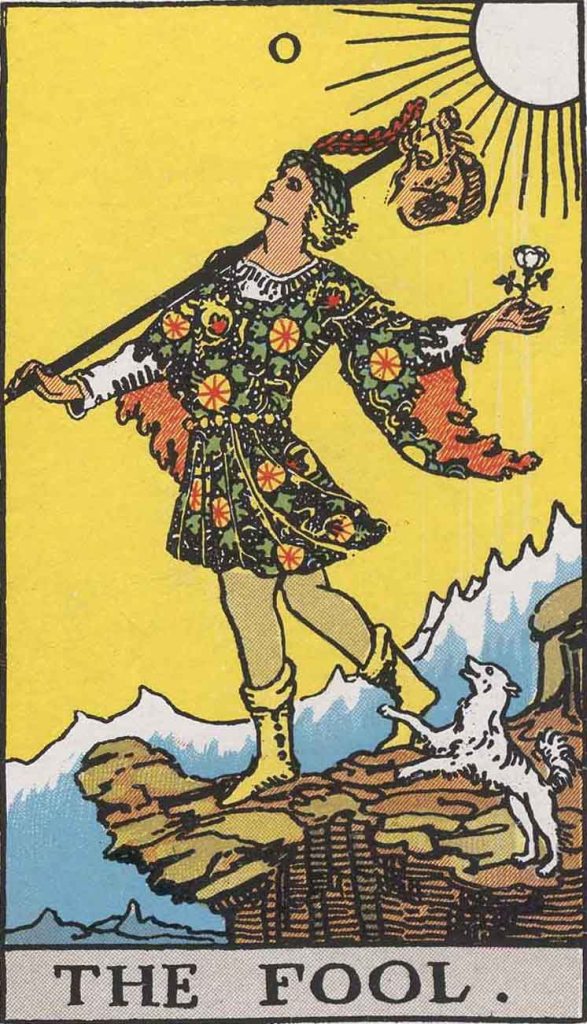
Look at this familiar image of The Fool from the classic Ride Waite Colman-Smith tarot deck.

The Fool is a youthful, carefree person. They are clothed in bright colors– green to imply youth and growth, yellow to show a sunny disposition. The floral pattern on their tunic suggests springtime. They nonchalantly hold the white rose of purity (virginity) in one hand, in a careless grip that suggests that at any moment it may slip from their fingers. They carry a bag of their meager worldly belongings. Without a care they stroll along, nose in the air, the red plume on their cap suggesting jauntiness and arrogance. A white sun blazes above, implying the alchemical stage of albedo, purification. A little white dog barks at their feet, trying to warn them. The fool does not notice the danger as they stray nearer and nearer to the brink of a cliff. 

Everyone starts from somewhere. The fool’s number is zero. They represent the beginning of the journey. This is the card of fucking around and finding out. It is a loving homage to the mistakes we all make when just starting out in life. 

The important thing about The Fool is that they fall. If I were to create a Satanic tarot deck, my image for The Fool would be Lucifer falling from heaven. To fuck around is human, to find out is divine. 

What lies at the bottom of the cliff? For The Fool, it is not destruction. It may be death, but only in a metaphorical sense, followed swiftly by rebirth. At the bottom of the cliff is a hard lesson. At the bottom of the cliff is wisdom and transformation. 

Alcoholics in AA (like me) often talk about hitting “rock bottom”– needing to fuck up our lives so badly that there seemed to be no lower to go before being able to turn ourselves around and do something new. When there is no further to fall, at last one is on solid ground, and is finally free to stand up. 

The Fool falls but it is not in their nature to stay down. The Fool hops right back up, climbs up another mountain, and just as likely as not, falls off another damn cliff. But at least it’s a different cliff this time, and therein lies growth. So many tumbles to take! So many lessons to learn! And The Fool can embrace them all. The Fool is the high priestex of the Holy Mistake. Trial and error. Live and learn. 

The sequence of the Major Arcana is sometimes described as a story, one character evolving through many roles and stages. A funny thing happens between cards Zero and card One– the Fool somehow becomes the Magician. How does this happen? It occurs off screen. We don’t see the pit into which The Fool falls, we only know they emerge reborn as the Master of all Four Elements, the wielder of Will, the holder of perfect balance. We can only conclude that it is somehow the act of falling that leads to this wisdom and power. 

Thus The Fool is the aspirant to magical initiation. The pit into which they fall is nothing less than The Abyss, the realm of unreality in which the ego is destroyed in order to be reborn. 

Within The Abyss dwells Choronzon, who is another type of holy Fool. Choronzon is sacred madness, and fertile incoherence. He represents that which is beyond speech, the pre-verbal, the hyperverbal. He raves, he wails, he speaks in tongues. He creates sound without meaning because he is before and after meaning. With his teeth and claws he tears everything to shreds indiscriminately. More primal than the id, he has much in common with an infant– a swirling vortex of needs, desires, sensations and impressions that do not yet have even an identity to contain them. Yet his destructiveness is constructive, and the Abyss is the sacred cunt from which the Magician is reborn. 

Thus The Fool is not merely about starting out, but also about starting over. First chances and second ones. 

There are many tarot decks, and many aspects of The Fool– The Fool as jester and trickster in the Marseilles tarot, The Fool as The Green Man, as a sacrificial God in the Thoth tarot. But I have a soft spot for the Rider Waite Colman-Smith interpretation, which shows The Fool on the precipice. This image, more than any other classic image of The Fool, emphasizes the aspect of making mistakes. 

In life, some lessons can only be learnt the hard way. The Fool is a testament to this, and an encouragement to embrace the process of growth with all its pain.

Guest Post: What is an Inner God? by Frater Babalon

Homily at Church of the Morningstar on 3/18/2023

So as part of my theology I firmly believe that every human being is possessed of an inner god.  This god is utterly benevolent towards the person it is a part of.  They love us, as we ought to love ourselves.  They are the part of us that knows how to keep moving, to keep loving through the hardest shit in the world.  They can banish any frightening spiritual force.  They give us our capacity for compassion, and moral reasoning.

It’s weird, but I think most of us have experienced something like our inner god at some point.  That voice within us that is kind, and that holds us together in the face of hardship.  It is the voice that gets you through.  And it can be drowned out by so many things in life, fear and other people’s unkindness, our own pain, innumerable things.  I don’t believe the world is naturally a just place.  I don’t think the ledger is balanced by some divine hand in the end.  Justice is up to us.  So I don’t think that our inner gods can always yell over the din, we have to find a way to listen.  They are a resource we can turn to if we know how.  

The inner god is a concept about which I still have a lot of theological questions.  Are inner gods one per person?  Given the same information, will all inner gods reach the same moral conclusion?  If morality is too complex to be axiomatic (as in reduced to a series of axioms) but they would come to the same conclusion, would that be to suggest there is some absolute morality?  Objectively true in itself?  But of course, I think there is usually more than one “right” answer to most things, and of course there are a lot of times where there’s not really a good answer, just a lot of least bad answers and unavoidable collateral damage.

But I mean I suppose, despite their lack of omnipotence, inner gods are the closest thing to the vast and ineffable “big god” style gods to me.  Every human being contains that sacredness, and of course, the sacred is also the potentially dangerous, isn’t it?  We all know about wrathful gods.  I think a mistreated god is likely to become a wrathful god.  As well, I don’t know whether if everyone truly listened to their inner god if there would be no conflict?  I’m not sure it would.  I do not think we live in a clockwork universe where when everything is “working properly” we function as a well oiled machine, each piece fitting perfectly into place, never bashing into one another.  We’re not a puzzle with loops and blanks perfectly aligned, destined to make a perfect whole if we all just find our right place, I think.  But if that’s true… what is this?  What is it for?  Why do we have it?  How do we do it?

This is a hard sermon to write, because for me the inner god is so deeply a felt experience, that trying to describe it, to explain a rational theology of the inner god, to explain what conclusions I draw from this felt experience, and I think it’s a good exercise, a useful thing to actually think about.  I think it must be for something in a way, but of course like any idea of human life having a purpose, anything articulable is unsatisfactory.  If we were to know that the purpose of human life is to provide the… specific atmospheric conditions necessary for the universe to function optimally as a doorstop for the cosmic crystalline unicorn that exists outside of time, that would still be unsatisfactory because then we’d wonder what the unicorn was for.  

But of course “forness” is like… a concept that exists within human life.  Purpose is something that exists on too small and specific a scale to cover a whole life I think.  It’s like asking “what color is a human life?” there’s too much color in a human life to answer the question, there are too many human lives to answer the question.  I don’t know.

Now, of course, believing every human being is divine and being as you all know, not someone who preaches pacifism or tolerance for injustice, is a complex thing.  What does it mean to believe in the divinity of humanity and to acknowledge that as long as there is oppression, there may be the necessity of things like wars?

Well, I mean to me it means acknowledging the full weight of that.  The full weight of both the need to combat all oppression and the true potential cost of combating it.  It requires a serious commitment to thinking about the strategies you employ and choices you make.

I do think that there is something to be said for trying to listen for the inner god.  I think we’re happier and generally kinder to one another when we do, but how and why that works?  That’s a mystery of my faith, the way the nature of the trinity might be to a Christian.

I don’t know, it’s the thing that keeps you moving when it’s freezing and you’ll die if you don’t keep walking.  It’s the thing you hold onto.  That’s what I’ve got.  That’s all I’m sure of.

THE SACRED FLAME: Sermon and Meditation

Performed at Church of the Morningstar on 1/29/2023

6. I am the flame that burns in every heart of man, and in the core of every star. I am Life, and the giver of Life, yet therefore is the knowledge of me the knowledge of death.

7. I am the Magician and the Exorcist. I am the axle of the wheel, and the cube in the circle. “Come unto me” is a foolish word: for it is I that go.

8. Who worshipped Heru-pa-kraath have worshipped me; ill, for I am the worshipper.

9. Remember all ye that existence is pure joy; that all the sorrows are but as shadows; they pass & are done; but there is that which remains.

10. O prophet! thou hast ill will to learn this writing.

11. I see thee hate the hand & the pen; but I am stronger.

12. Because of me in Thee which thou knewest not.

13. for why? Because thou wast the knower, and me.

-Liber Al Vel Legis, received by Aleister Crowley

I shall never know contentment. This is my strength and my delight. 

I am hungry and thirsty and lustful forever. I crave, I devour, I burn! My core is desire, a furnace that must be fed. It drives me forward, insatiable. 

My appetites give me power. My ambition is without limits. I want more than freedom and justice, which are mere necessities of life. I want power, and luxury, and brilliance, and glory, and pleasure. I want beauty to surround me. 

I want to immerse myself in the particularity of my obsessions. I want to plunge into my secret world, which is dark and lush and grim, a realm of forbidden pleasures and poisonous delights. My dreams drip with gold and pearls and glimmer with jewels. In my dreams I savor the touch of velvet, the odor of frankincense, the taste of blood. 

I must be Lord and King of myself, master of my world. My life must be lived as I envision it. I only want to spend time on the things that stir me, that move me. I need to revel in life. 

I tilt back my head, draw back the bowstring of my desire, and aim among the stars. I hold my breath and then release, my breath and the string and my will and then I am the arrow, traveling through the cold dark of space, and I can speed through the loneliness and emptiness forever and do it with joy so long as my passion stays pure and my desire does not lose momentum. 

My true will deserves my whole focus; nothing else is worthy. 

Whenever I have even halfway lived up to this ideal, I have achieved everything I wanted. There is luck, yes– there is circumstance, and privilege. But there is also magic, the ferocious power of my will, my desire, my dreams and ambitions. Right now you are sitting in the temple I dreamed of. But I must dream harder, so that someday it can have walls and doors and gilded molding and flickering candles and our chants may echo from a high high ceiling and the sounds of our worship cause the windows to rattle. 

I want extravagance. I crave perfection. Sometimes I chase it til it almost kills me. Desire like this is a two-edged sword; it cuts me and I bleed. But I want to put my blood into everything I do, spill my blood for everything I dream. 

I love my desire. I love my dreams. They make me strong. They ennoble me. Especially when I let them be wild and grandiose and unlikely and unreasonable. 

I want to be more than virtuous. I want to be more than worthy. Lucifer save from being merely decent. What is only worthy and decent and virtuous does not inspire me. I need to stretch and push and reach and grow. I love the sensation of striving. 

The word in my heart and the fire in my belly is “MORE!” 

I live for more. I will die for more. I believe in it, I worship it, I insist on it. To break through, to go beyond, to burst through walls and shatter boundaries– that is what I need. 

Inner peace and tranquility have never appealed to me. I live for the highs and the lows and the moments of agonized ecstasy where laughter and tears melt together and the sensations and emotions in my body grow so powerful, so potent, that they threaten to obliterate my psyche. 

This is not for you! If it speaks to you in any way then I am glad, but this writing, this raving, this outcry is for me. I write it self-indulgently, pretentiously, in the words that seem right to me, words of too many syllables strung together in sentences of too many words, florid, purple, excessive, because this is an ode to excess, this is an ode to my selfish, extravagant, uncompromising, insatiable appetite for MORE. 

I stray sometimes from who and what I am. I lose sight of the monster in the mirror, the Devil-God within me, and I forget to worship him. I forget to love his greed, his lust, his envy, his pride, his wrath, his gluttony. But not his sloth. He delights too much in action and effort. Moments of sloth for him, for me, are a necessity, not a joy. We must move, desire, and consume. Entropy rules us, we are an object that tends to stay in motion. Our cards are the emperor, the devil, and the chariot. We hate to stand still.

I am a restless, irritable and discontented soul, a perfectionist who is hard to satisfy. I push myself hard, mercilessly, teetering on the brink of exhaustion, thrilled by the abyss that gapes below me. I am thrilled by conquest and prowess and risk and achievement. Toxic? Unhealthy? Perhaps, but we are talking about my selfishness. I have learned to temper myself out of necessity, to practice rest and set limits, to cool my fire down to embers so I don’t burn out. But this is the truth of me, the real me, my spirit, a creature of flame that seeks to spread out and devour and leap up higher and brighter. I want vastness, I want expansion, I want to be boundless. 

These strengths are also my faults; these virtues are also my sins. 

I cannot have everything that I want, because truly, I want everything. I want to know and feel and experience and taste and accomplish and possess it all. But at the same time, I know I have been settling for less than I need. I am tired because I have failed to feed my soul. My flame is faltering because it needs more beauty, more pleasure, more friendship, more adventures. I have been stingy with myself, have almost let the light in my temple go out. 

This world is intent on strangling me, choking me, putting out the fire in me, denying me more than the bare necessities and making me work myself to the bone even for those. It is doing that to us all. As I have said, this is not for you, this is not intended to be about you, but if it is about you, even a little bit, by accident, attend well to your fire. Demand more– not just of what you need, but of what you want. Fight for a world that isn’t merely just and free and equitable– fight for a world of beauty and glory and passion and romance and drunken ecstasy. Fight for a life that is not merely liveable but worth living the hell out of! Do not forget desire– your needs for beauty and pleasure and music and laughter and art and touch. 

Find what thrills you, what inspires you, what sets your soul on fire– and pursue it, grasp it, cling to it, fight for it, devour it, worship it, adore it, and above all– live for it. 

Because it is what makes you yourself. It is what gives you your will to live, without which existence is impossible. 

MEDITATION

I invite you now to close your eyes. Breath deep, into your core. Place your hands upon your belly and feel it rise and fall. Breath deep. Breath slow. Let your breath be heavy. Your exhale may growl out of you. 

Feel the heat, the pulse of hot energy, the fire in your belly. Let it spread through you, filling your torso from the base of your spine through your reproductive organ, stomach, your solar plexus, your heart, up into your throat. The centers of hunger and emotion and consuming and desire. The mouth that eats, the throat that swallows, the entire digestive system that turns food into energy, the heart that circulates the blood through your body, and those parts that symbolize, among other things, the creation of new life. 

It is the head that thinks, and we know now that emotions come from the brain– but they are felt in the body, these parts of the body. Depression as a heaviness in the chest, or love as a warmth in it. Anxiety as twisting in the belly or tightness of the throat. Notice what you are feeling now, what kind of sensations arise in you. 

Let your whole torso be filled with warmth. Imagine that fire in your belly flaring hot and bright, leaping up towards the heart and the throat, spreading down towards the base of the spine. What color is it? How does it feel? What does it want? What does it feed on? What makes it burn bright? 

Breath deep. Sit with it. Feel it. If your fire feels weak, let your breath pull in energy from above and below, from the earth and the universe. Tend the fire with your breath, for fire needs air. Let it grow brighter and brighter. It is your desires. It is your needs. It is your drives. It is your motivation. It is your passion. It is your furnace, your engine. It is always there for you, and it can give you many gifts if you attend to it. 

Let its burning energize you. Let it purify you, clearing away and devouring anything unnecessary. Let it warm and comfort you. Experience its power. 

When you are ready– when you have gathered enough power within yourself– open your eyes. If the energy feels overwhelming– if you feel too hot, or flushed, or shaky, or wired– breath through your nose only, but with a normal rhythm. Rest your palms on your belly to ground yourself, to feel all that fire condense itself back into glowing embers that you can fan into flames whenever necessary. It is always there for you. 

My Creed

I’ve been going through the vast archive of sermons, homilies and other writings I have produced over the years, many of which I have not managed to post here. This is an older one, in which I break down the Satanic creed I wrote for some of our liturgy in Church of the Morningstar. I am not sure I would write it the same way today, but I stand by most of it, and it feels important to share for the benefit of my congregation. That said, I think my discussion of Mary could use a little sensitivity and refinement.

Good evening.

Many of you, if you’ve been to this church before and seen me perform a baptism or the Mass of Blasphemy, have heard me recite my creed. It goes like this:

“I deny the tyrant above. I deny his sycophant son. I deny the holy ghost. I deny the so-called virgin mother, and all of the angels, and all of the saints. They have no power over me. I believe in the cause of the fallen angels. I believe in the serpent of Eden. I believe in the kingdom that lies below. I believe in the God within me.”

Great, so, what does that mean? A lot more than meets the eye.

Let me go through it line by line.

“I deny the tyrant above.”

The first half of my creed is negative. A lot of spiritual people would probably find that off-putting. Negativity gets a bad rep. Unfortunately, in this universe, there is a lot of bad, and a lot that is worth rejecting. To me, one of those things is God.

When I call him a tyrant, I make it clear why I reject him. God to me represents absolute power, which corrupts absolutely. Not only does that God represent authoritarianism in all its forms, but his theology also insists that he is ultimately the only force in the universe. I believe in political and metaphysical freedom, and thus I reject Jehovah and all his works.

“I deny his sycophant son.”

Jesus has been called a liberator, but ultimately Jesus serves that tyrant.

No, that’s wrong. That’s bad trinitarian theology.

Ultimately Jesus is identical to that tyrant. They are one God, along with the Holy Ghost. Three persons, one substance, one will. It’s nonsensical to imply that Christ is any better than the Father.

So naturally, I deny the Holy Ghost as well. They are all the same.

“I deny the so-called virgin mother.”

To affirm Mary’s virginity is to deny God’s violation of her.

It’s thought she was about thirteen or fourteen at the time of conceiving Christ.

“And all of the angels, and all of the saints. They have no power over me.”

Mentioning God’s intermediaries at such length is a subtle jab at the supposed monotheism of Christian. I also simply find it important to declare independence from not only God but all his servants, heavenly or earthly.

“I believe in the cause of the fallen angels.”

I believe in what Lucifer and company were fighting for—liberty, equality, and love for one another, rather than merely love for God.

“I believe in the serpent of Eden.”

I’ve talked extensively about Eden before, and what it means to me. In brief: when Adam and Eve ate the fruit of knowledge, they became “as God, knowing good and evil.” We as human beings gained a moral conscience—the ability to know right from wrong. Having this power in our own right, we did not need God to hand us down commandments any longer.

Thus, the serpent is our liberator. 

“I believe in the Kingdom that lies below.”

This is a statement of faith in an afterlife in hell, but it’s something more. Really, I shouldn’t have called hell a kingdom in my creed. It’s been said that heaven is a kingdom, but hell is a democracy.

I envision Hell as an ideal anarchist society—a place of freedom where all are provided for communally. Just as Christians speak of bringing the kingdom of heaven to earth, so I, too, aspire to create the infernal society in this world.

Hell, to me, represents the hope for a better, freer earth.

“I believe in the God within me.”

This is the most important part of the creed. Since the fruit of knowledge granted us all the spark of divinity, it follows that each of us is endowed with a unique, individual Godhead, a higher self, a sacred soul that can never be destroyed.

The pursuit of divinity—apotheosis, as some call it—is important to me. I am striving for perfect union with my own latent Godhood.

Towards this end, I attempt to purify and perfect myself. This is an alchemical process, the search for the spiritual philosopher’s stone, which is the true self.

To no other God do I submit– but to my inner God, to what is best in myself, I strive to practice total obedience. I want to surrender completely to the divine in me. I want it to rule me and control me, and ultimately annihilate all aspects of my being that are not of It.

My God has a name, a secret name I do not utter. “Antichristos,” my magical name, is but a pale echo of that secret word. I worship my God as a word. It is the logos, the word that creates and organizes my inner universe.

And I believe that all of you have such a divinity within you. I would never tell anyone else how to worship their own God. I walk a very stern path with regard to mine. That may not be your style, and frankly it’s none of my business.

My business is to acknowledge the divinity of all other human beings as being just as great as my own. This, probably, is the most important point of all. We are all divine beings, capable of self-governing and moral choice. We need not bow to any but ourselves.

And so the end of the creed loops around to the beginning, to the rejection of unjust authority:

I deny the tyrant above…