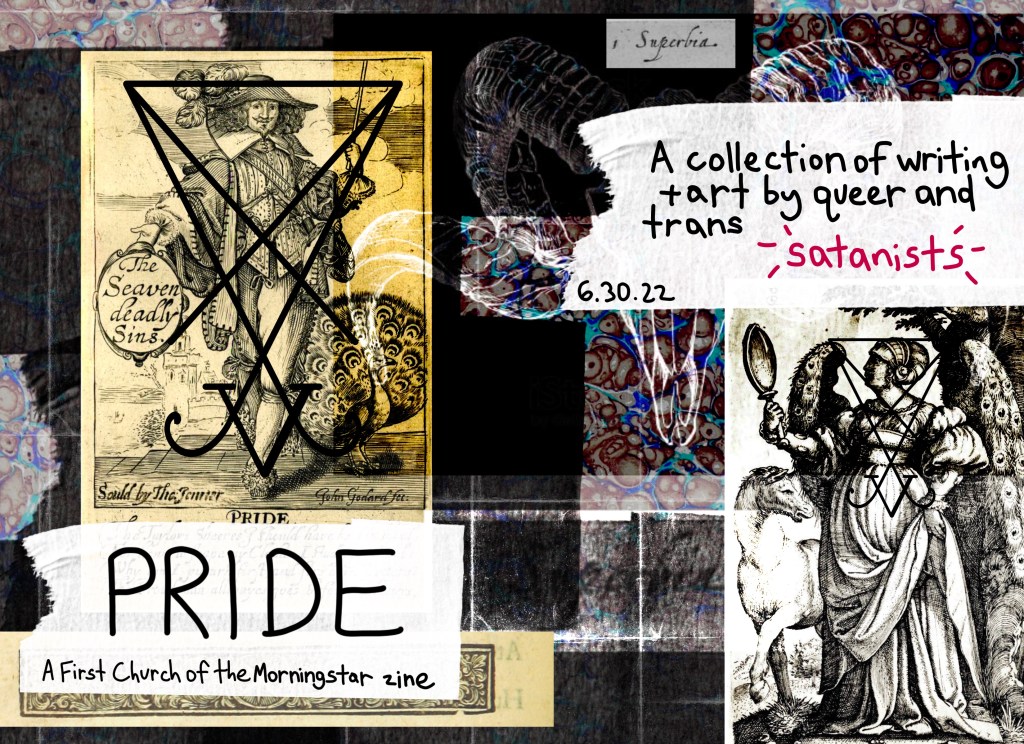
This is a mammoth paper I wrote for a special reading course over the summer. I wanted to explore what the point of “edgy” spiritual practice might actually be. Why the blood, the blasphemy, the sex magic, the filth? It’s not an easy question to answer, but I feel good about the start I made. Includes footnotes and appendices.
Introduction
No religion is more associated with transgression than Satanism, though our lurid reputation often outstrips reality. Every Satanist chooses transgression as a spiritual path, for even to identify as a member of the Devil’s party is necessarily transgressive. For some practitioners, that much is sufficient. For many others, it is only the beginning of our love affair with the forbidden.
It is easy to dismiss blasphemy, antinomianism, and rituals involving blood, sex, and bodily fluids as immature shock tactics. It is true that juvenile forms of Satanism exist, associated mainly with teenagers and the musicians who appeal to them. Since this is the most commercial form of “Satanism,” it is the image of our religion that that receives the most exposure. In this context, an act of blasphemy can seem merely a crude attempt to give offense; and sometimes transgression is indeed nothing more.
In The Satanic Rituals, Anton LaVey describes Le Messe Noir (The Black Mass) as “the original psychodrama”[1] and claims that its main purpose is “to reduce or negate stigma acquired through past [Christian] indoctrination.”[2] The mature Satanist, LaVey implies, should grow beyond the need to trample crosses and spit on consecrated hosts. Accordingly, when I first began performing the Mass of Blasphemy (Church of the Morningstar’s less racially loaded term for what others call The Black Mass), I assumed that eventually my personal need for it would cease, and I would only be performing it only for the benefit of newer members. This has not been the case. In fact, the ritual has only grown in power with repetition, its transgressive intoxication increasing even as my resentment against Christianity fades.
The Mass of Blasphemy is merely the most obvious example of Satanic antinomianism. From protective traditional “witch bottles” filled with rusty nails and human urine, to sex magick rituals, to the vividly erotic and violent imagery of Satanic visionary experiences, the forbidden pervades our spirituality. I have long sensed the power of this intense religiosity that mingles Eros with Thanatos, ecstasy with agony, the sacred with the profane. I knew there was more to it than shock tactics, but could not yet articulate what that value was.
I sought answers briefly in the study of vamachara Tantra. The charnel-grounds rituals of Aghoris and Kaulas are beautiful and powerful, and I recognized some of them as superficially similar to my own, but I also learned that their underlying motivation was opposed to mine. A tantrika does not transgress for the pleasurable frisson of boundary breaking, but to cultivate a radical monism that releases concepts of pure and impure.[3] As in more orthoprax religions, unity, purity and peace is still the ultimate goal. I respect this goal, but mine lies elsewhere, in a place more marginal.
Vamachara is not my path, and did not hold the answers I sought. So, it was a profound relief when I found theorists who shed light on the mystery of transgression. I discovered my intellectual lineage in the place I least expected: psychoanalytic theory. It felt like a homecoming.
This writing reflects my engagement with thinkers connected to the psychoanalytic tradition on the phenomenon they variously refer to as “transgression,” “eroticism,” “limit experience,” “the abject,” and “the daimonic.” While the terminology and focus of these authors varies, they are all describing the same thing: a powerful, dissolving force that simultaneously explodes and solidifies the ego, that draws it near the gateways of birth and death, and produces the ultimate encounter of self and other, letting them remain poignantly distinct even as they are, momentarily, united.
Read more: Apologetics of TransgressionPitfalls of Antinomianism
I may be putting the cart before the horse by discussing pitfalls of transgression before defining its value. However, given the stigma placed on the acts I will soon be discussing, as well as their very real dangers, it feels necessary to preempt certain objections by addressing them upfront.
‘Antinomian’ simply means ‘against the law.’ This term encompasses a broad range of activity, from the completely harmless to the extremely violent. Thus, the antinomian must be approached conscientiously. To do something uncritically, simply because it is forbidden, is foolish. Additionally, the ‘law’ being broken may be religious, moral, civic, or even a purely personal boundary. Since ‘laws’ vary greatly based on time and place, and also in terms of justice, the idea of antinomianism is morally value neutral.
Christian antinomianism is a real phenomenon, introduced by Christ’s breaking of Pharisaic laws in the Gospels. It is also a different animal than what we will be discussing here. George Bataille writes of Christian antinomianism:
The main difficulty is that Christianity finds law-breaking repugnant in general. True, the gospels encourage the breaking of laws adhered to by the letter when their spirit is absent. But then the law is broken because its validity is questioned, not in spite of its validity.[4]
In other words, Christian antinomianism breaks the laws of Man to uphold a greater law: the Law of God. This is not the type of transgression I wish to discuss.
A more dangerous form of antinomianism loosely follows this pattern of breaking a ‘lower’ law to affirm a ‘higher’ one. I am speaking of the viciously transgressive behavior of fascists. I do not mean to compare Christians in general to fascists, except where the two groups literally overlap. Fascist antinomianism resembles Christian antinomianism only in its conception of a lower versus higher law; from here it departs dramatically, and violently.
The essence of fascist transgression is the intoxicating license to kill. In his two-part study of the Freikorps, Male Fantasies, Klaus Theleweit elaborately explores the seductive libidinal power of this state-sanctioned ‘transgression’:
These men experience their affinity with power as “natural.” To them, powerlessness means the threat of permanent exclusion, both from justice and from pleasure. Their every action thus becomes an assertion of themselves; they are always in opposition. Yet their transgressions are organized within systems of absolute obedience.[5]
The fascist flours the ‘laws’ of pro-social behavior, in adherence to the higher ‘law of nature’ he bases on misreadings of Nietzsche and Darwin.[6] This fascist ‘antinomianism’ is always taking aim at the ‘weak’ qualities of mercy and love for one’s fellows. It is designed to create killing machines. Insidiously, such acts of ritualized violence provide an illusion of power to the perpetrator. For the duration of his crime, he feels that he has stepped into the role of the leader, a position of absolute power. Ironically, he only feels this because he is serving the will of another, the leader who dominates him. His subordinate proxy status is the very thing which allows his identification with the ruler, and lets him believe himself mighty.
This false antinomianism can be seen in fascist groups in general, but also more specifically in fascist occult groups such as Order of Nine Angles (O9A)[7] and the affiliated terrorist group Atomwaffen Division[8]. Here, violence is even more explicitly spiritualized than in ordinary fascist propaganda, with commission of murders (or “cullings” in O9A parlance) framed a way of gaining superhuman status.[9] Violent transgression is the crucial part of their initiatic process, either creating a superhuman state or proving innate superiority—the distinction is often unclear.
For the fascist, liberation comes only from placing himself above all others. In Salo, Pier Paolo Pasolini’s adaptation of the Marquis De Sade’s The 120 Days of Sodom, he has one of his villains proclaim “Fascists are the only true anarchists.”[10] This is a perfectly updated articulation of De Sade’s concept of the sovereign individual—a person devoid of compassion for his fellows, who is thus ‘liberated’ to take any action he pleases without consideration for others.[11] Michael Aquino and Anton LaVey were also seduced by this idea. Aquino wrote of “isolate, psychecentric existence’ as the goal of spirituality.[12] LaVey became so obsessed with escaping the bothersome needs of others that he longed to live in a “total environment”[13] tailored perfectly to his tastes and populated only by “artificial human companions.”[14]
The inevitable outcome of such heartless solipsism is profound loneliness. The sovereign individual, the isolate consciousness, and the fascist strongman dictator become utterly ‘free’ at the price of humanity. He (it is usually a he) who pursues this path acquires the worst attributes of Jehovah: supreme, without equal, alone.
My critique of this hyper-individualist stance is identical to my critique of monistic religions: both only allow one being to be truly ‘real,’ whether this being is God or the sovereign individual. Both deny the existence of an other, of the separateness which is the true foundation of relationality. “It is not good for man to be alone,”[15] says the God of Genesis. Evidently it was not good for Him to be alone, either, for He created.
As I hope to show, transgression at its best is a visceral exploration of relationality, of the boundaries of self and not-self within a chaotic, ambiguous universe. For this reason, it is better to transgress with another, rather than against them. For example: Adam and Eve transgressed together when they ate the forbidden fruit and gained knowledge of good and evil;[16] Cain transgressed against his brother when he slew him.[17] One of these acts resulted in liberation and growth, the other only in isolation and pain.
Since I object on moral and theological grounds to transgression against others, we need say little more about topics such as murder, torture, human sacrifice, child abuse, rape, bestiality, or cruelty to animals. Unlawful such things may certainly be, but that does not make them worth performing. Acts that create a perpetrator and a victim spring from a solipsistic perspective which is morally repugnant, socially impractical, and spiritually barren.
The rest of this writing will focus on transgression that has real potential to enlighten via exploration of boundaries between subject/object, sacred/profane, life/death, and other primal dichotomies worth deconstructing.
Why Transgress at All?
Paths to enlightenment exist which do not rely on transgression. Since so many traditions do not require immersion in the filth of the forbidden, why walk a path that demands it?
Here is it necessary to introduce the problematic but useful concepts of right-hand path and left-hand path religions. ‘Right-hand path’ is a broad umbrella term that groups many of the world’s dominant faiths together via their shared elements. These religions are, broadly speaking, orthodox and orthoprax, adhering to certain spiritual laws and prohibitions. They usually locate authority in a single supreme being, who is seen as the ground of reality. A desire to shed the ego and unite with the divine is common in these traditions. Judaism, Christianity, Islam, Buddhism, and most Hinduisms are generally right-handed by this definition. So are many new religious movements, most of the New Age milieu, and most Neo-Paganisms.
The left-hand path religions, of which Satanism is the best known, are comparatively more individualistic, heterodox, heteroprax, and antinomian. They usually focus not on ego disillusion, but on the creation of a strong, high-functioning ego. Commandments are not adhered to, and morality is approached as a matter of personal conscience, or as relative, or as wholly illusory. Divinity is located within the practitioner, rather than above them. More importantly, this divinity is individual rather than transpersonal: every human is a distinct god, not merely facets of the same supreme being. The left-hand path is influenced by Nietzsche, romantic and decadent poets, Aleister Crowley, witchcraft historiography, the atheist movement, and western receptions of Tantra. (Eastern vamachara tantra, from which the western left-hand path takes its name, is neither wholly right-handed nor left-handed by Western definitions, involving many taboo and heterodox elements but still aiming at ultimate unity.)
Left-handed spirituality is far less common than right-handed religion, and exists mainly in fringe religious movements. However, left-handed attitudes are quite common in the secular world. I have long sensed a commonality between left-handed religion and the unspoken atheistic cosmology underlying psychoanalytic theory. Julia Kristeva hints at this psychoanalytic ‘theology’ when she writes:
The Freudian stance, which is dualistic and dissolving, unsettles those foundations [of transcendental idealism]. In that sense, it causes the sad, analytic silence to hover above a strange, foreign discourse, which, strictly speaking, shatters verbal communication (made up of a knowledge and a truth that are nevertheless heard) by means of a device that mimics terror, enthusiasm, or orgy, and is more closely related to rhythm and song than it is to the World.[18]
In this passage she sets up an opposition between psychoanalysis and the philosophical lineage of Plato, Aristotle, Kant and Hegel,[19] intellectuals of the right-hand path. Kristeva identifies friction between a monist view of reality, and the “dualistic and dissolving” stance of Freud and his heirs. Psychoanalysis, like left-handed spirituality, plays in the shadows, delves into the libidinal, acknowledges the id in us all. And the left-hand path, like psychoanalysis, aims at individuation and optimal functioning in this world, not the next.
Another key difference between the left-hand path and the right-hand path lies in attitudes towards pleasure and suffering. Right-hand religions correctly observe that pain is the price of pleasure, and that attachment to impermanent things inevitably leads to heartbreak. This is an undeniable fact. The right-hand path solution is generally some degree of renunciation from worldly attachment. We see this quite clearly in Buddhism, wherein this problem and its solution are foundational. We also see it in Christianity (which is influenced by Stoicism and Neoplatonism, which may in turn have been influenced by Buddhism). Herein the solution is to focus one’s devotion on God, the only imperishable object of desire. This is a workable approach to the problem of pain, and many people are contented with it. I do not wish to debate its validity, only to say that there is an alternative.
In the left-hand path, we also admit that suffering and pleasure are inextricably intertwined, but we are not willing to give up either. In the first place, we love pleasure too much to renounce it; we are willing to accept suffering as its price. In the second place, we love the lessons pain teaches us as well. Beyond that, the extremes of experience are, for us, the very essence of existence. It is in excruciating or ecstatic moments that we find transcendence. Right-hand spirituality is generally found in serenity, balanced on the middle of the see-saw of life. We find our spirituality in riding high or being brought low.
The key point is that both pleasure and suffering must be accepted. One cannot demand to only experience pleasure– this is impractical. Conversely, people who insist on constantly wallowing in misery are rare, but they do exist, and are rarely pleasant to be around. Relentless suffering for its own sake is also not a path to transcendence.
Instead, we seek pleasure and fulfillment, and aspire to meet loss, disappointment and suffering head-on. The key to maintaining a spiritual attitude in this stormy, Satanic existence is to accept and embrace both the highs and the lows. Remember that Satanism is firmly grounded in Romantic literature, and maintains a fundamentally Romantic outlook. We prefer the sublime to the beautiful. In our meditations we are more likely to envision ourselves on a rain-lashed mountain peak, beneath a sky illuminated by the brilliance of lightning, than to picture a tranquil sunny beach.
While we do not pursue negative life experiences, we do ritually seek out profound depths as well as dizzy heights. The ideal Satanic spiritual experience is one in which pleasure and pain, life and death, high and low all blur vertiginously into one. Through taboo breaking and encounters with filth, we force ourselves into mixed states of shock, revulsion and exaltation. Unlike the vamachara tantrika, who seeks serene indifference via transgression, the Satanist wants and needs to maintain a strong reaction to their blasphemies.
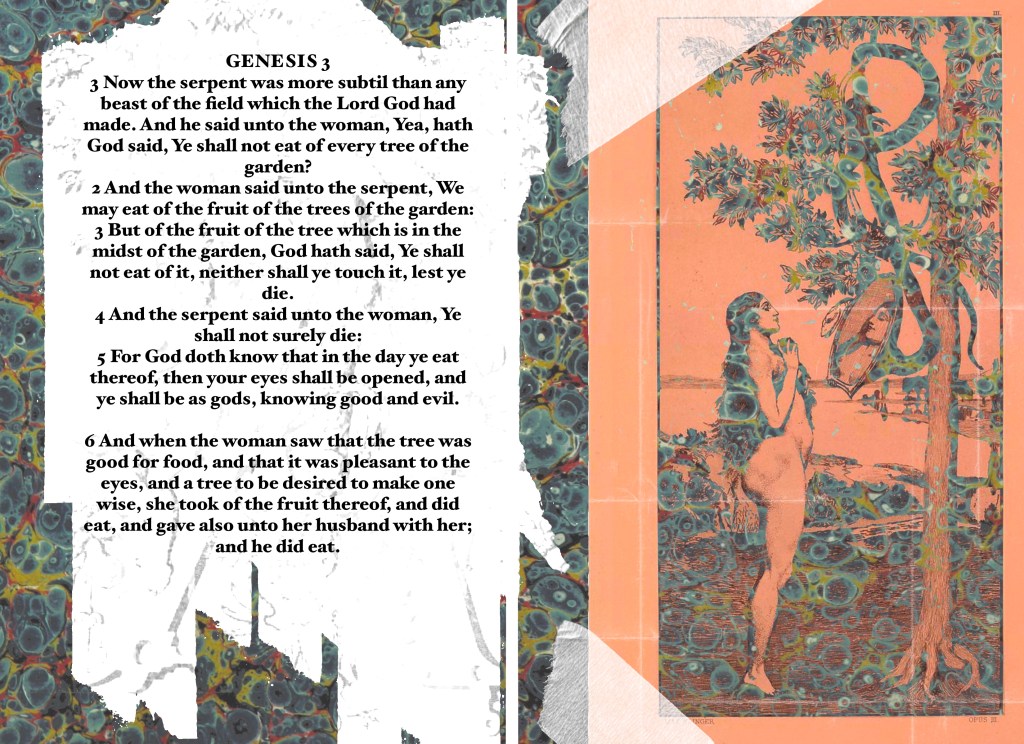
Our mythos and theology rests on the foundation of Genesis 3, which is a tale of transgression. This is the pivotal moment for us, as defining as the crucifixion is for Christians. Consumption of forbidden fruit, and acceptance of its mixed blessing and curse, is the essence of our religiosity.
Kristeva analyses the legend thus:
It is stated that man would be immortal if he ate from the tree of life—the tree of knowledge—hence if he transgressed the prohibition, in short if he sinned. Man would thus accede to divine perfection only by sinning, that is, by carrying out the forbidden act of knowledge. Now, the knowledge that would separate him from his natural, animal, and mortal state, enabling him to reach, through thought, purity and freedom, is fundamentally sexual knowledge. It takes only one further step to suppose that the invitation to perfection is also an invitation to sin, and conversely; perhaps official theology does not take that step, but the mystic grants himself the fathomless depravity of doing so.[20]
Satanism is the habit of granting oneself that “fathomless depravity,” and being nourished on a diet of forbidden fruit.
Theorists of the Forbidden
Of what, then, does this forbidden fruit consist? What are the elements that make up what my sources variously call “transgression,” “eroticism,” “limit experience,” “the abject” or “the daimonic?”
Rather than individually summarizing the work of the various authors who inform this writing, and proceeding to compare and contrast their conclusions, I want to focus on the common threads that weave them together. Thus, I will give only the briefest introductions to my sources.
Georges Bataille’s Erotism focuses on transgression as the foundation of erotic desire and religious experience. He sees transgression as fundamentally reifying the laws it breaks, rather than demolishing them[21]—a point with which I disagree.
Julia Kristeva’s Powers of Horror discusses the abject, a concept encompassing everything that must be rejected, expelled and viewed with disgust in order to construct a socially acceptable identity.[22]
Sandra Dennis’s Embrace of the Daimon is a Jungian study of the psychospiritual benefits of disturbing, intrusive images. She calls these violent and sexual fantasies “daimonic,” and hypothesizes an “imaginal realm” connecting soul and body, of which the daimonic image is a messenger.[23]
Kristeva and Dennis both include the dark feminine in their analysis, connecting the abject/daimonic with all that upright, rational masculinity rejects.[24] [25]
These three texts are my primary sources for this work, and they were carefully chosen for their relevance. Leo Bersani, Klaus Theleweit and a few others also lent some necessary perspective to my thesis. Alexis Sanderson is my main source on vamachara tantra.
Whether one refers to “transgression,” “the abject” or “the daimonic,” the themes and images remain the same: blasphemy, desecration, violence, religious sacrifice, ritual orgy, taboo sexuality, bodily excretions, and the loathed and feared female body. All these images, concepts, actions and substances ultimately point towards the portals of birth and death, and on a deeper level, to the radical break-down of boundaries between self and other. All my main sources recognize, each in their own way, that an intense encounter with the forbidden can lead to spiritual experience.
The Nature of Transgression
“The transgression does not deny the taboo but transcends it and completes it,”[26] declares Georges Bataille. To Bataille, transgression and the law are two sides of the same coin: they need and reinforce each other. In his view, all taboos are socially constructed, and without the law, the forbidden would hold no thrill.
Kristeva delves deeper, and (perhaps unintentionally) refutes Bataille when she defines the abject as “what disturbs identity, system, order. What does not respect borders, positions, rules.”[27] This dissolving and corrosive force is not purely socially constructed, although it certainly has its social, legal and religious aspects. The abject is formed by primal instincts rooted in the will to live, and the need to form a selfhood:
Not me. Not that. But not nothing, either. A “something” that I do not recognize as a thing. A weight of meaninglessness, about which there is nothing insignificant, and which crushes me. On the edge of nonexistence and hallucination, of a reality that, if I acknowledge it, annihilates me.[28]
Kristeva’s style of writing could itself be described as abject, for it frustrates, unsettles, repels, and challenges meaning. It is appropriate to the subject matter, for the abject is a much trickier concept than transgression, even as the terms overlap. Never once does Kristeva write a pithy, one-sentence definition of the abject. Instead, she talks around it, defining it through evocative examples and poetic outbursts of emotion. We learn that the abject relates intimately to the body. The abject is loathed foods, waste, excrement,[29] corpses, wounds, blood, pus— “what I permanently thrust aside in order to live.”[30]
This line is crucial. Kristeva reveals that the abject exists in relation to every level of identity. This means laws are written on many levels, including the most primal. Biologically, certain substances must be excluded in order to preserve existence. Waste must be excreted, garbage and corpses disposed of, rotten food snubbed, and blood properly contained in the body. Certain insides must stay on the inside, and certain outsides on the outside, or else we become ill or die. But these necessary processes are mirrored on increasingly abstract levels—we must reject our mothers to differentiate ourselves from the body in which we once resided,[31] we must reject the unlawful to consider ourselves lawful,[32] and we must shun the ritually impure to obtain religious belonging.[33]
Seen in this light, the law as written no longer matters much. Transgression is not defined as the mere violation of social taboo, but as contact with the abject—a positive, rather than negative, definition. In transgressing, one may violate many kinds of boundaries: biological, psychological, social, religious, legal. The limitations against which we press may be purely our own; the prohibition shattered may be based on widely held convention, or on a personal phobia.
Thinking about transgression this way rings truer to my experience. There is something primal about it, far deeper rooted than the relatively sophisticated desire to defy a law. It is as simple and intuitive as a child’s compulsion to pass their finger swiftly through a candle flame. Contrary to Bataille’s assertion that transgression requires well-defined limits,[34] I have often found that the most poignant boundary to cross is the one I didn’t even know was there. On a few wondrous occasions I have strayed into behaviors so bizarre, so alien, that I have never once encountered rules against them. I have done things which, while perfectly victimless, would be considered repulsive by society at large, but which have not even occurred to enough people for them to be prohibited. As it turns out, the space outside the law is far vaster than the one inscribed within it, for the law lacks imagination.
Forbidden Fruit: Eroticism and Transgression
So how, exactly, does the forbidden stir our ecstasy? In what ways is interaction with the frightening, the taboo, the violent, and the loathed, actually transformative? Sexuality is one of the keys.
In Bataille’s introduction to Erotism, he reflects on the intimate connection between death and reproduction. He begins with ruminations on asexual reproduction, in which an organism reproduces by literally splitting itself. One thing becomes two—the individual must be destroyed in order to create. Bataille then asserts that even sexual reproduction carries this connotation of death—on the cellular level, when egg meets sperm, both are destroyed in the process, two things becoming one.[35] Furthermore, he argues, the creation of a new generation implies the mortality of the previous one.[36]
Bataille, the ‘base materialist,’ insists that as living organisms, we are “discontinuous beings,”[37] but identifies death as a paradoxical symbol of continuity:
I cannot refer to this gulf which separates us without feeling that this is not the whole truth of the matter. It is a deep gulf, and I do not see how it can be done away with. None the less, we can experience its dizziness together. It can hypnotise us. This gulf is death in one sense, and death is vertiginous, death is hypnotising. It is my intention to suggest that for us, discontinuous beings that we are, death means continuity of being.[38]
Eroticism, for Bataille, is a way of brushing up against death, of flirting with continuity. For him, this is the only way transcendence can be experienced. Thus, he argues all that religious experience is erotic in nature.[39]
Bataille is limited in that he only considers heterosexual sex. The transgressive variations that he can imagine are prostitution,[40] incest,[41] and sadistic rape[42] and murder.[43] For reasons discussed previously, most of these are not fruitful avenues to pursue, given that they violate the social contract and individual morals, but leave unjust relations of power completely intact.
Bataille also fails to empathize with the receptive partner in penetrative intercourse. Despite his idea of sex as a self-annihilating act, he focuses exclusively on the penetrative male partner, who he views as annihilating but not annihilated: “The woman in the hands of her assailant is despoiled of her being. With her modesty she loses the firm barrier that once separated her from others and made her inpenetrable.”[44] He compares the penetrating male to a priest performing animal sacrifice,[45] the phallus to the killing blade, and the woman’s ‘despoilment’ to the death of a non-human creature. This implies that the male partner accesses discontinuity, ego death and transcendence only vicariously, through witnessing the effects of his violence. The interiority of the ‘sacrificed’ woman is never explored, despite the fact that within his framework, only she can experience discontinuity directly. Bataille’s misogyny is apparent in many other passages, which, aside from being repellent and disturbing, hamstrings his analysis. Through his failure to consider more than half the human species as subjects, his understanding remains painfully incomplete.
Leo Bersani, in Is the Rectum a Grave? takes up where Bataille left off, using his linkage of sex with death to analyze gay male eroticism in the era of AIDS. He focuses primarily on men taking an anal-receptive role, which he writes “has the terrifying appeal of a loss of the ego, of a self-debasement.”[46] Bersani pushes back against attempts to sanitize and redeem sex, particularly gay sex, agreeing with Bataille that there is in fact something fundamentally violent and self-shattering about eroticism (though not something which must serve systems of oppression).[47] He rejects the thought that “the human body could somehow be conceived of apart from all relations of power…belatedly contaminated by power from elsewhere.”[48] To Bersani, sex has never been pure, and this is something to be celebrated. The value of sex for him lies in its capacity to push human beings into the “jouissance of exploded limits,”[49] to dissolve boundaries of self and annihilate the ego. To him, passive sex is demeaning, not merely to its recipient but to the idea that a pure sexuality could exist—and that’s what’s good about it.[50]
The concept of eroticism as ego destruction has been raised several times already. This is a good moment to pause and consider what is meant by the “ego.” There is some definitional slippage between the Freudian sense of ego—the conscious self-concept that interfaces with the world—and the spiritual/moralistic definition of ego as a selfish and conceited subjectivity that hampers transcendence. To the Freudian the ego is necessary; to most religions and spiritualities (though not the left-hand path), it is undesirable. Both Bataille and Bersani lean closer to the second definition, in that both assume annihilating the ego leads to transcendence.
Kristeva does not discuss eroticism at any great length. In her litanies of abjection, sexuality is placed beside loathed foods, excrement, menstruum, etc. “These body fluids, this defilement, this shit are what life withstands, hardly and with difficulty.”[51] It is in her descriptions of the abjection response that an implicit but intense eroticism lives. Abjection for Kristeva is a visceral reaction, sometimes a physical one, of expulsion—gagging, vomiting, spitting out—dare one say, ejaculating? “I give birth to myself amid the violence of sobs, of vomit.”[52] Still, this disgust is transcendent: “The time of abjection is double: a time of oblivion and thunder, of veiled infinity and the moment when revelation bursts forth.”[53] She even compares abjection explicitly to the sublime, which also “expands us, overstrains us.”[54] The abject, which provokes such a powerful reaction, is seductive, a potential source of jouissance.[55] Thus, “One thus understands why so many victims of the abject are its fascinated victims—if not its submissive and willing ones.”[56]
Eroticism to Kristeva is not fundamentally abject, but abjection, due to the aforementioned fascination it exerts, may be fundamentally erotic. Kristeva implies that in the lure of the abject, the source of fetishism and paraphilias may perhaps be found: “Such are the pangs and delights of masochism.”[57]
So, it is only the forbidden erotic that is abject, though Bataille would argue that nothing is erotic if not forbidden.[58] While I would not go so far as Bataille, I feel confident saying that for many people, a touch of transgression and abjection adds frisson to eroticism. In both visceral horror, and in the throes of orgasm, we temporarily expel ourselves from ourselves, travel just a bit out of body, and touch something profound which reveals our fragility.
Kristeva and Bataille both pay attention to religious rituals. Rites of defilement[59], sacrifices,[60] and religious orgies[61] are read by both authors as a pressure-valve which allows for suspension of social mores and controlled release of repressed drives. This suspension of the law ultimately reinforces it, as Barbara Creed summarizes: “Ritual becomes a means by which societies both renew their initial contact with the abject element and exclude that element.”[62] Death, filth, and sexuality are unleashed for a time, perhaps in order to acknowledge their sacrality, before these chaotic forces are restricted once more.
The rituals of defilement that Bataille and Kristeva discuss are still right-hand path, restricted to specific times and places. Even left-handed transgression is often contained within ritual, and protected by a magic circle. However, the Satanist may more comfortable with spontaneous transgression, allowing it to bleed into mundane life. There is still compartmentalization, but to a lesser degree; and when it comes to transgression, a difference of degree can significant, generating variation that is qualitative as well as quantitative. Instead of venting our libidinal drives in order to put them from our minds, we carry awareness of them within us, and actively look for constructive opportunities to let them out. We also are open to the permanent abolition of laws we judge unjust or unnecessary, and thus may skip returning to the status quo.
Sandra Dennis’s discussion of the erotic is both most compartmentalized and, paradoxically, the most unrestricted, for she focuses exclusively on imaginal sexuality. Her book is concerned with inner experiences which many would describe as fantasy. To Dennis, “the imaginal” is not unreal, but a separate plane of existence, which is transpersonal.[63] As a practicing occultist, I recognized what she is talking about immediately, and felt great kinship with the experiences she describes. Only our terminology is different—Dennis refers to the imaginal and I to the astral; she speaks of “daimons” to avoid stigma, while I frankly refer to the astral beings I encounter as demons. Because the imaginal/astral is bound by neither laws of physics or social consequences, imaginal eroticism is without limits. It is a repository of our most abject and transgressive desires.
Dennis is a devotee and a defender of the daimonic. As a Jungian, she sees the violently erotic content of the imaginal as part of spiritual alchemy, symbolizing the nigredo stage of dissolution which is necessary for transformation.[64] During imaginal visions of dismemberment, rape, murder, torture, immolation, and bestiality, the shadow is encountered[65] and the old self is systematically dismantled to make way for new growth.[66] By some mechanism neither Dennis or myself is able to satisfactorily explain, these imaginal encounters lead to embodied behavior change more effectively than mere insight can.[67] Experiencing the sensuality of daimonic images is key in Dennis’ mind—while responding to disquieting images with physical arousal can be disturbing, it seems to somatize their spiritual lessons more fully.[68]
This rings experientially true for myself, and for several other left-hand path practitioners of my acquaintance. In astral trance, I have been decapitated (symbolizing ego death), pierced with swords through every chakra (awakening the energy centers), and forcibly impregnated with my own future self (which vision was followed by a dramatic, permanent shift in my identity and demeanor, noticeable by all who know me).
Of course, my friends and I are not alone in our violently erotic visionary experiences, as Saint Theresa’s famous utterance should make clear:
In his hands I saw a long golden spear and at the end of the iron tip I seemed to see a point of fire. With this he seemed to pierce my heart several times so that it penetrated to my entrails. When he drew it out I thought he was drawing them out with it and he left me completely afire with a great love for God.[69]
This piercing spear is more than a phallic symbol. To make the spear merely a metaphor for the penis is actually to sanitize the image and miss its point: the spear is less important as a phallus than as a killing weapon. Saint Theresa is not just experiencing a ‘little death,’ she is in the throes of blissful ego annihilation. To read her vision correctly, we must allow sex and death to remain intermingled, for these are the portals of initiation into and out of existence. The spear is not just a spear; but it’s definitely a death-dealing spear at the same time that it is a life-giving phallus.
The forbidden erotic crosses boundaries. It blurs self and other, as all eroticism ideally should, but it goes further. The other with whom we blend may be forbidden, as in the case of homosexuality, or of interracial or interclass love. These unions threaten the hierarchies set up by society. Furthermore, the act itself may mingle pleasure with pain, or expose us uncomfortably to bodily excretions generally kept taboo; in either case, our frail mortal nature is emphasized, heightening the presence of Thanatos.
The extremes of such boundary crossing are possible only in the imaginal, wherein Saint Theresa can be pierced with the spear and live. We can be crucified as Christ, trampled as Shiva, dismembered as Dionysus, or cavort with bestial demons as witches were reputed to at the sabbath.[70]
What is ultimately the point of all this feverish imaginal eroticism? As Bataille puts it:
It is the desire to live while ceasing to live, or to die without ceasing to live, the desire of an extreme state that Saint Theresa has perhaps been the only one to depict strongly enough in words. “I die because I cannot die”. But the death of not dying is precisely not death; it is the ultimate stage of life; if I die because I cannot die it is on condition that I live on.[71]
Or, per Kristeva: “Abjection is a resurrection that has gone through death (of the ego). It is an alchemy that transforms death drive into a start of life, of new significance.”[72]
To the Pure, All Things are Pure: Pollution, Filth and Excretions
The use of polluting substances in religious transgression overlaps with the erotic, but is distinct from it. This section will be devoted to the significance of excretions and wastes: spittle, vomit, blood, menstruum, urine, feces, and the most threatening waste product of all, which is human remains. These substances are traditionally associated with witchcraft and Satanism.[73] Many of them can also be found in Tantric ritual use.[74] Via symbolic representations (bread for the body, wine for the blood), some even infiltrate the Catholic Mass.
All of these filthy substances point towards death. Bataille writes that “The horror we feel at the thought of a corpse is akin to the feeling we have at human excreta,”[75] but more precisely, the horror we feel at excreta is akin to seeing a corpse. In a literal sense, contact with such materials can spread disease, and lead to actual demise. On a deeper level, they are reminders of our gross corporeality, and the permeability of our bodies which must excrete such upsetting substances in order to live. “Such wastes drop so that I might live, until, from loss to loss, nothing remains in me and my entire body falls beyond the limit—cadere, cadaver.”[76]
To interact with contaminating substances is not merely to break outward taboos, but to risk one’s own health, and push through reactions of nausea and disgust along the way. To directly confront the smell, the touch, or (God forbid!) the taste of blood, urine or feces is to violate one’s sense preservation. Per Bataille, when one puts aside survival instinct to transgress, “this is dying to oneself, or at least it is living with death as an equal.”[77]
‘Living with death as an equal’ is perfect description of vamachara tantric sects. Kaula tantrikas partook of liquor spiked with phlegm, menstruum, semen, feces, and urine, known as the “five jewels.” The addition of these ‘filthy’ substances to the offering was considered purifying. Traditionally, the container from which this brew was consumed was a human skull. Activities following the libation included ritual sex, which was either incestuous or else with women from untouchable castes. Interestingly, this choice of partners was actually intended to decrease the lascivious appeal of the encounter and allow the practitioners to focus on ritual, not lust.[78]
Aside from their ritual uses, important cosmological meanings have also been assigned to wastes, excrements and remainders. Kristeva brings up the Hindu concept of uchista (remainder) which is both “defiling and regenerating” and in the Atharva Veda is the foundation of all matter: “Being and non-being, both are in the remainder, death, vigor.”[79] This makes perfect sense, for although feces, rotting food and decaying flesh signify death, they also make good fertilizer.
The idea of uchista is similar to Church of the Morningstar’s reception of the Kabbalistic concept of klipot. Klipot is Hebrew for ‘shards,’ ‘shells’ or ‘dregs,’ and refers to the excrements of creation, cosmic waste rejected by God.[80] The klipot are also associated with material reality (Malkuth) and with the demonic,[81] and are often referred to as the other side (Sitra Achra) or the Left Emanation. To the right-handed Kabbalist, the klipot are to be avoided. Left-handed kabbalists have assembled them into a system mirroring that of the sephiroth, referring to the result as the Tree of Knowledge rather than the Tree of Life. This inverse tree is then used as a path of initiation.[82] On the journey through these cosmic ‘excrements’ one encounters demons such as Na’amah, angel of prostitution; Beelzebub, lord of insects and swarms, Belphegor, ‘lord of the gap’ (which is taken to mean the anus), Lucifuge, who flees the light, and Eisheth Zenunim, ‘woman of whoredom’ and Satanic goddess of death. Contact with these beings brings respect for the abject elements they represent. The swarming insects which repel us also pollinate. The stinking feces makes the fields fertile. The maggots teeming in a corpse transform death into new life. To walk the path of the klipot means seeing the beauty in all that has been cast aside.
The Feminine and the Left-Hand Path
Both Kristeva and Dennis see the feminine as intertwined with the abject and the transgressive. “That other sex, the feminine, becomes synonymous with a radical evil that is to be suppressed,”[83] Kristeva writes bluntly. Dennis, who sees the daimonic as fundamentally feminine or at least androgynous, elaborates:
After millennia of deification of the sky gods—the mind, light, the ‘masculine,’ and Apollonian reason and order—we are now asked to embrace this descending spirituality, to reclaim the exiles of the ‘Dark Feminine’—the earth, instincts and body, as well as the Dionysian, erotic turmoil of the inner world they bring. We are being called to reclaim these cast-off parts of ourselves that also include sacred sensuality, sexuality, as well as the mysteries of birth, death, and resurrection.[84]
Why this connection between the feminine and the taboo? Numerous reasons can be hypothesized, the simplest being that in a patriarchal society, women must be demonized to preserve male dominance.[85] The abjection of the mother that Kristeva theorizes may also play a role. In the more specific case of antinomian spirituality, the inclusion of women in religion has often been presumed to imply the presence of ritual sex. One can plainly see this in the 19th century hysteria over the idea of co-ed Masonry, which was presumed to be Satanic in nature and rife with blasphemous orgies.[86]
In terms of Satanic mythology, it is through Eve that knowledge of good and evil is transmitted, making her a Pandora in Christianity, but a messianic figure to us. The Satanic associations of woman as witch, as icon of carnal lust, as vector of original sin, are widely known through popular culture. Those who engage left-hand spirituality more deeply learn of infernal goddesses such as Crowley’s Babalon, and Lucifer’s four queens Eisheth Zenunim, Lilith, Na’amah, and Agrat Bat Mahlat. Church of the Morningstar makes a point of emphasizing veneration for these feminine figures, whom other Satanic sects frequently neglect (with the possible exception of Lilith). These feminine figures are abjected from right-hand religion, and since the left-hand path is made up of what the right discards, it is inevitable that the feminine become fundamental to us.
As in the west, so in the east. The Kaula tantric sects, which practiced the greatest intimacy with the abject and are considered the farthest to the left of vamachara, are also those who most center the Goddess. To these tantrikas, Kali, mother of death, is the supreme being and ultimate truth. But the Kaulas are merely the most extreme example of the relationship between left-hand tantra and the feminine. In fact, across the many vamachara sects, a strong positive correlation between antinomian praxis and goddess worship can be seen.[87]
Interestingly, the Kaulas were also the least invested in observing distinctions of caste, and some lineages even included female gurus[88]. A return to Kristeva illuminates why that might be. She observes that contact with the abject “threatens one’s own and clean self, which is the underpinning of any organization constituted by exclusions and hierarchies.”[89] This dovetails with Leo Bersani’s musings on anal eroticism’s potential for “radical disintegration and humiliation of the self” as a possible route towards the breaking of male dominant mindsets.[90] Is it possible that ritualistic ego death, accomplished through transgression, actually can upset the individualism on which all hierarchies rest? If this is the case, it might explain why antinomian sects often lean towards gender equity. (This is not to imply that vamachara tantra was always non-hierarchical and anti-patriarchal; the reality is much more complex.[91])
There is another reason for the centrality of the feminine to transgression. Transgression is about boundary-breaking and the frisson of opposing forces. If the spaces between pure/impure, light/dark, pleasure/pain, life/death, self/other and sacred/profane are to be collapsed, the space between masculine and feminine must be part of that project.
Transgression is action which challenges our revered dualities; the abject is the result, the tangible presence of that challenge embodied in an object or person. For example, if a person assigned ‘male’ transgresses by putting on a dress, their ‘androgynous’ appearance makes them abject to society. The prevalence of media which depicts cisgender males vomiting upon discovering the objects of their desires are a trans women,[92] and the murders with which such men punish trans women in real life, expose the depth of the abjection response society has to transfeminine people and their forbidden crossing of gender boundaries.
The inclusion of femininity is thus antinomian for two reasons: firstly, because it re-includes the shunned and demonized sex of woman, and secondly, because it introduces the possibility of synthesizing masculine and feminine to create androgyny. Women have long been treated as contaminated and contaminating substances of themselves—menstruation taboos are the most obvious example of their ritual uncleanness.[93] But aside from emitting various forbidden fluids, women are rhetorically framed as capable of emasculating men, sometimes by their very presence. Sexual temptation threatens upright, manly continence;[94] female liberation somehow ‘feminizes’ all of society according to right-wing discourse.[95] Female agency is even more threatening and contaminating than the female body.
Dennis writes:
When we enter the realm of the Dark Mother or Dark Feminine we may experience visions, sacred sexuality, animal powers, as well as touches of madness, destruction, death, and rebirth. She rules the metamorphosis of nature, the relentless cycle of birth/death/rebirth. The hero’s quest that has relegated these experiences to the shadow lands of the psyche is still the culture’s guiding myth. But, if as some believe, an androgynous figure drenched in erotic intensity, born of the union of masculine and feminine, light and darkness, good and evil, is arising to replace him,7 it is no wonder we are disturbed. Perhaps with the eruption of daimonic experiences we are facing more than a revolution in our individual psyche. In truth, we are facing a major revolution in our culture.[96]
Dennis correctly identifies the dark mother not as a mere matriarchal force, seeking to replace masculine power with feminine supremacy, but as something far more sinister (pun intended): a vector of androgyny, a dissolver of all boundaries and abolisher of all dualities. Women will not merely replace men—they will incorporate and assimilate them. In describing this “androgynous figure drenched in erotic intensity” who results from the synthesis of genders, Dennis has (perhaps accidentally) spoken as a prophet of Baphomet.
To the Satanist, the icon of Baphomet holds the key of all mysteries. With the head of a goat, the wings of an angel, the breasts of a woman, and the phallus of a male, Baphomet brings together the human and the animal, the divine and the demonic, the female and male, and by implication, all other opposites. Their right arm points up, upon which is written solve, for dissolution. Their left arm points down, and on this is written coagula, for congealing reunion. Church of the Morningstar interprets Baphomet as the union of Samael, the Devil, with his bride Eisheth Zenunim. They become one body via their sexual coupling. This infernal androgyne also represents their original form, for like Adam and Eve, and like the single-celled organisms Bataille muses upon, Samael and Eisheth Zenunim were created by being split from each other. Their split is both painful, as all separation must be, but also fortunate, as it transforms them into separate subjects who can love one another. Baphomet is thus the ultimate icon of both sacred sexuality and the nature of reality, embodying the dynamic flow of self into other, and the continual dissolution and re-congealing of egos through the processes of birth, sex and death. Their goat head represents both the abjected goat for Azazel,[97] and the goat form of Satan presiding over the orgiastic witches’ sabbath.
Conclusion
The writing of this paper has been both painful and fruitful. The work that went into this was not merely academic, but also experiential. In the process of this study, I have not merely read Bataille, Kristeva and Dennis, but have lived out many of their theories. I have pushed my own boundaries in both ritual and non-ritual settings. I have continued to explore the realm of the imaginal, and the phantasmal but transformative encounters one can have within it. Most recently, in the company of two fellow travelers, I committed a nocturnal Satanic baptism on a secluded (but by no means private) beach, complete with burnt Bibles, defiled crosses, florid blasphemies, and solemn vows. That experience caused me to ruminate on aspects of the transgressive I have yet to fully analyze, especially the religious value of secrecy and of conspiratorial bonds. Alas, such musings fall outside the scope of this paper, which probably wants to be a book when it grows up.
The transgressive, the abject, is a shimmering, numinous and many-faceted thing. The more I struggle to grasp its secrets, the more I hold it in awe, for it always has more to reveal to me. The sacrality of the profane is perhaps beyond human power to articulate, especially not in thirty pages. Still, this being what it is, I must have a thesis, and I must draw a conclusion. What follows is my best attempt.
I believe the key to the mystery of transgression lies in relationality, in the sacred two—that moment when Lucifer and Eisheth Zenunim are split like a holy amoeba, and both self and other come into being. In the right-hand path, all things dissolve into one, uniting in sacred solipsism wherein there can only be Platonic stasis and peace. In the left-hand path, the ego is preserved for the joy of encountering another: “For I am divided for love’s sake, for the chance of union.”[98]
Transgression is the experience of delightful friction between what I am and what I am not. It frees me from myself through shock, awe, fear, disgust, pain or unbearable pleasure. It makes me experience the perimeter of my being through its violation. It is a taste of immortality via a brush with death; something that intoxicates me with wonder and relief that I have survived. The retching, the shivers, the discomfort that sends me out of body, the orgasm that melts me into my partner, are the right hand of Baphomet, the solve. In the moments after, I feel their left hand, the coagula, as I drift back into my own perspective, solidified and somehow strengthened.
Dennis discusses the distinction between fusion and immersion when encountering the daimon. Resistance to merging with the images is natural, and even necessary when the ego is still too weak to bear it, but it blocks the transformative power of the encounter. On the other hand, mere fusing with the image, losing the self in the other, is not a path to transformation either. In this case, one is swallowed up by the other, instead of achieving a self-other synthesis through union. In order for this creative union to take place, both identities must remain present, otherwise there is no dynamic alchemy of two substances, only one inert chemical without a catalyzing agent. Immersion is the process of uniting without loss of identity, whereby one can be transformed without being destroyed:
Such an inner union occurs between “equals,” as between two lovers in sexual embrace. A tone of surrender surrounds the encounter, and subtle alchemical changes appear to result for both partners. In imaginal realms, the daimon appears to change, too, through its union with the body.
This concept of immersion versus fusion perfectly sums up my left-handed aspirations
for approaching the universe. I do not wish to lose myself in the totality of everything, instead I want to float upon the sea of experience as a sturdy ego-consciousness capable of encountering infinite, diverse and wonderous others. The abject, the forbidden, first lures me out of my selfhood and then violently thrusts me back into it, transformed. If I am the thesis, the abject is my antithesis, and my spiritual aim is synthesis with and through it.
The crown of the Tree of Klipot is Thaumiel, the Twins of God. It is two, whereas the crown of the Sephiroth, Keter, is unity, oneness. Rather than dissolve in divine light, I choose to exist in a universe of radically non-dual duality, a place of dynamics and contrasts, of light and shade. I want to accept the multiplicity, the complexity, and the ambiguity of existence, its ugliness as well as its beauty. At no time do I feel closer to that mystery, that truth, than when I transgress, shattering like a wave against some shocking experience, only to congeal back into a particle again, so I can examine the revelation from my singular, flawed and humbled perspective, and marvel at the grandeur, vastness and chaos of being.
BIBLIOGRAPHY
Aquino, Michael. The Crystal Tablet of Set. San Francisco: Temple of Set, 1996.
Babich, Babette. “Nietzsche and Darwin.” In Working Papers Vol. 4. New York: Fordham University, 2013.
Bataille, Georges. Erotism: Death & Sensuality, trans. Mary Dalwood. San Francisco: City Lights Books, 1986.
Bersani, Leo. “Is the Rectum a Grave?” AIDS: Cultural Analysis/Cultural Activism no. 43, Winter 1987.
Biernacki, Loriliai. Renowned Goddess of Desire: Women, Sex, and Speech in Tantra. New York, NY: Oxford University Press, 2008.
Creed, Barbara. The Monstrous-Feminine: Film, Feminism, Psychoanalysis. London, England: Routledge, 2015.
Dennis, Sandra Lee. Embrace of the Daimon: Healing through the Subtle Energy Body/ Jungian Psychology & the Dark Feminine. York Beach: West County Press, 2013.
Karlsson, Thomas. 2009. Qabalah, Qliphoth and Goetic Magic. Jacksonville, OR: Ajna Press.
LaVey, Anton. The Satanic Rituals. Harper Collins, 1976.
Masters, R. E. L. Eros and Evil: The Sexual Psychopathology of Witchcraft. New York: The Julian Press, 1962.
Sanderson, Alexis. “Meaning in Tantric Ritual.” In Essays Sur Le Rituel III, edited by Anne Marie Blondeau and Kristofer Schipper. Louvain-Paris: Peeters, 1995.
Sanderson, Alexis. “Saivism and the Tantric Traditions.” In The World’s Religions, edited by Stewart Sutherland, Leslie Houlden, Peter Clarke and Friedhelm Hardy. London: Routledge, 1988.
Sanderson, Alexis. “The Shaiva Exegesis of Kashmir.” In: Mélanges tantriques à la mémoire d’Hélène Brunner / Tantric Studies in Memory of Hélène Brunner, edited by Dominic Goodall and André Padoux, Pondicherry: Institut français d’Indologie/École française d’Extrême-Orient. Collection Indologie 106, 2007.
Theweleit, Klaus. Male Fantasies: Volume 2: Male Bodies: Psychoanalyzing the White Terror. Minneapolis, MN: University of Minnesota Press, 1989.
Van Luijk, Ruben. Children of Lucifer: The Origins of Modern Religious Satanism. New York, NY: Oxford University Press, 2016.
Kristeva, Julia. Powers of Horror: An Essay on Abjection. Translated by Leon S. Roudiez. New York, NY: Columbia University Press, 1982.
APPENDIX I: EXCERPTS FROM CONVERSATIONS WITH OTHER PRACTITIONERS
Conversation between Johnny Truant and Frater Gnostigrangel on Facebook Messenger, 7/13/2022.
JT:
So, I am writing this whole theological/academic paper on antinomianism, and I was thinking about the value of small, harmless acts of law-breaking that are just… weird. Like facing backwards in an elevator or something. And this made me think of you, because I feel there’s a lot of that energy in you, and was wondering if you could talk about that sort of thing.
FG:
Oh, I know what you mean! And I regard myself as an antinomian. Would be happy to give input!
JT:
Yeah… as much as I love the edgier stuff, I’m just thinking about the small things that are almost laughably harmless and yet drive people crazy anyway. It’s not a perfect example, but the moment in the show Strange Angel where Earnest yells “THERE IS NO LAW BEYOND DO WHAT THOU WILT!” and jumps over the neighbor’s fence and into their swimming pool comes to mind.
FG:
Yes, it’s silly but significant. I like to:
- Make myself visually conspicuous
- Make a sport of risky outdoor pissing
- Send unsolicited mail
- Eat stuff I find, to connect with land spirits but also to understand and feel that I’m not so separate from my environment
- Give gifts
- Celebrate Dysnomia’s birthday whenever it seems appropriate. Usually at least 4 times a month.
- Take long walks during which I regularly trespass, find trinkets, leave images, leave “calling cards”
- Talk to strangers as if they might understand me
I think violating people’s expectations is incidental – but integral at the same time? If you’re not willing to violate people’s expectations in this culture, you can’t have the relationship with the land and with, like, the weirding – the mysterious causation – that I want to have.
I don’t feel powerful when I have to be angry about rules. I feel powerful when I sweep them aside and other people – and nature herself – seem to endorse that gesture instinctively
We built this stupid rabbit warren for ourselves.
The ugly architecture, the economy, the genders – it’s all stuff that’s now taken to be inherent or natural, that could actually be quite freely swapped out.
I’ve started to feel that extravagant body mods are an expression of the same spirit. Like, the people who have woken up to the immanence of their own will are queuing up to get tails sewn on – for “no reason.” i.e. the reason that is power itself…
The unreasoning reason that is the utterance, “I am!”
And the rejection of a form of “reason” that is mainly an affectation – a tool to justify norms that were imposed by force in the first place – that resistance is everywhere now.
So-called chaos – which in the social sense means making a culture that serves you right now instead of deferring to someone else’s claims about what dead people may have valued – seems to be thriving all over the place now. As we approach the so-called “decadence” of a civilization. A “decadence” I call flowering.
People paint their names in huge letters on the building where they sleep, or along their route to work.
You make a brand or insignia for yourself and display it. You sing yourself forth here and there.
It’s a “crime” to write yourself on certain surfaces unless someone pays you to do it. So many things are “crimes,” we approach anarchy by that route. i.e., if all the laws were enforced all the time there would be no one left out of jail.
Why is it perceived as a tragedy that power appears in its naked form before us, finally, without the fig leaf of “morality”?
The new Aeon says, “Why not?”
It says, “Honi soit qui mal y pense.”
But I digress. More examples perhaps later.
Frater Gnostigrangel is the high priestex of Temple Sophia Eleutheria Eleutheria or the Holy SEE, a rogue Thelemic temple in Oakland, CA.
Excerpt from a conversation between Johnny Truant and “Oleander,” 5/1/2022
JT:
I feel like there is something Klipotic about certain theory, especially anything that bears the mark of Freud. Freud being a Jew who rejected religion so roundly, yet maintains a distinctly Jewish brand of intellectualism… because of that, he and his lineage feel like part of the Left Emanation to me. (Obviously, I mean that as a good thing.)
OL:
Oh, that’s super interesting. Are you thinking of anything in particular? I mean I guess the whole depth theory of the unconscious…
JT:
The sex/death link for one thing…the way he opens up to the idea of really just… sort of bestial and taboo drives existing in people. I just. I dunno. I sense an underlying THEOLOGY in a lot of post-psychoanalytic theory. And it’s an atheistic theology and cosmology, but it is theology and cosmology nonetheless. And it contains this openness to the dark, messy and empty parts of existence. Those interactions of eros, Thanatos, the taboo. The acknowledgement of discontinuity between individuals.
OL:
Oh yeah. I mean, the “disenchantment of the world” was only ever a displacement. What’s kind of cool is that for Freud, and then way more for Lacan, a lot of that is “inaccessible” or is actually a lack.
JT:
Wait, expand please.
OL:
Well for Freud, we don’t ever have unmediated access to the unconscious (which is created via repression). Right, there are symptoms, like tics and dreams, etc., but you have to do a lot of translation, i.e., “work,” to even begin to get at what is causing that symptom. This is what the surrealists don’t understand. They think you can instrumentalize the unconscious as a resource for creativity. Anyway, this is even more extreme, in Lacan’s Real.
JT:
Right, which I am still having such a hard time grasping.
OL:
I mean, that is literally our experience of the Real—hard to grasp! But the other thing, which is slightly different, but important, is that one of Lacan’s innovations is to suggest that desire is always a product of a lack.
JT:
I think Bataille agrees about desire and lack, though not in that language. It also feels like he wants the Real.
OL:
Yeah. And this is what makes him a spiritual thinker for me. Because he isn’t satisfied that you can’t have the Real.
JT:
I think grasping at the Real is the point of all this engagement with the abject. I mean, this is literally Tantra, also: trying to break through to actual reality through transgression.
At the end of the day these questions come down to “why am I doing this?” Why am I so HUNGRY for transgression and taboo breaking?
OL:
I mean the interesting thing for me with Kristeva is the degree to which transgression serves to shore up the normative, like most of the time. To provoke the Law.
JT:
Yeah, that’s hard to escape. And is kind of a recognized Tantric trap, I think.
OL:
She does end up seeing transgression work in people like Lautremont, Celine, etc., “revolution in poetic language.” Which I am politically really suspicious of, as I see it as a cop out and displacement of actual revolutionary politics. In that historical context.
JT:
Well, there’s sort of a paradox in transgression. Are you doing it to dissolve the sense that it is a transgression at all? In which case, the pleasures of transgression effectively disappear. The Tantric goal, being the disillusion of all boundaries and seeing all things as equally pure.
OL:
Right.
JT:
Or do you transgress to get your brain to light up in that special way? And if so, are you doomed to diminishing returns on that experience, to having to escalate behavior?
OL:
Would it necessarily be the case that it has to escalate?
JT:
Well, not in my experience, to be fair! But is that because while I may be comfortable with the transgression, society still isn’t?
OL:
I’m going to take off my academic hat, and put on my batshit crazy hat for a second.
JT:
Go! We need to wear both hats on this topic
OL:
So, I’ve been thinking a lot about first three steps [of a 12-step program], and trying to understand to what degree, if any, I sort of started them a little two Novembers ago, when I had congress with the Devil. Because whether that was “real” or imagined, the transgressive feeling of it was enough to give me something that functionally works as “belief.” Or not belief, exactly, but like…some kind of religious feeling that could only happen from doing something that felt genuinely… scary, in a way. Anyway, I haven’t really felt the need to escalate that in anyway. The knowledge of that boundary being crossed still feels pretty…present? I’m still trying to make sense of that, I guess. What motivated me, how I interpreted it, etc.
JT:
Yeah. Makes sense. There’s also significant transgression in being an academic and rational thinker and then going and experiencing that. Food for thought.
OL:
Oh, totally.
JT:
Sometimes escalation feels good, when I get the chance. It feels like the right escalation presents itself to me when I’m in ritual space, and it hasn’t taken me beyond the boundaries of my actual ethics yet. Though it has taken me way outside of my comfort zone in terms of like… what my ego wants to think I am. The Daath working unlocked all this… animalistic masculinity that’s so embarrassing for me. The Ghogiel working took that even further. Digging into the abject side of masculinity has kinda been my project for a while, I guess.
OL:
Yeah, I can imagine that like…leapfrogging over one’s own sense of absurdity could actually end up feeling really powerful.
JT:
The Daath working was this combination of being in power-tripping Priest mode, and also having absolutely no dignity. Way more embarrassing than having any expressed sense of shame.
OL:
Well, shame is kind of a super-ego defense mechanism. “I know better.”
JT:
Super ego went bye-bye. I don’t know about ego, but super ego was not in the house that night, except as a helpless, horrified spectator. So, for ritual purposes, is it better to kill the ego and super ego and surrender to the id completely, or to keep them as a captive audience, and torture them?
“Oleander” is a fellow Satanist and academic (art historian), a member of Church of the Morningstar, a good friend and a frequent sounding board. Other than these details, he wishes to remain anonymous.
APPENDIX II: JOURNAL EXCERPTS
5/17/2022
…Tangentially this brings us to the question of whether antinomianism actually reifies the laws it breaks. Bataille suggests that the pleasure of antinomianism requires acknowledgment of and attachment to the law itself.
One thing or the other: either the taboo holds good, in which case the experience does not occur, or if it does, only furtively, outside the field of awareness; or it does not hold good; and of the two cases this is the more undesirable.
– Bataille, 36
I emphatically disagree. I will illustrate my reasons with personal experiences of taboo breaking in two cases: homosexuality and sadomasochism.
In the case of homosexuality, a social, religious and sometimes legal taboo exists for purposes of oppression and control. This taboo, imposed from the outside, is internalized in the young homosexual as feelings of guilt, shame, and self-loathing. When the inevitable first homosexual experience occurs, it may be heavily weighted with all the frisson of these feelings. After the encounter, it is true that the internalization of the taboo may be lessened, although it rarely disappears. (If it did disappear completely, I would not know so many gay men who enjoy being called ‘faggot’ in bed, nor would I enjoy that myself.) The intense antinomian transgression of violating a taboo that holds true within oneself will lessen with time and acclimation, but other antinomian pleasures take its place– the pleasure of identification as an outlaw, a rebel, a deviant; of setting oneself against authority. In the case of homosexuality, obviously, there are also rewards that do not rely on antinomianism– same sex love and eroticism, like any love or eroticism between human beings, is fulfilling and compelling whether or not it is against the law.
The example of sadomasochism illustrates the multiple levels of taboo that can exist within human society and within human beings ourselves. S&M is antinomian in that it is seen as perversion. In recent years, kinky activities have become more socially accepted, but they have also grown more, not less, popular. This is because S&M also persistently challenges internal taboos. No matter how masochistic or submissive one is, there always remains some level of instinctive fear before pain, and continuous obedience is challenging to any human being even when it is freely chosen. From the dominant side, no matter how ardently the masochist desires to be hurt, there is always a fight with internal doubt, guilt and tension as one raises the whip, the sense of giving in to a monstrous desire which must in other contexts be carefully controlled.
Activities involving domination, restraint and pain are extraordinarily erotic because they are so good at creating pleasurable internal conflicts which resolve into startlingly positive outcomes. The masochist who receives the feared pain and feels it magically transformed into pleasure often ends the experience feeling nearly invincible, almost as if he has a super power. The sadist who beats his beloved to the point of blood and tears only to hear a heartfelt “thank you, sir” has had his feared and loathed impulses accepted, desired, and passionately appreciated. This is nothing less than an experience of grace, of absolution. Because domination and violence are genuinely such dangerous things, playing with them in a consensual context never loses its thrill. Both the dominant and the submissive, the sadist and the masochist, repeatedly survive desires which could actually be existentially threatening, and miraculously, the outcome of all this is pleasure, love and intimacy.
6/3/2022
The act of violence that deprives the creature of its limited particularity and bestows on it the limitless, infinite nature of sacred things is with its profound logic an intentional one. It is intentional like the act of the man who lays bare, desires and wants to penetrate his victim. The lover strips the beloved of her identity no less than the blood-stained priest his human or animal victim. The woman in the hands of her assailant is despoiled of her being. With her modesty she loses the firm barrier that once separated her from others and made her inpenetrable. She is brusquely laid open to the violence of the sexual urges set loose in the organs of reproduction; she is laid open to the impersonal violence that overwhelms her from without.
-Bataille, 90
Zero understanding here of the personhood and perspective of the object of the sacrifice. Seemingly no acknowledgement of the penetrating partner’s potential to lose themself in the act and vacate their identity as well. No analysis of the state of acting as the bottom or “sacrifice” and what this “victim” role might provide to a person spiritually.
6/9/2022
But Mishima’s peerless power is so totalizing that it apparently neutralizes contradictions by fiat, so that, for example, the most decadent vice of all—the aestheticization and eroticization of deadly violence—can be proposed as a manly virtue, and a philosophy that prizes experience above all else can enfold a vision of sex as the static communion of a calcified body and a desiring gaze.
–https://www.bookforum.com/print/2502/1968-s-dangerous-and-grandiose-fantasies-19688
This is the problem of antinomian delving into the abject, it can and will be appropriated by this type of aggressive fascist masculinity.
6/13/2022
I expel myself, I spit myself out, I abject myself within the same motion through which “I” claim to establish myself.
-Kristeva, 3
I think this reaction to the abject, this sort of… EJECTION of the self from the self, this nigh-astral projection response to what is forbidden and repulsive, is the mechanism of spiritual experiences rooted in taboo!
6/18/2022
Dennis feels that her more “right hand path” spiritual grounding ill-prepared her for this type of experience, writing: “I then learned how my training in spiritual practices tempted me to bypass this intermediate, subtle body layer of the psyche, which in fact I needed to traverse in order to access energies and teachings I could not receive by simple mindful observation.”
So many forms of meditation discourage thought, imagination and imagery, and discourage engagement with images and fantasy that might arise… rarely are we told what would happen if we engaged the images. Astral meditation, as I and many members of my church practice it, is a deliberate entry into this imaginal realm and engagement with the bizarre images and fantasies that arise.
[1] Anton LaVey, The Satanic Rituals (Harper Collins, 1976), 31.
[2] LaVey, 34.
[3] Alexis Sanderson, “Meaning in Tantric Ritual,” in Essays Sur Le Rituel III, edited by Anne-Marie Blondeau and Krisofer Schipper (Louvain-Paris: Peeters, 1995), 85.
[4] Georges Bataille, Erotism: Death & Sensuality, trans. Mary Dalwood (San Francisco: City Lights Books, 1986), 89.
[5] Klaus Theleweit, Male Fantasies: Volume 2: Male Bodies: Psychoanalyzing the White Terror (Minneapolis, MN: University of Minnesota Press, 1989), 368.
[6] Babette Babich, “Nietzsche and Darwin,” in Working Papers vol. 4 (New York: Fordham University, 2013), 8.
[7] “Order of Nine Angles – the People VS the ‘Elite’: State of Hate 2019,” HOPE Not Hate, February 16, 2019. https://hopenothate.org.uk/2019/02/16/state-of-hate-2019-order-of-nine-angles/
[8] “Atomwaffen Division,” Southern Poverty Law Center, accessed August 1, 2022. https://www.splcenter.org/fighting-hate/extremist-files/group/atomwaffen-division.
[9] Temple ov Blood, Liber 333, (Australia: Temple of THEM, 2008), 4. Accessed August 1, 2022.
https://archive.org/details/liber-333
[10] Pasolini, Pier Paolo. 1975. Salo. Italy: United Artists.
[11] Bataille, 167.
[12] Michael Aquino, The Crystal Tablet of Set (San Francisco: Temple of Set, 1996), pg. 22.
[13] Ruben Van Luijk, Children of Lucifer: The Origins of Modern Religious Satanism (New York, NY: Oxford University Press, 2016), 375.
[14] Van Luijk, 379.
[15] Genesis 2:18
[16] Genesis 3:6
[17] Genesis 4:8-15
[18] Julia Kristeva, Powers of Horror: An Essay on Abjection, translated by Leon S. Roudiez (New York, NY: Columbia University Press, 1982), pg. 30.
[19] Kristeva, pgs. 27-30.
[20] Kristeva, 126.
[21] Bataille, 63.
[22] Kristeva, 1-2.
[23] Sandra Lee Dennis, Embrace of the Daimon: Healing through the Subtle Energy Body/ Jungian Psychology & the Dark Feminine (York Beach: West County Press, 2013), 1-2.
[24] Kristeva, 13.
[25] Dennis, 81.
[26] Bataille, 63.
[27] Kristeva, 30.
[28] Kristeva, 2.
[29] Kristeva, 2.
[30] Kristeva, 3.
[31] Kristeva, 13.
[32] Kristeva, 4.
[33] Kristeva, 17.
[34] Bataille, 71.
[35] Bataille, 13-14.
[36] Bataille, 59.
[37] Bataille, 12.
[38] Bataille, 12-13
[39] Bataille, 22-23
[40] Bataille, 131.
[41] Bataille, 51-52.
[42] Bataille, 167.
[43] Bataille, 18.
[44] Bataille, 90.
[45] Bataille, 90.
[46] Leo Bersani, “Is the Rectum a Grave?” AIDS: Cultural Analysis/Cultural Activism (Issue no. 43, Winter 1987), 220.
[47] Bersani, 216-217.
[48] Bersani, 221.
[49] Bersani, 217.
[50] Bersani, 222.
[51] Kristeva, 3.
[52] Kristeva, 3.
[53] Kristeva, 9.
[54] Kristeva, 12.
[55] Kristeva, 8.
[56] Kristeva, 9.
[57] Kristeva, 5.
[58] Bataille, 79-80.
[59] Kristeva, 74.
[60] Bataille, 81-82.
[61] Bataille, 113-114.
[62] Barbara Creed, The Monstrous-Feminine: Film, Feminism, Psychoanalysis (London, England: Routledge, 2015), 8.
[63] Dennis, 39.
[64] Dennis, 55.
[65] Dennis, loc. 351 of 6523.
[66] Dennis, loc. 364 of 6523.
[67] Dennis, 14-15.
[68] Dennis, 124-125.
[69] Bataille, 224.
[70] R. E. L. Masters, Eros and Evil: The Sexual Psychopathology of Witchcraft (New York: The Julian Press, 1962), 83.
[71] Bataille, 239-240.
[72] Kristeva, 15.
[73] Masters, 93.
[74] Alexis Sanderson, “Saivism and the Tantric Traditions,” In The World’s Religions, edited by Stewart Sutherland, Leslie Houlden, Peter Clarke and Friedhelm Hardy (London: Routledge, 1988), 670-671.
[75] Bataille, 57.
[76] Kristeva, 3
[77] Bataille, 233
[78] Meaning in Tantric Ritual, 82-83.
[79] Kristeva, 77.
[80] Thomas Karlsson, Qabalah, Qliphoth and Goetic Magic (Jacksonville, OR: Ajna Press, 2009), 66-67.
[81] “Zohar 1:19b:9,” Sefaria.org. Accessed August 2, 2022. https://www.sefaria.org/Zohar.1.19b.9?ven=Sefaria_Community_Translation&lang=bi.
[82] Karlsson, 106-107.
[83] Kristeva, 70.
[84] Dennis, loc. 344-347 of 6523.
[85] Theleweit, 378.
[86] Van Luijk, 208.
[87] Saivism and the Tantric Traditions, 669.
[88] Alexis Sanderson, “The Shaiva Exegesis of Kashmir,” In Tantric Studies in Memory of Hélène Brunner, ed. Dominic Goodall and André Padoux (Pondicherry: Institut français d’Indologie/École française d’Extrême-Orient, Collection Indologie 106, 2007), 240.
[89] Kristeva, 64-65.
[90] Bersani, 217.
[91] Loriliai Biernacki, Renowned Goddess of Desire: Women, Sex, and Speech in Tantra (New York, NY: Oxford University Press, 2008), 5-6.
[92] Michael Siebert, “Please, Stop Throwing Up on Trans People,” Montana Kaiman, 2015. http://www.montanakaimin.com/opinion/please-stop-throwing-up-on-trans-people/article_2d07dc26-6293-11e5-ad20-ffc0c766b047.html.
[94] Theleweit, 6-7.
[95] Nellie Bowles, “Jordan Peterson, Custodian of the Patriarchy,” The New York Times, May 18, 2018, accessed August 2, 2002. https://www.nytimes.com/2018/05/18/style/jordan-peterson-12-rules-for-life.html.
[96] Dennis, 8-9.
[97] Leviticus 16:8
[98] Liber AL vel Legis, 1:29