Review- “Lucifer: Princeps” by Peter Grey

I have not been overly impressed by excerpts of Peter Grey’s work in the past, so I approached “Lucifer: Princeps” reluctantly and with trepidation. I was pleasantly surprised.

Grey’s florid writing style* takes some getting used to, and may induce an occasional eye-roll. However, this book is an insightful and well-researched look at the origins of the Lucifer legend. It’s similar content-wise to some other surveys of the Devil in scripture, apocrypha and early theology. What sets it apart from works like those of Jeffrey Burton Russell is an occultist slant, and a positive perspective towards Lucifer. The information is familiar, but the analysis is pro-Luciferian, and that is refreshing. 

Grey had some interesting insights I had not encountered elsewhere, and as an occultist took care to include a few tidbits that secular scholars probably don’t find relevant. For example, Grey’s recounting of a legend wherein fallen angels transform themselves into precious gems furnishes magical associations folks like us can work with, but it’s not the type of content academics concerned with religious history find interesting. 

Grey’s take on Isaiah 14:12 is the best I have read so far, and on its own made the book worth the read. Analyses of this passage that argue that Helel ben Sahar is “just” a human king ignore the tradition of divine/deified kingship in the ancient world. Grey doesn’t make that mistake, and his arguments open up a fresh origin story for Lucifer, not as a fallen angel but as an ascended mortal. 

Grey’s faults include his purple prose and some underlying antisemitic tendencies (of the “I think this is OK because I hate all organized religion” type). You’ll definitely encounter a bit of Christian-bashing in here, too. None of it was super egregious, just typical edgelord occultist-bro nonsense. Those tendencies are part of what turned me off from his other works, but they are muted here by an attempt at serious occult scholarship which mostly succeeds. 

I recommend it as I read it: reluctantly and with trepidation, but at the same time compulsively. There is very little content about Lucifer out there which even comes near this level of research. “Lucifer: Princeps” may shine mostly due to lack of competition, but in the almost starless night of current Satanic scholarship, it still shines. 

*This review is written under the influence of Grey’s prose style. I just finished the goddamn book and seem to currently be incapable of writing like a human being who is not a pretentious prick. If you find my phrasing annoying in this post then you have a good idea of what you are in for with “Lucifer: Princeps.” 

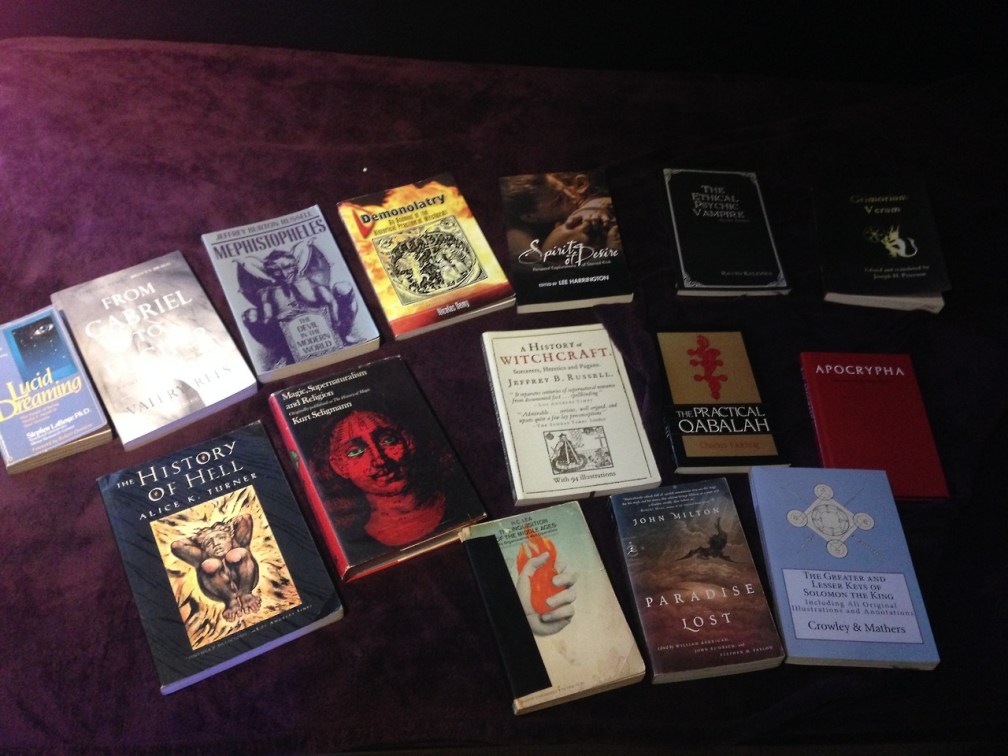
Mini book review: “A History of Witchcraft: Sorcerers, Heretics and Pagans” by Jeffrey Burton Russell

Jeffrey Burton Russell has sure written a lot about witchcraft and also about the history of the Devil– so I suppose he can be forgiven for citing his own other books in the bibliography.

This slim, elaborately illustrated volume is clearly meant to be one of his more “consumable” books, aimed at the lay person. I suspect it is meant almost as a condensation of his longer, more academic works. 

A lot of the scholarship seems pretty solid, but he makes some assertions that I would love to see citations for (for example, that British “cunning folk” regularly collaborated with witchfinders and bear some responsibility for the executions of witches!). 

The section on “modern witchcraft” is fairly dated, and deals mostly with Wicca in the ‘70s. 

Overall, however, this is a good read. I appreciated Russell’s genuinely agnostic take– it is rare to find a scholar who is not into witchcraft himself who is so sympathetic to the practice of witchcraft. I also deeply appreciated his survey of striking similarities between witch lore the world over, and his admission that the reasons for these similarities remain largely unknown. 

Quick Book Reviews

I have been doing a LOT of reading. Unfortunately I am not too pleased with most of it.

  • The Book of the Law by Aleister Crowley- OK, well, been there, read that, guess I had to at some point. That sure was a book, and also a thing that exists, and you can read it with your eyeballs if you feel like it. 
  • Witchcraft and the Gay Counterculture by Arthur Evans- I really wanted to like it, but it made me shriek with uncontrollable rage. If you like soft polytheism and historical inaccuracies, you’ll love this. 
  • I, Lucifer by some dude straight up named Corvis Nocturnum Don’t buy this, please don’t. There are pretty pictures but it’s the most poorly written thing I have encountered this side of “The Eye of Argon.” I don’t think there was an editor. It is possible there wasn’t even a second draft. There may not have even been spellcheck.

Some better reads:

  • The Devil’s Bride by Martin Ebon- a neat little book about exorcism from a psychological stand point– particularly about demonic possession and exorcism as a cathartic ritual which leads to emotional healing. Reads as fairly skeptical but is surprisingly open-minded about ESP and psychokinesis. But not demons. OK! We all have our biases, I guess. Anyway, it’s a fun read, but by no means essential.
  • A Dictionary of Angels Including the Fallen Angels by Gustav Davidson- What it says on the tin. Shouldn’t be your only source but if you happen to find yourself wondering who the fuck Cabiel is this probably beats Wikipedia for a first stop. Nicely cited and will lead you straight to better sources.