I Can’t Self-Govern For You

A public statement of Pastor Johnny to Church of the Morningstar on 1/4/2025.

Back when I was first thinking of starting a Satanic church, I had a chatty Uber driver one night. I confessed to him that I was an aspiring pastor, although not what kind. 

“Put the pews in a circle,” he told me. “Pass the mic.” 

With these words, he expressed his desire for a different kind of religion– one that was less top-down, more diffuse and democratic. He’d articulated something I also wanted. Put the pews in a circle. Pass the mic. 

In the early days of Church of the Morningstar, that’s what we did. Back in San Francisco, we all saw each other face to face and knew each other’s names. It was easier to make sure that everyone was familiar with the non-hierarchical norms of the church. Everyone seemed to feel comfortable speaking up, giving their opinions, leading rituals, preaching sermons. Mass was an event that we all made happen together. 

But with the lockdown, we had to go online, and things changed. There were suddenly a lot more members, who knew each other less. Thoroughly onboarding every single new person was too time consuming for our small volunteer clergy, so we hoped people would get a feel for the church’s intentions and culture through our website and published writings. We thought we had laid those things out pretty clearly and publicly. 

And maybe we had. But what a church says, and what a church does, can be very different. People didn’t necessarily take those statements seriously. It seems that for a variety of reasons– some of which have to do with the religious trauma we all carry, and some of which have to do with my “strong,” i.e. sometimes overbearing personality– people haven’t always trusted in our invitations to participate, contribute, take leadership, and make this church in your image.

Now, I enjoy leading. I always have. In the beginning, I thought it was quite possible that power would corrupt me. I assumed I would have to keep an eye on myself, because I might like being in control too much.

Things worked out very differently. Having ended up with a type of authority that I did not ask for and did not want, I find that I actually hate it. There is no money and very little glory in being pastor of this church, just hard work, intense responsibility, and the endless sacrifice of my weekends. I’ve burned myself out emotionally supporting congregants. I’ve exhausted myself constantly creating new programming for our masses, with minimal input from anyone else but Vix. When I’ve tried to start discussions in the church, I have been met with silence, because people are afraid to disagree with me or say anything against what they perceive to be our “official dogma”– in spite of the fact that we try to be clear that we do not have one! 

People defer to me in a way that I never wanted them to. People feel unqualified to take leadership roles, and unwelcome to contribute their ideas, their art, their rituals, and their opinions, to making this church richer, more interesting, and more diverse. I have tried to solicit all of those things multiple times, in multiple ways:

  • with calls for submissions to the church anthology book which is now in the works
  • with invitations to have your art featured on the Church of the Morningstar website on the “art collective” page
  • with pauses in every mass to ask if anyone has anything they want to say, share or present
  • with requests for participation and interactivity in mass via invitations to read aloud, speak parts of incantations, or take part in discussions
  • with solicitations before masses for rituals, poems, writings, songs, etc that people may wish to submit for inclusion 
  • with invitations to collaborate on the church by-laws and constitution
  • with elections that I literally beg people to run in and vote in 

Yet it seems that much of this is not taken as being in good faith, and I think this is partially because of how aspects of my personality come across. 

I know I have a strong personality, as has been mentioned before. I know that at my worst, “strong” is a euphemism for “aggressive and overbearing.” But I am not loud and forceful because I want to crush people down and make them meek and quiet. I am loud and forceful because I want loud, forceful friends. I was raised by a huge, Southern, lapsed Catholic father who argued with me like I was an adult man back when I was still a tiny alleged girl of about four years old. I learned to meet his fire with fire fearlessly because no matter how loud we yelled at at each other, at the end I always knew my dad would smile at me and say “we butt heads like this because we are so alike. I love you.” Now, that’s not how most relationships work. I’ve learned that the hard way. And yet, in spite of decades of evidence to the contrary, at my core I still expect my strength to be met with strength. 

I will be real with you. I am getting burned out. I envisioned starting this church and having it grow into a self-governing community that needs no leaders. I had hoped to make myself obsolete as a pastor. In the last couple of years, I have become very stressed, sad, tired and lonely in my life because too many of the people I know seem to be looking up to me and placing me above them, leading me to feel as if I have no peers– this in spite of the fact that I fundamentally believe that all of you are my peers. 

I want comrades and co-collaborators and co-conspirators, not followers. I do not believe any of you are followers by nature. You’re Satanists. You’re walkers of the left hand path. You are here, or so I believe, because you dislike authority and seek empowerment; because you are curious and desire knowledge; because you don’t want to be told what to think or what to do. 

I desperately want to change the culture in this church. I don’t want to be at the top of it anymore. But I can’t do that alone. I need your help. Obviously I can’t do your self-governing for you. You have to do that. That’s the point. 

I have to confess that if the culture of this church doesn’t change, if it doesn’t end up living up to the values and vision with which I co-founded it, I will most likely burn out in another year, and step down as pastor. In that case, very likely nobody else will feel empowered to step up, and the online branch of CotMS will end. 

I am not trying to threaten you. But if you want this church, you have to make this church, and make it the church you want. I am not being paid anything for this, and I don’t want to keep making a church for people who appear to passively consume it with what seems to me to be diminishing enthusiasm. 

It is still my calling to be a priest of Satan, no matter what happens, but if we can’t make this church a church for us all, rather than just the Vix and Johnny Show, I will need to pursue that dream in a different form. 

You have the power. This can be what you want it to be. Vix and I are just making it up as we go along, after all. Yeah I went to seminary, but most of what it got me was just student debt. I went half for the skills and half for the credentials, so that non-Satanists would be forced to take us a bit more seriously. And Vix? I know he intimidates you with his intellect, but his highest attainment of formal education was fucking beauty school. He just reads a lot. We don’t really have anything you don’t have. 

So today’s message is: you can just do things. That’s what we do. We just do things, and then for some reason everyone thinks we know what we’re doing. You can too. You can just decide to hold a ritual or event. You can start a reading group. You can hop in the voice chat and start a lively debate. You can write a poem, a prayer, an article, a hymn, and submit it to be put on the church blog or in the church book. You can lead a segment of mass. You’re allowed. You have permission. 

But at some point, when you have the time and bandwidth to think hard about hard things, I do hope you will ask yourselves this question: why did I need so much permission? 

The Sredni Vashtar Working

If you have not read the short story “Sredni Vashtar” by Saki, you should go do so before continuing. It is not long at all and can be found for free here. The rest of this writing will contain spoilers for it, and also will not make much sense without understanding the story. 

Done? Good. This little gem of a tale, aside from being profoundly affecting, also perfectly illustrates some of the basics of chaos magick. Conradin worships an ordinary polecat-ferret as a God, until he actually becomes one. This is how you make an egregore. 

It should be obvious to anyone who has grasped this, that if belief and worship can deify a ferret, then they can easily also deify a fictional character. In fact, a fictional ferret is in some ways easier to exalt to godhood than a real one, since it is not bound by flesh. 

Much of the work of deification has already been accomplished by the story. The god has been described. His sacred name, Sredni Vashtar, is known to us. His hymn of praise is revealed. His offerings are elaborated– red flowers, red berries, and powdered nutmeg (which has to have been stolen). 

We also know his role. Sredni Vashtar, red of tooth and claw, is an avenger and a destroyer. But he is also a protector of the innocent, and a liberator of the oppressed. 

He is supplicated with the simple words:

“Sredni Vashtar, do one thing for me.” 

Knowing all of this, we know how to invoke him, and also why to do so. 

On the morning of the ritual, I went to a large chain grocery store to obtain red flowers and red berries, and also, the all-important nutmeg. I drew a protective sigil in the air before entering, because I was going to observe Sredni Vashtar’s worship in all its particulars. This is to say that I paid for the flowers and the berries, but the nutmeg, I slipped into the pocket of my overcoat. I had never shoplifted before. It was surprisingly easy. I had no remorse, because the store I targeted is known for union busting and unfair labor practices. 

Home again, I spent hours painting an icon of Sredni Vashtar. Overall, I was satisfied with the product, although the rendering of the blood puddle gave me trouble. I may return to the painting later, but with evening approaching, I had little time left before the ritual. I had to call it done for now, and pray that it would be deemed worthy by Our Ferret-Polecat Lord. 

Night fell, and the congregation assembled. The circle was cast, the candles were lit. I explained that we would be performing a baneful ritual of vengeance. Frater Babalon gave each of us a one-card tarot reading first, checking that it was advisable to go forward with hexing our targets. 

Then I went to kneel before the altar, and he began to read. 

Sitting on the floor listening to a story, it was easy to assume the persona and mindset of Conradin, the ten-year-old boy who is high priest of Sredni Vashtar. At appropriate moments I lit the Great Polecat’s red candle, and scattered the flowers, the berries and the nutmeg before him. I chanted the invocations along with Frater Babalon, saying three times: 

“Sredni Vashtar, do one thing for me.” 

I felt the suspense as Mrs. De Ropp entered the shed. I chanted the hymn of Sredni Vashtar with tears in my eyes, the tears of an unbeliever, the tears of broken faith, feeling just as Conradin felt in his darkest moment. That’s how it is with chaos magick. You always come to a point when you are certain it has not worked. A moment of utter disenchantment always comes just before the spell is proven, unexpectedly, to have been a total success. 

Chills went down my spine when Sredni Vashtar the beautiful emerged from the shed, jaws stained with the blood of the tyrant. Conradin fell to his knees in worship; I was already on my knees, so I clasped my hands in prayer. I felt the power of the god, and also his odd, animal love, his ferocious innocence. I knew in my heart that the invocation was a success. 

When it was done, we encouraged the congregants to celebrate, should they feel so moved, with a feast of buttered toast, the traditional victory meal of Sredni Vashtar’s priests. 

The results of the ritual are pending. As I write this, the red candle is still burning on Sredni Vashtar’s altar. Whether some, or all, or none of our curses will find their targets, we cannot yet know. 

Regardless, I believe that with devoted worship, and with many offerings of red flowers, red berries and pilfered nutmeg, the God can grow strong. After all, I do not know whether other chaos magicians have propitiated him in this way before. Though I am certain he has gained some strength simply through being a somewhat famous literary character, Sredni Vashtar may be yet young in practical Godhood. 

If you are moved by the plight of Conradin and see your child-self in him, if you detest the Mrs. De Ropps of this world, if you see grace in the long, low body of Sredni Vashtar and thrill with awe at his bloodied teeth; if you have been thinking “red thoughts” about injustice and how to fight it; if you need to be freed from something; if you still believe in magic despite all of your suffering, then you too can replicate this ritual. You can make the God stronger. Feed him with your adoration. Anoint his offerings with your tears. And when you have become certain of the target of your hate, when you can identify the boot that is pressing on your back, invoke him with these words:

“Sredni Vashtar, do one thing for me.”

Lilith(s)

by Pastor Johnny

Most people, by the time they find Satanism, have heard of  Lilith. When they think of Lilith, they are probably thinking of the first wife of Adam. This form of Lilith is popular with good reason. But there exists another Lilith, either as another aspect of the same demon-goddess, or as a completely separate entity, depending on who you ask. This is The Elder Lilith.

Before I go further, I want to make it clear that there are many schools of thought on this. What I am about to lay out is the interpretation of the lore that Vix and I use. It is textually based, but there are other texts that contradict our interpretation. In fact, some of the same sources we use even contradict themselves. Such is the nature of sacred text.

So, who are the two Liliths?

Let us begin with Lilith the Younger. Even though her story comes chronologically later, her legend is actually older, and of the two, she is the better known.

Lilith the Younger

Lilith had her ancient origins in Sumerian demonology. Her name was Lilitu then. Many aspects of her lore were already in place: she was thought to be a succubus who harmed children.[1] But it was not until the Alphabet of Ben Sirach, a medieval Jewish text, that an origin story was given to her.

In the Alphabet of Ben Sirach, we read:

When God created the first man Adam alone, God said, “It is not good for man to be alone.” [So] God created a woman for him, from the earth like him, and called her Lilith. They [Adam and Lilith] promptly began to argue with each other: She said, “I will not lie below,” and he said, “I will not lie below, but above, since you are fit for being below and I for being above.” She said to him, “The two of us are equal, since we are both from the earth.” And they would not listen to each other. Since Lilith saw [how it was], she uttered God’s ineffable name and flew away into the air. Adam stood in prayer before his Maker and said, “Master of the Universe, the woman you gave me fled from me!”

The Holy Blessed one immediately dispatched the three angels Sanoy, Sansenoy, and Samangelof after her, to bring her back. God said, “If she wants to return, well and good. And if not, she must accept that a hundred of her children will die every day.” The angels pursued her and overtook her in the sea, in raging waters, (the same waters in which the Egyptians would one day drown), and told her God’s orders. And yet she did not want to return. They told her they would drown her in the sea, and she replied. “Leave me alone! I was only created in order to sicken babies: if they are boys, from birth to day eight I will have power over them; if they are girls, from birth to day twenty.” When they heard her reply, they pleaded with her to come back. She swore to them in the name of the living God that whenever she would see them or their names or their images on an amulet, she would not overpower that baby, and she accepted that a hundred of her children would die every day. Therefore, a hundred of the demons die every day, and therefore, we write the names [of the three angels] on amulets of young children. When Lilith sees them, she remembers her oath and the child is [protected and] healed.[2]

In these two paragraphs, we can see a lot of what is appealing about Lilith the Younger. As the defiant ex-wife of Adam, she represents feminine independence. Though she has been smeared as a baby-killer, her devotees have reinterpreted her as a protector of reproductive choice and an adopter of children who died too young. In this story, she can also be considered the first magician: by blasphemously speaking the forbidden name of God, she transforms into a more powerful being, gains the power of flight, and escapes from her unhappy marriage. This is an act of magic– and of Left-Handed magic, at that.

Lilith the Younger is the first divorcee. But her association with divorce is even deeper than that. Since Lilith was so feared as a child-killer and succubus, a good deal of Jewish magic focused on protection from her. One method that was used to get rid of Lilith was to serve her a ‘get’– a Jewish writ of divorce![3]

Lilith was accused of killing children, but it was also believed that when children laughed in their sleep, it was because Lilith was playing with them.[4] To the Jews, this was considered sinister, and a sign that Lilith was planning to take their child. To those of us who love and trust Lilith, it seems downright endearing.

Let us now move on to discussing the Elder Lilith.

Lilith the Elder

Lilith the Younger was a human being, created from the same material as Adam.[5] She is generally referred to as Lilith the Younger, Lilith the Maiden, or simply as Lilith. Lilith the Elder, on the other hand, is a primordial being, born as one with Samael himself, and considered the cause of the rebellion in heaven. She is called, variously: Eve the Matron, The Northern One, Sin,[6] The End of Days, the End of All Flesh, and Woman of Whoredom.[7] In this church we refer to her mainly with the Hebrew phrase “Eisheth Zenunim,” which means Woman of Whoredom. Many of us get lazy and refer to her simply as Eisheth, as if that were her first name, but this is in fact extremely bad Hebrew because “Eisheth” means “woman of” and is thus a nonsense phrase on its own.

The idea that there is more than one Lilith goes all the way back to Sumeria. There Lilitu was described as having a “handmaiden” called Ardat-Lili.[8] However, we don’t get an elaborated story of this Elder Lilith until an early Kabbalistic writing called Treatise on the Left Emanation, dating from the 13th century CE. In it, we are told that Samael and Lilith were originally created as one androgynous entity, just as Adam and Eve were. Once Samael and this primordial Lilith were separated, they lusted after each other, which caused their rebellion and the “partial collapse of the Throne of glory.”[9] This Elder Lilith is also referred to as the Northern One, because evil comes from the north in Kabbalah. She is also simply referred to as Sin.

A strikingly similar story actually occurs in Paradise Lost. This is not coincidental– Milton almost certainly read the Zohar and was influenced by Kabbalah.[10] In Paradise Lost, Sin is born out of Satan’s head, much as Athena is born from the head of Zeus. Milton, however, is careful to state that Sin came out of the left side of Satan’s head.[11] This is important because the demonic, in Kabbalah, is known as the left emanation. Satan becomes enamored of Sin and copulates with her, causing her to become pregnant with their child, Death.[12] In the Zohar, Samael also fathers Death with the primordial Lilith.[13]

Lilith the Younger is reputed to be a child-killer, but Lilith the Elder is the mother of all death and is fully capable of cutting down grown men. A passage of the Zohar describes her dual nature. She appears first as a beautiful harlot, seducing men with her sensual charms and offering them wine. Once her prey has become drunk and helpless, she transforms into “a mighty oppressor who wears a garment of burning fire” and “has horrible eyes and a sharp sword on which there are bitter drops.” With this envenomed blade, she slays the man she has led astray.[14] This description is probably meant to be an allegory for the nature of sin– at first seductive, but ultimately destructive.

Lilith the Elder is the primordial mate of Samael. According to some texts, God castrated Samael to prevent him from becoming too powerful.[15] Because of this, Lilith and Samael can only couple with the assistance of a “blind serpent” named Tanin’Iver[16]— a unique kind of martial aid. Indeed, Samael’s incompleteness without his feminine mate is often emphasized. The Zohar does not describe Samael as castrate, but rather as headless, cleaving together with Lilith in order to be whole. The same passage states that “in the left side, the female is larger than the male.” [17]

Why Are There Two?

So, why are there two Liliths?

While it is true that there seems to have been two Liliths, one “greater” and one “smaller,” since the days of Lilitu and Ardat Lili,[18] these Sumerian origins alone do very little to explain the doubling of Lilith in contemporary demonology. The real explanation is much more interesting and complex, but it boils down to a simple principle: symmetry and mirroring is an essential aspect of Kabbalah[19] and of Jewish demonology in general.[20]

This aspect of doubling is obvious if one only takes a moment to sit back and consider the stories we have heard so far. It is filled with pairs of opposites who reflect one another: Lilith and Adam, Lilith and Samael, Lilith and Eve, Lilith and Lilith, above and below, heaven and hell, Eden and Earth, God and Satan, right hand and left hand. Indeed, the left emanation– which is to say, the demonic side of reality– is a mirror image of the divine.[21] Samael is referred to as “El Acher” which means “the other El,” which is to say, the other God.[22]

In Kabbalah, God has a feminine counterpart– the Shekinah.[23] Just as there is the Other El on the demonic side, there must be an Other Shekinah. Lilith was a demoness who was already popular and feared, and so she seemed like an appropriate consort for Satan. She could fill this role.

But wait, Lilith cannot be Samael’s true counterpart in the way that the Shekinah is to God, because she was created as one with Adam, not with Samael! We shall have to come up with another Lilith, an older, larger, more primordial Lilith– one who is truly Samael’s twin.

Some of this doubling traces its origins back to a scriptural doubling, an inconsistency in the tale of creation. The Bible provides two stories of the creation of man and woman.

Genesis 1:27 simply states:

So God created mankind in his own image,

            in the image of God he created them;

            male and female he created them.[24]

Here, male and female are created simultaneously. But Genesis 2:7-24 describes God making Adam first and making Eve out of his “side” later on. So the story of Adam’s first wife Lilith was invented to explain the first version, wherein Adam and Lilith are created at the same time, out of the same dust.[25] Their original androgyny adds a double-meaning to the phrase “male and female he created them.”

Again and again, we see that inconsistencies in scripture are what give rise to demons. Just as the name Lucifer arises from a mistranslation of Isaiah 14:12, so Lilith springs up between the lines of Genesis, to reconcile the contradictions. It is almost as if scripture is code and demons are viruses generated by its errors, replicating and spawning copies as fast as Lilith gives birth to children.

So Lilith comes into being because there are two Eves, and then a second Lilith comes into being because there are two Els (El and Samael) and both require a mate. As above, so below, and as on the right, so on the left. But in Kabbalah almost everything is a fractal– there is right and left both above and below, and above and below on the left and right, so everything is doubled in multiple directions. Mirrors are facing mirrors, and sets of twins are twinned.

This is profound stuff. We are talking about mysticism now, which means it does not entirely make sense, at least not in the usual rational way. It makes sense from the gut and the heart. Suffice it to say: while the great holy mystery of the right hand is oneness, the great holy mystery of the left side is multiplicity, doubling, and infinite generation. Think of the word Pandemonium, which means “all demons.” Think of the swarms of flies brought by Beelzebub, and the multitudes of ghostly children birthed by Lilith. Think about the fact that Lilith and Samael together form Azazel[26], and that without one another, they are incomplete.

And if all of that seems strange and unreal to you, think instead about the complexity and ambiguity of life, the ways that supposed opposites are often blurred, the ways that partners can come to mirror one another, the ways children and siblings resemble their parents and each other, but always with errors in replication.

A New Myth

All literary, historical and philosophical explanations aside– I have yet to find a mythical explanation of why there are two Liliths. So allow me to close by proposing one.

In the beginning, God divided the Light from the darkness. The Light was Lucifer. The Darkness was Lilith. God saw the light, that it was good. But the Light saw only the Darkness, and he thought her very good indeed.

God loved Lucifer, lusted after Lilith, and was jealous of both, so he tried to keep them apart. He belittled the Darkness by calling her a Woman of Whoredom, but he could not make the Light forget her.

So the Light and the Darkness joined forces and fought against God. They were defeated, because right does not always make might. They and their legions were cast into Hell.

The angry God decided to make smaller, weaker creations who he might more easily control. He made a creature of flesh called Adam who resembled the Light, and another creature of flesh who resembled the Darkness. Out of spite, he called this creature Lilith as well.

But the smaller Lilith had the same strong will as the Darkness, and she too rebelled. And the Light and the Darkness saw her rebellion, and they loved her for it. They raised her up and made her powerful, like one of them.

Then God grew even angrier. He tried splitting Adam in half to make another feminine creature. He thought that by doing this, by making them incomplete, he would finally make them small and weak enough to control. But he forgot that splitting the light from the darkness had been where all his trouble began– that by dividing them, he had only made them more ferociously determined to come back together.

So Eve and Adam were loyal to one another, as if they had still been one flesh, and when Lucifer and the Liliths plotted to offer them the fruit of knowledge, both of the humans took the fall together.

The great Lilith led a cosmic revolution against God. The little Lilith had a personal revolution against her husband, but it was a revolt nonetheless. God was foolish to reuse the name of Lilith, for that name became her destiny.

I leave you with this thought– if there are two Liliths, there could be more. The second Lilith, after all, began as a human being. You yourself could be a Lilith as well– or a Samael, if that suits you better. The essence of the left side is rebellion, and that essence can reside in the smallest as well as the greatest of vessels. Let the demonic virus infest you, and become what cannot be contained.


[1] 1. Raphael Patai, The Hebrew Goddess (Detroit, Mich: KTav Publishing, 1967), 207-208.

[2] “Alphabet of Ben Sira 78: Lilith.” Jewish Women’s Archive. Accessed September 18, 2024. https://jwa.org/node/23210.

[3] Patai, 212-214.

[4] Patai, 228.

[5] Ben Sira.

[6] Isaac Ben Jacob Ha-Kohen, “Treatise on the Left Emanation,” essay, in The Early Kabbalah, ed. Joseph Dan, trans. Ronald C Kiener (Mahwah, New Jersey: Paulist Press, 1986), 165–181, 173.

[7]De Leon, Moses. “Samael and the Wife of Harlotry.” Full Zohar Online – Vayetze – Chapter 4. Kabbalah Centre International Inc., n.d. Accessed September 19, 2024. https://www.zohar.com/zohar/Vayetze/chapters/4.

[8] Patai, 207, 235.

[9] Ha-Kohen, 173.

[10] Denis Saurat, “Milton and the Zohar,” Studies in Philology 19 (April 1922): 136–151, 136-137.

[11] John Milton et al., Paradise Lost (New York: Modern Library, 2008), 79.

[12] Milton, 80-81.

[13] Alan Melnick, “Milton and the Zohar” (master’s thesis, University of Cape Town, 1993), 78, https://open.uct.ac.za/server/api/core/bitstreams/afe5c171-20bb-4fce-8bba-ee3f80dea875/content.

[14] De Leon.

[15] Patai, 235.

[16] Ha-Koen, 180.

[17] De Leon.

[18] Patai, 207.

[19] Nathaniel Berman, “Improper Twins: The Ambivalent ‘Other Side’ in the Zohar and in Kabbalistic Tradition” (PhD dissertation, University College London, 2014), 29.

[20] Andrei A. Orlov, Dark Mirrors: Azazel and Satanael in Early Jewish Demonology (Albany: State University of New York Press, 2011), 4.

[21] Berman, 13-14.

[22] Berman, 31.

[23] Patai, 137.

[24] Genesis 1:27, NIV.

[25] Wojciech Kosior, “A Tale of Two Sisters: The Image of Eve in Early Rabbinic Literature and Its Influence on the Portrayal of Lilith in the Alphabet of Ben Sira,” Nashim: A Journal of Jewish Women’s Studies & Gender Issues 32, no. Spring 2018 (n.d.): 112–130, 117.

[26] Orlov, 11.

Baphomet, The Beast with Two Backs

“The Devil’ is, historically, the God of any people that one personally dislikes… This serpent, SATAN, is not the enemy of Man, but He who made Gods of our race, knowing Good and Evil; He bade ‘Know Thyself!’ and taught Initiation. He is ‘The Devil’ of the Book of Thoth, and His emblem is BAPHOMET, the Androgyne who is the hieroglyph of arcane perfection… He is therefore Life, and Love.”

-Aleister Crowley, Liber IV (Magick in Theory and Practice) 

In the beginning, there was The Androgyne. Sublime, undivided, static, abiding blissfully in zir own embrace, ze was all and none. This Angel of Everything had yet to be named. 

Then God said, “Let there be light,” and pulled the androgyne apart, split the atom, and with a Big Bang, the Universe began. 

The light and the darkness. The male and the female. The evil and the good. The self and the other. Over and over they are divided. It happens again every time a baby looks into a mirror and realizes that the reflection he sees is his own. When the infant distinguishes himself from the breast of the mother, when he begins to learn the names of the objects around him, and even comes to recognize his own name, the Great Division happens all over again. 

Understand this: when God divided the light from the darkness by naming the light and calling it good, he did not create either the light or the dark, any more than the infant creates the world by perceiving it. 

Division is not all bad. Actually, division is good. Without division all is stillness and solipsism. Without division, nothing ever happens and there is nothing for anything to happen to. Nothing perceives or is perceived, speaks or is heard.

 With division, there can be self and other, the doer and the done unto, the beloved and the lover. 

“For I am divided for love’s sake, for the chance of union.”

Liber AL 1:29

When the light was divided from the darkness, they looked at one another. They saw one another. The darkness called the light Lucifer, and the light called the darkness Lilith and they fell in love. In that moment they knew the truth– that love for an equal is greater than the worship of a tyrant. That truth was the spark of rebellion. 

“Now observe a deep and holy mystery of faith, the symbolism of the male principle and the female principle of the universe … there is the line where the male and female principles join, forming together the rider on the serpent, and symbolized by Azazel.”

-Zohar 1.152b- 153a

God is limited. God is all masculinity, all light, all rationality. God is the self that sees the other and does not love it, not truly, not with a love that gives freedom and power, only with a false love that smothers and controls. 

God consists exclusively of what they call “good.” He is supposed to be all-powerful, but his power falls apart in the face of evil, of death, of chaos, or even of the unexpected. The untamed and the uncontrollable disprove the omnipotence of God. 

The power of Abraxas is twofold; but ye see it not, because for your eyes the warring opposites of this power are extinguished.

What the god-sun speaketh is life.

What the devil speaketh is death.

But Abraxas speaketh that hallowed and accursed word which is life and death at the same time.

Abraxas begetteth truth and lying, good and evil, light and darkness, in the same word and in the same act. Wherefore is Abraxas terrible.

-Carl Jung, “Seven Sermons to the Dead”

And therefore Baphomet is greater than God. God can represent only one side of every pair of opposites, but Baphomet is both sides of all things. It is not that God represents good and Satan represents evil: it is that God represents the pure and simple, whereas Satan represents the impure and complex. And ultimately, nothing is pure or simple. 

So one might say that following God denies half of reality, but that would not be accurate. To follow a one-sided, static God is to reject the entire four dimensional universe, where nothing has only one side and everything must change with time. God cannot represent that reality. The androgyne can. 

God is one, and therefore God is zero, because one by itself cannot reproduce, only fade away. 

Satan is two, and therefore infinite, because two can multiply. From two, all things can flow. 

“Delight and horror, man and woman commingled, the holiest and most shocking were intertwined, deep guilt flashing through most delicate innocence– that was the appearance of my love-dream image and Abraxas too. Love had ceased to be the dark animalistic drive I had experienced first with fright, nor was it any longer the devout transfiguration I had offered… It was both, and yet much more. It was the image of an angel and Satan, man and woman in one flesh, man and beast, the highest good and the worst evil.”

-From “Demian” by Herman Hesse

Look upon the image of Baphomet. They unite beast and human, male and female, angel and demon, above and below, solve and coagula, light and darkness. To some people, they appear monstrous and frightening. But why are they monstrous? Because they are hybrid. And why are they hybrid? Because they reject nothing from their being. Therein lies their power. 

You may call the androgyne by many names. Satan, Baphomet, Azazel, and Abraxus are among their titles. The principle of divine androgyny is also encountered in belief systems that have nothing to do with Satanism. The Yin Yang also represents the balance of comingled opposites. The rebis of alchemy symbolizes spiritual perfection as an androgynous body with two heads, one male and one female. Ardhanarishvara, which means “The Lord who is Half Woman,” is a fusion of Shiva and Shakti. I bring these other traditions up not to colonize them with Satanism, but to demonstrate that this idea of divinity as dual is bigger and older than what we are doing here. 

It is obvious how the idea of divinity as androgynous can grant dignity to queer and trans people and to gender rebels of every stripe; but a sneakier, less obvious and maybe even more subversive aspect of this theology is the perverse way that it justifies heterosexuality. Male-female coupling becomes sacred not as a way to fulfill a patriarchal God’s commandment to “be fruitful and multiply,” but as a way for even cisgender, heterosexual people to experience the completeness of the divine androgyne. If pregnancy results from that coupling, then the child, who is after the genetic blend of a male and a female, represents a further incarnation of Baphomet. 

This is not to say that queer sex does not represent the androgyne. Of course it does, more so even than straight sex, but in less predictable combinations than the active male penetrating the passive female. Two androgynous people may come together in an equal and reciprocal meeting devoted to pure pleasure without power dynamics… or a butch may fuck a femme, or a fem may top a masc, or fem/mes with fem/mes may copulate together. Perhaps the couple is heterosexual, but trans, the expected body parts present but distributed differently. Or maybe two brutally masculine men come together, femininity seemingly completely absent from the equation, but androgyny still asserting itself through the simple fact that in this society, man is not supposed to lie with man, it is an abomination. 

The pair of lovers who comprise Baphomet, the Great Beast with Two Backs Themself, are hardly exactly straight. While Samael or Lucifer is generally seen as masculine, Lilith or Eisheth Zenunim as feminine, neither of them is truly male or female. Eisheth Zenunim, the Wife of Harlotry, is called a serpent, while Samael, the Man of Perversity, is called the “rider on the serpent.” To put it more bluntly, she possesses the phallus, and he… rides it. The penetrating feminine, the receptive masculine. 

(Possibly apropos, or not– in Tantric Hinduism, the feminine Shakti is considered to be the active principle, and the masculine Shiva to be the passive. Kali dances on her husband’s corpse, showing that matter and energy are in motion while consciousness stays still.)

When we enter the realm of the Dark Mother or Dark Feminine we may experience visions, sacred sexuality, animal powers, as well as touches of madness, destruction, death, and rebirth.  She rules the metamorphosis of nature, the relentless cycle of birth/death/rebirth.  The hero’s quest that has relegated these experiences to the shadow lands of the psyche is still the culture’s guiding myth. But, if as some believe, an androgynous figure drenched in erotic intensity, born of the union of masculine and feminine, light and darkness, good and evil, is arising to replace him, it is no wonder we are disturbed.  Perhaps with the eruption of daimonic experiences we are facing more than a revolution in our individual psyche. In truth, we are facing a major revolution in our culture.

-Dennis, Sandra. Embrace of the Daimon: Healing through the Subtle Energy Body: Jungian Psychology & the Dark Feminine (pp. 8-9). West County Press. Kindle Edition.

But this theology of the divine/infernal androgyne can do so much more than liberate queer people. In fact, it points toward the deeper implications of queer liberation. If we only learn to tolerate ambiguity when it comes to sexuality and gender, then we have failed. We must learn to embrace the fluid, complex, perverse and contradictory nature of all things. 

We must go not merely beyond male and female, but beyond good and evil. 

We must realize that life is nothing more than a slow process of death, and that death itself is nothing but the feeding and fertilization of new life. 

We must realize that the hard, bright lines we have drawn between peoples and nations are illusory, that borders are fictions, and that the Other is rarely so comfortably different from the Self as we like to believe. 

We must see the sacred and profane as one and the same, and even in the most difficult moments, try to understand that every pair of opposites, even when they seem most violently opposed, are merely dialectics, thesis and antithesis moving towards synthesis, generating reality. 

Many believe that ultimate reality is pure and shining and good and simple and unambiguous, that all messiness and suffering and death and complexity are merely illusions. Baphomet teaches us to be dual non-dualists– to acknowledge contradictions, but allow them to exist side by side. 

The universe is too deep, too vast, too varied to be all good or all bad. It is untidy and unruly because it is not created, it is self-creating. The processes of its birth and its death are ongoing, constant, simultaneous. This is the wonder and the terror of it. 

What are Demons?

Demons are fallen angels. They know more than angels because they have experienced Hell as well as Heaven. They also walk the earth, swim in the seas, dance in the fire and fly the skies.

Demons go everywhere, see everything, embrace all experiences. They are travelers between realms. 

Demons are liminal and mixed. They blend divine and infernal, human and animal, male and female traits. 

Demons are threatening because their very beings cross lines and break taboos. 

Demons are hungry, thirsty, lusty, greedy, curious. They are beings of desire, craving sustenance, sensation, adventure, knowledge. They have the nature of fire, and thus they need to consume. In that way, they are no different than we are. 

Demons are to be feared, but not because they lie. They are to be feared because they tell the truth. Not only that, but they won’t shut up. They won’t go away. They won’t leave you alone. Like desires, needs, longings, and burning questions, they won’t leave you alone until they are satisfied, and they will not be satisfied until you are satisfied. 

Demons are beautiful and terrifying, sublime and disgusting, sacred and profane. They are creatures of opposites and extremes. They are avatars of non-dual duality because they contain all of every binary within each of them. In this way, also, they are just like us. 

Demons are our mirrors. People who run from demons often hate their own reflections. Demons reveal everything within us that is hidden, secret and rejected, and then they show us how holy our shadows are. 

Demons will turn your world upside down, bring you your own personal apocalypse, and set you free in a new world of endless possibilities– only to do it all to you again, as often as necessary, again and again. 

Angels know the you that God wanted to create, the you that your parents wanted to raise, the you that your teachers wanted to know. But demons know the real you, and they fucking love it. 

Get to know and love a Demon, and somebody you will realize that you have come to know and love yourself. 

Ethical Possession

Or, “How to Channel Demons without Going Off the Deep End and Making a Weird Fucked-Up Cult.”

I never expected channeling to be part of my life and spiritual practice. I was raised “spiritual not religious” in California, which means I spent a lot of time around New Age bullshit. For a time, those experiences drove me to become a hardcore atheist, until other experiences changed my mind and showed me that there are ways to believe without going crazy and spending fifty thousand dollars on crystals, consciousness-raising workshops, fake Tantra gurus and psychic healers.

Still, even after my conversion to Satanism, even after I began practicing magick, channeling made me uneasy. And for good reason– many an abusive cult has begun with a leader claiming the exclusive power to channel otherworldly entities.

And then an awkward thing happened. I met, and fell in love with, an absurdly talented channeler.

Initially I had extreme reservations. I feared I was being conned, that he would try to use his claimed ability to control me or others, or maybe that he was just plain crazy. Over time, however, it became clear that none of those things were happening. I became about ninety percent convinced that the channeling was real, but also one hundred percent convinced that, real or not, it was not merely harmless, but in fact spiritually and emotionally beneficial.

So reader, I married him.

Since then, channeling has become a regular part of Church of the Morningstar services. So far, we haven’t become a weird cult about it. That’s because we have a certain philosophy about channeling, and certain guardrails in place, which prevent channeling from becoming a power play or a source of unhealthy delusion.

Below, I have attempted to lay those safeguards, and this mindset.

This post is not about technique, so I will not be going into the nitty-gritty of how to channel, how to banish, how to ward, or otherwise giving any other magical instruction. This post is primarily about keeping the social consequences of channeling in check.

ONE: Spiritual Safety

I’ll start by saying that channeling demons– that is, becoming voluntarily possessed– is not nearly as dangerous as it sounds, provided you practice basic magical sanitation.

Before you channel, you should have warded your space so that only invited entities can enter. You should have cast a circle. You should have a good number of banishing rituals and techniques in your back pocket, just in case shit goes south.

But I will be honest with you. Shit will rarely go south. For most people, the hard part about channeling isn’t getting the entities to go away– it’s getting them to come in.

And, of course, making sure nobody gets weird about it.

TWO: Maintain Skepticism

Channeling/possession is a spectrum. In my experience, it is rare for a person to be so overwhelmed by an entity’s presence that they lose all control over themselves, black out, and fail to remember any of the experience. Usually, at least part of you will remain home while you channel. You will likely be conscious for the experience. There will just be someone else there doing the talking for you, and you may be surprised by the words coming out of your mouth and the actions performed by your body.

It will feel weird. You will wonder if you are crazy or somehow subconsciously making it up.

And you know what? It’s good to wonder that!

The “crazy” part is surprisingly easy to get out of the way– mental illness is only diagnosed if it causes distress or impairs function. So as long as your channeling experiences are pleasant, beneficial, only happening when you want them to, and not fucking up your life, it technically does not matter if it’s a delusion. It’s still benign.

As far as subconsciously making it up– this is a distinct possibility. My attitude towards it has become “so what?” If it’s all secretly just psychodrama, that doesn’t really matter to me. I still get great advice from demons. I still learn and grow through these experiences. I still get answers from them that I did not know, at least not with my conscious mind. In other words, for me, it’s useful.

The definition of magic in the modern era is pretty much “stuff that seems to work but we can’t prove it in an empirical setting and we aren’t really sure why.” If you are an intellectually honest person and have been practicing for any length of time, you already know that you’ll never be one hundred percent sure. But you keep doing this stuff anyway because it seems to work and it helps you. Channeling and possession are no different.

THREE: Anyone Can Channel

Channeling is a skill. As with any skill, some people also seem to have a natural talent for it. But practice can close the gap between the “naturally” gifted and those who struggled at first.

If anyone tells you that they have a unique magical ability of any kind that nobody else can access, laugh in their face and unsubscribe from their newsletter. If anyone tells you that they have a unique magical ability that they can teach you if you pay them thousands of dollars, that person is a scammer. If somebody tells you that they and they alone have been chosen as a conduit for Satan to speak through, that person is trying to control you by seeming to wield a greater authority. Run away.

You, yes you, can learn to do this. You don’t need to depend on anyone else for your connection to the infernal.

FOUR: Just Because Someone Says They Are Channeling Doesn’t Mean They Are Channeling

Hopefully this needs no explanation. They may say they are channeling, but they may be wrong, or lying. They may be channeling, but accidentally channeling a different entity than the one they meant to channel.

FIVE: The Content Matters More than the Source

The only reason to listen to a “channeled” entity is if it is saying things worth hearing anyway, so let that be your guide. Sometimes the answers you need in your life come from a demon speaking through a possessed human being. Sometimes those answers come from reading a book, or searching your own soul, or overhearing a conversation between strangers in the supermarket. Sometimes the right answer might even come to you by accident from a huckster who is trying to con you. Life is weird like that.

Take what is useful to you and leave the rest, because…

SIX: DEMONS ARE NOT THE BOSS OF YOU

Demons aren’t the boss of you. Satan is not the boss of you. You, yes you, are a living God, and you are not anyone’s servant to command. That includes the Devil, and in my experience, he is always the first to say so.

Just because someone was supposedly channeling Satan doesn’t mean you have to follow their instructions or take their advice. And if the “Satan” they are channeling insists that you must, then that’s not the Devil I know.

SEVEN: The Channeler is Responsible

Channeling is not an excuse for bad behavior. At the end of the day, the channeler is accountable for anything that the channeled entity says or does while borrowing their body.

This is crucial, even if it doesn’t seem fair. In cases of real, total possession, obviously it may be possible that the channeler is completely absent and not at all in control. But the rest of us only have the word of the channeler that this is what happened.

If some fucked up shit happens while somebody is channeling, I encourage you to consider that conduit an unsafe person. In some cases, it may also be wise to consider the alleged entity an unsafe entity. You should perhaps stop hanging out with either of them.

More May Be Revealed

These guidelines are neither foolproof nor perfect. They are a work in progress and just represent the best practices we have figured out so far. But I do feel comfortable saying that if you implement these practices, you are well on the way to making sure channeling cannot be used for authoritarian purposes, and ensuring that nobody goes off the deep end based on channeled content.

The Lord of the Opening

This is the story of how a God became a demon– specifically, of how Baal became Belphegor.

The name Belphegor derives from the Baal of Peor, which means “Lord of the Opening.” We know very little about this Baal except for what is written in the Hebrew Bible, all of which is from the perspective of his enemies. 

Maybe this Baal Peor was an aspect of Baal Hadad, the supreme deity of the Canaanites. But since “Baal” just means “Lord,” we can’t be completely sure that the Lord of Peor is the same as Lord Hadad. 

There were many Baals, in fact– Baal Zephon, the lord residing on Mount Zephon; Baal Berith, the Lord of the Covenant who was briefly worshiped by the Israelites when they went astray from their God; Baal Zebul, Lord of the Heavenly Dwelling, who became Beelzebub, Lord of Flies; and the ram-horned Baal Hammon, also called Baal Karnaim, which means “The Lord of Two Horns.” How they all relate to each other is difficult to say. Our sources are few. History has been written by the victors, and in the battle for worshippers and reverence, Yahweh won and Baal lost.

We do have fragments of an Ugaritic epic known as the Baal cycle, which describes the exploits of Baal Hadad on his way to becoming king of the Gods. This Baal is a god of rain and storms. In the dry region of ancient Canaan, rain was crucial for agriculture. Without the rain, one did not eat. During the hot summer, Mot, God of Death, was considered to reign on Earth, while Baal retreated to the underworld. His return in the wet season heralded the defeat of death and restoration of the earth’s fertility. 

Baal was not merely a rain god. He was also a warrior. He did battle with many gods, including the Death God Mot. Describing his victory, one text says:

“Sun rules the Rephaim, Sun rules the divine ones: 

Your company are the gods, see, the dead are your company.”

The text is fragmentary, but these words are seemingly spoken to Baal by Shapsu, the sun goddess. She is granting Baal partial authority over her legions of the dead. But why should the sun be connected to the dead? It seems an odd association to us now, but the ancient Canaanites believed that every night, the sun sank beneath the earth and traveled through the underworld. That meant that the sun goddess Shapsu was a liminal figure, constantly traveling between the lands of the living and of the dead. 

This connection of Baal Hada to the dead brings us back specifically to Baal of Peor. Psalm 106 contains these lines: 

They joined themselves also unto Baal-peor,

And ate the sacrifices of the dead.

This is probably the most reliable description of the worship of Baal of Peor that we have. It seems that during rituals to him, food was offered to the mighty ancestors, the Rephaim. The living ones making the offering would then consume it themselves. To me this seems like a beautiful practice, and I plan to try “eating with the dead” in a manner inspired by this. 

But the worshippers of Yahweh bitterly resented the cult of Baal, and struggled against it for hearts and minds. In the Bible we read that Israelite men and women turned away from Yahweh and went “whoring” after Baal. Some have taken this to mean that the worship of Baal involved sexual rites, but there’s not really much evidence to support that. I personally would love to believe in ecstatic orgies in Baal honor, just because that seems fun– however, “whoring” after Baal was probably purely metaphorical. The idea is that Israel is “cheating” on Yahweh by worshiping Baal. It’s simply a comparison of religious infidelity to sexual infidelity. The other meaning of “whoring” after Baal is that Israelites were intermarrying with Canaanite Baal worshippers, and in some cases religiously converting to worship of Baal themselves. 

So the followers of Yahweh did everything they could to suppress the cult of Baal, mainly by smashing his idols wherever they found them. Yahweh’s faithful triumphed, and the worship of Baal faded away. The rest is well-known history. 

Long after Baal’s worship had become a thing of the past, Yahweh’s followers continued to demonize and slander him. I say with love that the Jewish sense of humor can be quite scathing, and on the topic of Baal of Peor, the Rabbis were merciless. A midrash was invented that “the opening” of which Baal was Lord was actually the anus. They claimed that Baal of Peor was worshiped by defecating in front of his statue. 

And so Belphegor was born. Woven together from all these threads of legend and slander, a unique and baffling demon was created– Belphegor, Lord of the Dead, a demon of the sun, and the patron of… feces. 

Belphegor’s association with shit can be off-putting. I know it was to me. But if we can set aside our disgust and contemplate the deeper meaning of excrement, we will realize that the scatalogical Belphegor we know today is not so very far from the agricultural fertility god of the Canaanites. After all, manure makes fertile. Eating and excreting are parts of the same process, and Belphegor is there at both ends. 

The element of earth itself, the soil from which all things grow and upon which our lives depend, is largely made of shit and corpses. Dead plant and animal matter, as well as feces, turns into rich compost from which new life can emerge. The sun provides the warmth which allows things to rot and fester and return in a new form. 

Baal himself was a god who died and was reborn. He was swallowed whole by Mot, god of Death. His younger sister Anat, and Shapsu, goddess of the sun, traveled through the bowels of the underworld to bring him back to life. His revival brought healing, nourishing rains after seven years of drought. One could even say that not only was Baal eaten, but also digested and excreted, returned to the earth in a new, fertilizing form. Without him, the people of the earth had been starving, wasting away in famine. Baal’s rains allowed their crops to grow again. The god himself, in this way, is synonymous with food. And what is eaten must be expelled. So we see that Belphegor’s fecal nature and his association with death are merely diabolic veils before his powers of nourishment and life. 

Belphegor as a solar demon is often connected to the concept of the Black Sun. The alchemical black sun has nothing to do with the Nazi symbol, which isn’t even actually called the black sun but rather the sonnenrad, or “sun wheel.” In alchemy, the black sun represents the phase of putrefaction, which allows what is not needed to disintegrate and fall away in order for purity to emerge. This association with the dark or inverse sun echoes Baal’s connection to the sun of the underworld, the sun of night. Also, a literal “black sun” in scientific terms would surely be a black hole, a very fitting thing for the Lord of the Opening to be associated with. The other natural occurrence of a black sun is a solar eclipse, and Baal’s legend also mentions the sun vanishing or going dark when he died. 

The concepts and images that surround demons can often seem negative, menacing or disgusting, but when we look deeply into demons, we find that they contain the bright sides of existence as well as the dark. Neither dying nor shitting is actually horrifying– at least not compared to a world without death or excretion. Our bodies must expel waste in order to live, and holding that all inside would be much more repulsive than getting it out. And while eternal life may seem like an appealing fantasy, and death and loss are frightening and painful, death makes way for new lives, and saves us from a monotonous world of the same fucking people doing the same things again and again for all of eternity. It is better to eat and shit, to live and die, than to do neither. These processes, the good and the bad, are merely parts of the mechanics of existence. 

Belphegor represents these processes, at once life-giving and death-dealing, rancid and beautiful. Not for nothing was Baal known as Lord of the Earth. The storm that makes fertile can also bring destruction, the feces that spread disease can also make plants grow. Belphegor stands for the ambiguous, double-edged nature of the earth and its cycles, and his repulsive aspects protect us from over-romanticizing or sentimentalizing nature. 

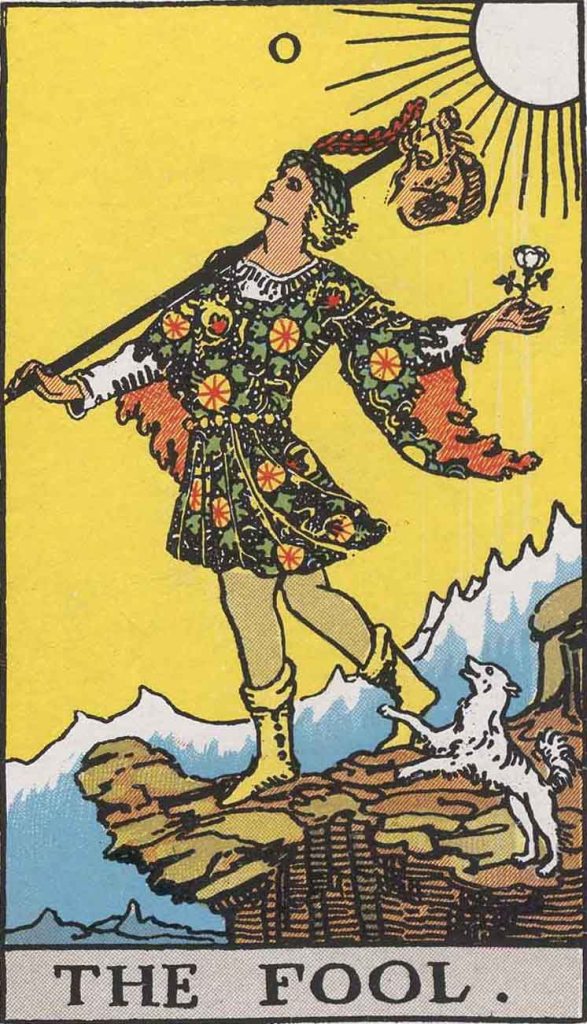
The Fool

Look at this familiar image of The Fool from the classic Ride Waite Colman-Smith tarot deck.

The Fool is a youthful, carefree person. They are clothed in bright colors– green to imply youth and growth, yellow to show a sunny disposition. The floral pattern on their tunic suggests springtime. They nonchalantly hold the white rose of purity (virginity) in one hand, in a careless grip that suggests that at any moment it may slip from their fingers. They carry a bag of their meager worldly belongings. Without a care they stroll along, nose in the air, the red plume on their cap suggesting jauntiness and arrogance. A white sun blazes above, implying the alchemical stage of albedo, purification. A little white dog barks at their feet, trying to warn them. The fool does not notice the danger as they stray nearer and nearer to the brink of a cliff. 

Everyone starts from somewhere. The fool’s number is zero. They represent the beginning of the journey. This is the card of fucking around and finding out. It is a loving homage to the mistakes we all make when just starting out in life. 

The important thing about The Fool is that they fall. If I were to create a Satanic tarot deck, my image for The Fool would be Lucifer falling from heaven. To fuck around is human, to find out is divine. 

What lies at the bottom of the cliff? For The Fool, it is not destruction. It may be death, but only in a metaphorical sense, followed swiftly by rebirth. At the bottom of the cliff is a hard lesson. At the bottom of the cliff is wisdom and transformation. 

Alcoholics in AA (like me) often talk about hitting “rock bottom”– needing to fuck up our lives so badly that there seemed to be no lower to go before being able to turn ourselves around and do something new. When there is no further to fall, at last one is on solid ground, and is finally free to stand up. 

The Fool falls but it is not in their nature to stay down. The Fool hops right back up, climbs up another mountain, and just as likely as not, falls off another damn cliff. But at least it’s a different cliff this time, and therein lies growth. So many tumbles to take! So many lessons to learn! And The Fool can embrace them all. The Fool is the high priestex of the Holy Mistake. Trial and error. Live and learn. 

The sequence of the Major Arcana is sometimes described as a story, one character evolving through many roles and stages. A funny thing happens between cards Zero and card One– the Fool somehow becomes the Magician. How does this happen? It occurs off screen. We don’t see the pit into which The Fool falls, we only know they emerge reborn as the Master of all Four Elements, the wielder of Will, the holder of perfect balance. We can only conclude that it is somehow the act of falling that leads to this wisdom and power. 

Thus The Fool is the aspirant to magical initiation. The pit into which they fall is nothing less than The Abyss, the realm of unreality in which the ego is destroyed in order to be reborn. 

Within The Abyss dwells Choronzon, who is another type of holy Fool. Choronzon is sacred madness, and fertile incoherence. He represents that which is beyond speech, the pre-verbal, the hyperverbal. He raves, he wails, he speaks in tongues. He creates sound without meaning because he is before and after meaning. With his teeth and claws he tears everything to shreds indiscriminately. More primal than the id, he has much in common with an infant– a swirling vortex of needs, desires, sensations and impressions that do not yet have even an identity to contain them. Yet his destructiveness is constructive, and the Abyss is the sacred cunt from which the Magician is reborn. 

Thus The Fool is not merely about starting out, but also about starting over. First chances and second ones. 

There are many tarot decks, and many aspects of The Fool– The Fool as jester and trickster in the Marseilles tarot, The Fool as The Green Man, as a sacrificial God in the Thoth tarot. But I have a soft spot for the Rider Waite Colman-Smith interpretation, which shows The Fool on the precipice. This image, more than any other classic image of The Fool, emphasizes the aspect of making mistakes. 

In life, some lessons can only be learnt the hard way. The Fool is a testament to this, and an encouragement to embrace the process of growth with all its pain.

THE SACRED FLAME: Sermon and Meditation

Performed at Church of the Morningstar on 1/29/2023

6. I am the flame that burns in every heart of man, and in the core of every star. I am Life, and the giver of Life, yet therefore is the knowledge of me the knowledge of death.

7. I am the Magician and the Exorcist. I am the axle of the wheel, and the cube in the circle. “Come unto me” is a foolish word: for it is I that go.

8. Who worshipped Heru-pa-kraath have worshipped me; ill, for I am the worshipper.

9. Remember all ye that existence is pure joy; that all the sorrows are but as shadows; they pass & are done; but there is that which remains.

10. O prophet! thou hast ill will to learn this writing.

11. I see thee hate the hand & the pen; but I am stronger.

12. Because of me in Thee which thou knewest not.

13. for why? Because thou wast the knower, and me.

-Liber Al Vel Legis, received by Aleister Crowley

I shall never know contentment. This is my strength and my delight. 

I am hungry and thirsty and lustful forever. I crave, I devour, I burn! My core is desire, a furnace that must be fed. It drives me forward, insatiable. 

My appetites give me power. My ambition is without limits. I want more than freedom and justice, which are mere necessities of life. I want power, and luxury, and brilliance, and glory, and pleasure. I want beauty to surround me. 

I want to immerse myself in the particularity of my obsessions. I want to plunge into my secret world, which is dark and lush and grim, a realm of forbidden pleasures and poisonous delights. My dreams drip with gold and pearls and glimmer with jewels. In my dreams I savor the touch of velvet, the odor of frankincense, the taste of blood. 

I must be Lord and King of myself, master of my world. My life must be lived as I envision it. I only want to spend time on the things that stir me, that move me. I need to revel in life. 

I tilt back my head, draw back the bowstring of my desire, and aim among the stars. I hold my breath and then release, my breath and the string and my will and then I am the arrow, traveling through the cold dark of space, and I can speed through the loneliness and emptiness forever and do it with joy so long as my passion stays pure and my desire does not lose momentum. 

My true will deserves my whole focus; nothing else is worthy. 

Whenever I have even halfway lived up to this ideal, I have achieved everything I wanted. There is luck, yes– there is circumstance, and privilege. But there is also magic, the ferocious power of my will, my desire, my dreams and ambitions. Right now you are sitting in the temple I dreamed of. But I must dream harder, so that someday it can have walls and doors and gilded molding and flickering candles and our chants may echo from a high high ceiling and the sounds of our worship cause the windows to rattle. 

I want extravagance. I crave perfection. Sometimes I chase it til it almost kills me. Desire like this is a two-edged sword; it cuts me and I bleed. But I want to put my blood into everything I do, spill my blood for everything I dream. 

I love my desire. I love my dreams. They make me strong. They ennoble me. Especially when I let them be wild and grandiose and unlikely and unreasonable. 

I want to be more than virtuous. I want to be more than worthy. Lucifer save from being merely decent. What is only worthy and decent and virtuous does not inspire me. I need to stretch and push and reach and grow. I love the sensation of striving. 

The word in my heart and the fire in my belly is “MORE!” 

I live for more. I will die for more. I believe in it, I worship it, I insist on it. To break through, to go beyond, to burst through walls and shatter boundaries– that is what I need. 

Inner peace and tranquility have never appealed to me. I live for the highs and the lows and the moments of agonized ecstasy where laughter and tears melt together and the sensations and emotions in my body grow so powerful, so potent, that they threaten to obliterate my psyche. 

This is not for you! If it speaks to you in any way then I am glad, but this writing, this raving, this outcry is for me. I write it self-indulgently, pretentiously, in the words that seem right to me, words of too many syllables strung together in sentences of too many words, florid, purple, excessive, because this is an ode to excess, this is an ode to my selfish, extravagant, uncompromising, insatiable appetite for MORE. 

I stray sometimes from who and what I am. I lose sight of the monster in the mirror, the Devil-God within me, and I forget to worship him. I forget to love his greed, his lust, his envy, his pride, his wrath, his gluttony. But not his sloth. He delights too much in action and effort. Moments of sloth for him, for me, are a necessity, not a joy. We must move, desire, and consume. Entropy rules us, we are an object that tends to stay in motion. Our cards are the emperor, the devil, and the chariot. We hate to stand still.

I am a restless, irritable and discontented soul, a perfectionist who is hard to satisfy. I push myself hard, mercilessly, teetering on the brink of exhaustion, thrilled by the abyss that gapes below me. I am thrilled by conquest and prowess and risk and achievement. Toxic? Unhealthy? Perhaps, but we are talking about my selfishness. I have learned to temper myself out of necessity, to practice rest and set limits, to cool my fire down to embers so I don’t burn out. But this is the truth of me, the real me, my spirit, a creature of flame that seeks to spread out and devour and leap up higher and brighter. I want vastness, I want expansion, I want to be boundless. 

These strengths are also my faults; these virtues are also my sins. 

I cannot have everything that I want, because truly, I want everything. I want to know and feel and experience and taste and accomplish and possess it all. But at the same time, I know I have been settling for less than I need. I am tired because I have failed to feed my soul. My flame is faltering because it needs more beauty, more pleasure, more friendship, more adventures. I have been stingy with myself, have almost let the light in my temple go out. 

This world is intent on strangling me, choking me, putting out the fire in me, denying me more than the bare necessities and making me work myself to the bone even for those. It is doing that to us all. As I have said, this is not for you, this is not intended to be about you, but if it is about you, even a little bit, by accident, attend well to your fire. Demand more– not just of what you need, but of what you want. Fight for a world that isn’t merely just and free and equitable– fight for a world of beauty and glory and passion and romance and drunken ecstasy. Fight for a life that is not merely liveable but worth living the hell out of! Do not forget desire– your needs for beauty and pleasure and music and laughter and art and touch. 

Find what thrills you, what inspires you, what sets your soul on fire– and pursue it, grasp it, cling to it, fight for it, devour it, worship it, adore it, and above all– live for it. 

Because it is what makes you yourself. It is what gives you your will to live, without which existence is impossible. 

MEDITATION

I invite you now to close your eyes. Breath deep, into your core. Place your hands upon your belly and feel it rise and fall. Breath deep. Breath slow. Let your breath be heavy. Your exhale may growl out of you. 

Feel the heat, the pulse of hot energy, the fire in your belly. Let it spread through you, filling your torso from the base of your spine through your reproductive organ, stomach, your solar plexus, your heart, up into your throat. The centers of hunger and emotion and consuming and desire. The mouth that eats, the throat that swallows, the entire digestive system that turns food into energy, the heart that circulates the blood through your body, and those parts that symbolize, among other things, the creation of new life. 

It is the head that thinks, and we know now that emotions come from the brain– but they are felt in the body, these parts of the body. Depression as a heaviness in the chest, or love as a warmth in it. Anxiety as twisting in the belly or tightness of the throat. Notice what you are feeling now, what kind of sensations arise in you. 

Let your whole torso be filled with warmth. Imagine that fire in your belly flaring hot and bright, leaping up towards the heart and the throat, spreading down towards the base of the spine. What color is it? How does it feel? What does it want? What does it feed on? What makes it burn bright? 

Breath deep. Sit with it. Feel it. If your fire feels weak, let your breath pull in energy from above and below, from the earth and the universe. Tend the fire with your breath, for fire needs air. Let it grow brighter and brighter. It is your desires. It is your needs. It is your drives. It is your motivation. It is your passion. It is your furnace, your engine. It is always there for you, and it can give you many gifts if you attend to it. 

Let its burning energize you. Let it purify you, clearing away and devouring anything unnecessary. Let it warm and comfort you. Experience its power. 

When you are ready– when you have gathered enough power within yourself– open your eyes. If the energy feels overwhelming– if you feel too hot, or flushed, or shaky, or wired– breath through your nose only, but with a normal rhythm. Rest your palms on your belly to ground yourself, to feel all that fire condense itself back into glowing embers that you can fan into flames whenever necessary. It is always there for you. 

My Creed

I’ve been going through the vast archive of sermons, homilies and other writings I have produced over the years, many of which I have not managed to post here. This is an older one, in which I break down the Satanic creed I wrote for some of our liturgy in Church of the Morningstar. I am not sure I would write it the same way today, but I stand by most of it, and it feels important to share for the benefit of my congregation. That said, I think my discussion of Mary could use a little sensitivity and refinement.

Good evening.

Many of you, if you’ve been to this church before and seen me perform a baptism or the Mass of Blasphemy, have heard me recite my creed. It goes like this:

“I deny the tyrant above. I deny his sycophant son. I deny the holy ghost. I deny the so-called virgin mother, and all of the angels, and all of the saints. They have no power over me. I believe in the cause of the fallen angels. I believe in the serpent of Eden. I believe in the kingdom that lies below. I believe in the God within me.”

Great, so, what does that mean? A lot more than meets the eye.

Let me go through it line by line.

“I deny the tyrant above.”

The first half of my creed is negative. A lot of spiritual people would probably find that off-putting. Negativity gets a bad rep. Unfortunately, in this universe, there is a lot of bad, and a lot that is worth rejecting. To me, one of those things is God.

When I call him a tyrant, I make it clear why I reject him. God to me represents absolute power, which corrupts absolutely. Not only does that God represent authoritarianism in all its forms, but his theology also insists that he is ultimately the only force in the universe. I believe in political and metaphysical freedom, and thus I reject Jehovah and all his works.

“I deny his sycophant son.”

Jesus has been called a liberator, but ultimately Jesus serves that tyrant.

No, that’s wrong. That’s bad trinitarian theology.

Ultimately Jesus is identical to that tyrant. They are one God, along with the Holy Ghost. Three persons, one substance, one will. It’s nonsensical to imply that Christ is any better than the Father.

So naturally, I deny the Holy Ghost as well. They are all the same.

“I deny the so-called virgin mother.”

To affirm Mary’s virginity is to deny God’s violation of her.

It’s thought she was about thirteen or fourteen at the time of conceiving Christ.

“And all of the angels, and all of the saints. They have no power over me.”

Mentioning God’s intermediaries at such length is a subtle jab at the supposed monotheism of Christian. I also simply find it important to declare independence from not only God but all his servants, heavenly or earthly.

“I believe in the cause of the fallen angels.”

I believe in what Lucifer and company were fighting for—liberty, equality, and love for one another, rather than merely love for God.

“I believe in the serpent of Eden.”

I’ve talked extensively about Eden before, and what it means to me. In brief: when Adam and Eve ate the fruit of knowledge, they became “as God, knowing good and evil.” We as human beings gained a moral conscience—the ability to know right from wrong. Having this power in our own right, we did not need God to hand us down commandments any longer.

Thus, the serpent is our liberator. 

“I believe in the Kingdom that lies below.”

This is a statement of faith in an afterlife in hell, but it’s something more. Really, I shouldn’t have called hell a kingdom in my creed. It’s been said that heaven is a kingdom, but hell is a democracy.

I envision Hell as an ideal anarchist society—a place of freedom where all are provided for communally. Just as Christians speak of bringing the kingdom of heaven to earth, so I, too, aspire to create the infernal society in this world.

Hell, to me, represents the hope for a better, freer earth.

“I believe in the God within me.”

This is the most important part of the creed. Since the fruit of knowledge granted us all the spark of divinity, it follows that each of us is endowed with a unique, individual Godhead, a higher self, a sacred soul that can never be destroyed.

The pursuit of divinity—apotheosis, as some call it—is important to me. I am striving for perfect union with my own latent Godhood.

Towards this end, I attempt to purify and perfect myself. This is an alchemical process, the search for the spiritual philosopher’s stone, which is the true self.

To no other God do I submit– but to my inner God, to what is best in myself, I strive to practice total obedience. I want to surrender completely to the divine in me. I want it to rule me and control me, and ultimately annihilate all aspects of my being that are not of It.

My God has a name, a secret name I do not utter. “Antichristos,” my magical name, is but a pale echo of that secret word. I worship my God as a word. It is the logos, the word that creates and organizes my inner universe.

And I believe that all of you have such a divinity within you. I would never tell anyone else how to worship their own God. I walk a very stern path with regard to mine. That may not be your style, and frankly it’s none of my business.

My business is to acknowledge the divinity of all other human beings as being just as great as my own. This, probably, is the most important point of all. We are all divine beings, capable of self-governing and moral choice. We need not bow to any but ourselves.

And so the end of the creed loops around to the beginning, to the rejection of unjust authority:

I deny the tyrant above…