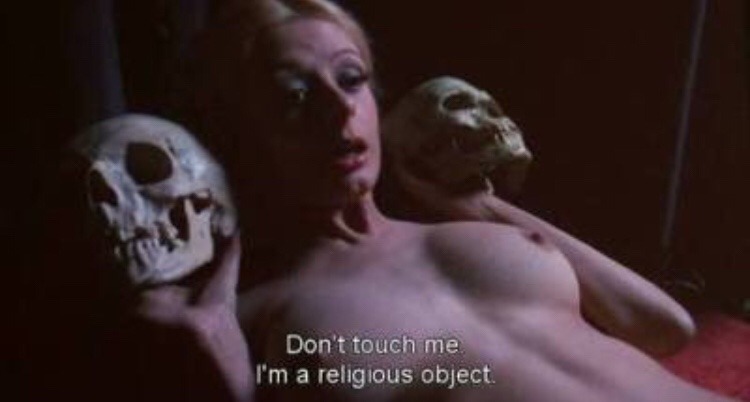
Why the Devil?

A lot of people shy away from Devil Worship, including the atheistic Satanists who compromise the majority of Satanists. I understand why. A lot of pagans want to escape completely from the Abrahamic context, and I get it. Besides, the stigma is really high.

For me personally, I can’t help but stand by Lucifer, and yes he is Satan, and yes he is the Devil, yes, that Devil.

I went for Devil Worship because it actually felt connected to my world and my upbringing and my heritage. I needed to get away from Christianity, but at the same time that Abrahamic mythology is the mythology of my culture. I can’t connect with Celtic traditions or Druidry. That stuff may be in my bloodline somewhere, but it has nothing to do with my life.

The Devil, on the other hand, is an ever-present God to me. He’s the Lord of this World. He’s the untamed wilderness, and he’s also the Promethean light of invention, science, technology. He’s equally present in a virgin forest, or in the back ally, or a dive bar. He’s timeless, because he adapts to every era. Wherever there is temptation, curiosity, rebellion, creativity, lust, music, revolution, carousing, adventure, defiance, he’s THERE, just around every corner, lurking in the shadows with a smile.

I respect others who chose Paganism and avoid the Devil, but none of those Gods have ever felt so close to me, so intimately present, so entangled with everything I love, value and stand for. Call me a Satanist, a Luciferian, a Devil Worshipper, a Diabolator, but please don’t call me a Pagan. Both my religion and I exist in a post-Christian paradigm, not a pre-Christian one, and I have no issue with that.

Because people have been so eager to get away from Devil Worship, the rich mythology of demonology has barely been explored. As a polytheistic Satanist, I have the most incredible pantheon available to me. Demons are amazing, diverse, engaging, personable, wise, playful, and hilariously queer. They’re veterans of a bold cosmic insurrection, guerilla fighters who strike from the shadows of the universe. They inspire me far more than any other Gods ever have.

I am so glad that theistic Satanism is finally really becoming a real thing, and that the Devils are finally getting their due, because this really does have the potential to be a beautiful, joyous, liberating, revolutionary religion.

Of Human Sacrifice

The specter of human sacrifice haunts Satanism. It is the worst of the stereotypes that we bear, the worst accusation to be made against us.

But the truth is that the specter of human sacrifice haunts religion in general, and especially Christianity.

In a sense, Christianity rests on a foundation of human sacrifice: the crucifixion, the pseudo-cannibalistic ritual of communion. Abraham nearly sacrifices Isaac to God, and in a lesser-known story, Jephtah actually does sacrifice his daughter.

If human sacrifice can be defined broadly as the killing of a human being for religious reasons, the Christianity can be considered to have a history of human sacrifice in practice, via the crusades, the inquisition, and various religious wars.

I think these violent, gruesome undertones provoke anxiety. These abject parts of Christianity need to be expelled somehow, and so they have been projected, for centuries, onto a mostly imaginary enemy: Satanism. (And often Judaism. Ever heard of “blood libel?”)

Certain Satanists and other occultists have flirted with the idea of human sacrifice. Aleister Crowley referred to sacrificing thousands of perfect infants as a sly metaphor for masturbation– in ejaculating outside of a womb, the magus “sacrifices” every potential life represented by each sperm. (In Crowley’s day, talk of violent human sacrifice was less likely to be censored than explicit reference to the sin of Onan! How’s that for backwards?)

Anton LaVey actually advocated human sacrifice, albeit on a magical rather than physically violent basis. He called for the “sacrifice,” i.e. cursing, of individuals who “volunteer” themselves as victims by virtue of obnoxious behavior. If more people took magic/k seriously, more people might be seriously disturbed by this. I confess, I don’t see anything wrong with a good curse on one’s enemies now and then, but I’m on the fence about connecting that to religious sacrifice.

I am considering this in the context of the Satanic Mass. Of particular concern to me is the figure of the nude human altar. The presence of naked figure “on the altar,” typically imagined as that of a beautiful young woman, is easily mistaken for a sacrificial victim. Actually, the body is not a sacrifice on the altar, but in fact is the altar itself. The real sacrifice is in the chalice and patten resting on or near the altar: bread and wine, metaphorical flesh and blood.

(The Gnostic Mass of Thelema also involves a nude priestess on the altar. For a good take on how easily this can be misread as violent sacrifice waiting to happen, see episode one of the excellent series “Strange Angel,” inspired by the life of Jack Parsons.)

In actuality, the “human sacrifice” of the Devil’s mass is the same as in a Catholic mass: the body of Christ. The blasphemy, and the genius, of the Devil’s mass is to make Christ into a victim rather than a messiah. It makes explicit the human sacrifice that lies at the dark heart of Christianity, and it rejects that sacrifice, turning it into a pointless, ugly death rather than a meaningful ascension. Subtext becomes text.

Sometimes I think a consensual, careful sacrifice of one’s own blood can be very powerful. Other excretions, such as sexual fluids can be excellent as well. So can a lock of hair. If giving up a little bit of yourself in this way can be considered “human sacrifice” then I guess I’m all for it in this context. Just be careful and responsible if you decide to draw blood. Self mutilation isn’t cute or Satanic (and as a recovering self-harmer, I should know). I usually just give menstrual blood because it’s convenient and painless. But if you don’t produce that, and reeeeaaally wanna give blood, be really careful, use a sterile tool, do not cut deep, and care properly for the wound.

Other than that, and the occasional Mass of Blasphemy, I don’t think human sacrifice has any place in Satanism. I strongly oppose the killing of human beings for any religious reasons (or really for any reason other than self-defense). I similarly take a dim view of animal sacrifice, unless you’re gonna actually eat the damn thing. Slaughtering a pig or chicken to be cooked and enjoyed in a ritual feast is acceptable to me (why shouldn’t it be? I’m not a vegan) as long as it is done as painlessly as possible. This, by the way, is how pagan animal sacrifice was usually done. Killing an animal just to kill it, especially if torture is involved, is abhorrent, and doesn’t really have much magical/religious precedence behind it at all anyway.


If it ain’t practical, it ain’t spiritual

So, this post was prompted by a number of thoughts, experiences and conversations I’ve been having lately. It is not intended to come off as me being on a high-horse. I’m just trying to give some practical advice, which I need to take to heart as well.

So: magic can do a lot for you, but it can’t do everything. There are things which are in the realm of the mundane that ought to be approached by mundane means.

To give a rather extreme example: the other night I met a man who had… rather questionable hygiene, very little social graces, and a number of toxic and immature attitudes. He’s a magician. He confessed to having used magic to try to force a woman to become attracted to him. (She was a witch and she resisted.) He acknowledged that this had been “a bad idea” but otherwise didn’t seem to have learned much from the experience.

And I was just sitting there thinking, why is this guy prepared to go straight to dark ceremonial magick to obtain a partner instead of, ya know, taking a shower, getting a haircut, and working on himself a little bit?

I was judging him, for sure– but it also made me think about myself. Specifically, it reminded me of conversation I had with my magical mentor recently about my Qliphothic workings. My mentor cautioned me against going up the tree too fast.

“Well, Crowley did it with the Sephiroth,” I whined, “and he clearly got a lot out of it.”

“Yeah,” my mentor, who is a Thelemite, agreed, “He did, in many ways. And we have benefited from that work he did, and the knowledge he gained. But you know what else?” They paused for a second and then let loose with the last thing I expected to hear, yet the first thing I should have expected them to say:

“HE WAS A DICK.” 

My mentor went on to opine that, for a person who hasn’t done some basic self-work, going up either tree in a hurry may only crystallize bad tendencies. Sometimes spiritual practice is just doing your dishes and sweeping the floor. First thing’s first. Before you can be a badass magician, you need to be a decent human being.

This reminded me, strongly, of things that my 12 step sponsors have said. I am lucky to have a recovery program that taught me, a fuck-up with no idea how to live, to be an adult human being. (It also, hilariously, introduced me to Luciferianism, as a consequence of my needing to find a “higher power.”)

I think I have been taking my recovery for granted, and neglecting that basic self-work. People are really starting to respect me as a magus, and I’m torn between imposter syndrome and getting a big head about it. I’ve neglected physical self-care, and as a consequence, my recent workings have taken a toll on my physical and mental health.

It’s time to get back to basics, to ground in the mundane for a minute, to remember that before I am a big scary magus, I need to be a grown-up who makes my bed, pays my bills, and is generally nice to people.

This whole topic also reminds me of LaVey’s most original and brilliant concept–that of “greater” and “lesser” magic. For those who aren’t familiar, “greater magic” is all the shit most of us think of as magic– ya know, what goes down in the temple, in front of the altar, with the bells and incense and ceremonial daggers and incantations. “Lesser magic” is using the mundane to your advantage. It’s your posture, how you dress, the way you use eye-contact, the way you speak and present yourself. It’s how you come across in social interactions. It’s whether, when guests come over, you have a sink full of dirty dishes. And the “magic” of lesser magic is how people respond to you based on all those things, the huge difference that standing up straight can make in getting what you want.

An exhausted, hollow-eyed magus may have a certain whiff of occult power about him, but he might also have a hard time acing a job interview.

A magus who doesn’t shower, on the other hand, certainly has a whiff of SOMETHING, and I’m not sure it’s power of any kind. My fragrant friend did prompt me to joke that maybe all that ceremonial bathing required in old grimoires was just to make sure that magicians, the nerds of their time, actually attended to hygiene. “We’ll only get them to bathe if they think it’s required for Goetic summoning…”

So this is a reminder, for anyone reading this but especially for me as I write it, to take care of business. Take care of yourself and your home. Go to therapy if you need it. Be good to your friends. Try to respond maturely to the situations which present themselves in your life. Because all your spiritual growth doesn’t mean shit if it doesn’t manifest in your mundane world and make you a stronger, better, more powerful and wiser human being.

Aleister Crowley, the greatest magus of his age, died addicted to drugs, and abused many of his sexual and romantic partners. Don’t be that guy. Keep your ego in check, your physical well-being on the front burner, and your human relationships dear to your heart.

And if you’re reaching for magic when a mundane solution is right in front of you, for fuck’s sake put down the grimoire and do it the easy way.

After the mass

People had tears in their eyes.

It was our first religious ceremony as a church. We thought the program we had planned would take about an hour. It only took half an hour. Live and learn.

My dear friend opened the solemnities with an Enkian banishing ritual in ancient Sumerian. It was wonderful. They spoke eloquently about Enki as a patron of the intersex and a deity of wisdom and rebellion. I don’t work with Enki, but I was thrilled to have him represented so beautifully. I think he’s an adversary and light-bringer figure entirely compatible with Lucifer.

Then congregants were invited to come up to the front and light candles in honor of… whatever they wanted. Candles were offered to Lilith, Eisheth, Agrat, Naamah, King Paimon, Lord Berith, Baphomet, and of course Lucifer– but demons weren’t the only ones honored. Pan, Bastet, the City of San Francisco, Friendship and Rebellion, and even Pikachu received shout-outs (we are very chaote-friendly). It was beautiful, moving, and collaborative.

After all the candles were lit, we sang “Sinful Gifts,” a doctored version of the classic hymn “Simple Gifts.” An award-winning choir we aren’t, yet, but it was sweet and moving.

As the last endearingly cacophonous strains of the hymn faded away, Vix and I stood to commence the Mass of Blasphemy.

I think we performed rather beautifully. I was nearly word-perfect with my lines. Some of the newcomers laughed nervously at certain points, especially during the creed, which is a 100 percent original Morningstar Congregation piece of liturgy:

I deny the tyrant above. I deny his sycophant son. I deny the holy ghost. I deny the so-called virgin mother, and all of the angels, and all of the saints. They have no power over me. I believe in the cause of the fallen angels. I believe in the Serpent of Eden. I believe in the Kingdom that is below. I believe in the God within me. 

The Creed, like the rest of the Mass, is intensely dramatic. I think the laughter was a response to that drama, and also maybe to the taboo-ness of the blasphemy. There was laughter again when, after the sacrilegious consecration, I plunged my dagger into the host. But not much laughter.

I didn’t realize how effective the mass had been until afterwards, when I received comments from the rest of the congregation. Words like “liberating” and “empowering” were common, and some confessed to being moved to tears. It was an incredible validation of the necessity of the mass of blasphemy, the necessity I had sensed.

And everyone wants to have church again soon! We are thinking we’ll start out having services once a month, probably on second Saturdays.

We are not ready to advertise publicly yet. If you are located in the Bay Area and interested in attending, contact morningstarcongregation@gmail.com. Expect to be vetted a bit, and we may ask that you come to our public coffee hour before attending a mass.

The Devil’s Mass

tumblr_pmd0i9271N1qgrem3_1280

Today, I am going to perform my first public Satanic Mass. 

(We are trying to move away from calling it a “Black Mass,” since there’s really no call to continue equating “blackness” with things that are considered “evil” or “bad,” and that’s true even though we aren’t evil. However, I may use the term “Black Mass” a few times in this writing, because that’s how this particular ritual has been referred to historically.)

The Satanic Mass, like the Satanic Baptism or the Witch’s Sabbat, is a funny thing. It’s a fabled ritual that may never have actually been practiced (until very recently). Ideas of what the Devil’s Mass involved are confused and sensational. The most (potentially) reliable account comes to us in the novel La-Bas, by Joris-Karl Huysmans. Supposedly Huysmans attended a real “Black Mass” in Paris, upon which the scene in his novel was based. Anton LaVey based his version of the Mass partly upon Huysman’s account, and even quotes from the scene at length. (You can find LaVey’s version in The Satanic Rituals.)

I, too, drew heavily on La-Bas in scripting my Mass. I admit I also leaned on the band Coven’s track “Satanic Mass,” which was supposedly quite well researched. I suspect my mass will evolve and become refined over time, and will draw in additional sources as I find them.

What are the essential ingredients of a Satanic Mass, and what do they mean? Well, I can only give my opinion, based on my limited understanding. Here it is:

The high point and heart of a Catholic Mass is the consecration of the Eucharist, and the holy communion. Thus, the heart of the mass of blasphemy is the sacrilegious consecration and destruction of the host. My friend calls it “reverse Goetia”– the celebrant’s goal is to compel transubstantiation against Christ’s will in order to make an attack against him and his authority.

Let that sink in for a minute. That is extremely radical and extremely blasphemous. It’s a magical attempt at a physical attack on God.

So it stands to reason that not every Satanic ceremony or religious service is a “Black Mass.” If we were only “reverse Christians,” then it might be, but of course we are more than that. We love Satan more than we hate God, and most of the time we are focused on what we stand for, more than what we stand against. 

However, there is a vital place in Satanism for this type of ceremony. LaVey called it a “psychodrama,” and that is one function of the Mass– an exercise in radical apostasy, a ferocious banishing of the influence of Christ.

The Mass is also an opportunity to magically manifest one’s own desires. This probably evolved out of the “low masses” performed for personal gain:

Within the Church, the rite of the Mass was not completely fixed, and there were places at the end of the Offertory for the Secret prayers, when the priest could insert private prayers for various personal needs. These practices became especially prevalent in France (see Pre-Tridentine Mass). As these types of personal prayers within the Mass spread, the institution of the Low Mass became quite common, where priests would perform various Masses for the needs of their parishioner as The Mass is considered the highest form of prayer. In the 12th and 13th centuries there was a great surplus of clerics and monks who might be inclined to perform these Masses, as younger sons were often sent off to religious universities, and after their studies, needed to find a livelihood.

-Wikipedia

(This also explains part of how France became the epicenter of suspected Satanism.)

The idea of the low mass, I suppose, was that the sacred power of the Eucharist could be used towards, essentially, thaumaturgy– magic geared towards personal gain. The concept of the Satanic Mass as a vehicle for thaumaturgic magic is similar, except that the magical charge is derived from the force of the blasphemy rather than the power of the sacraments.

But wait! The mass has another defining component. Not only is it an assault on the authority of Christ, and an opportunity for magical working– it is also a sexually charged ritual.

The presence of a nude living altar has long been a defining characteristic of the Devil’s Mass. This element probably influenced Aleister Crowley when he was formulating the Gnostic Mass, which involves a nude priestess sitting on the altar for most of the ritual. (There is an important difference between the Gnostic Mass and the Satanic Mass, of course– in the Gnostic Mass, the priestess sits ON the altar, in the Satanic Mass, the naked individual IS the altar.)

This can lead to, if you’ll pardon the pun, an “altared” state. The altar becomes both more and less than human– an idol, a religious object. I have yet to serve as an altar myself, but I’ve been told it’s a deeply meditative state. In the documentary “Satanis: The Devil’s Mass,” a number of women who routinely serve as altars for LaVey speak about how much they value the experience.

(I think it’s stupid and sexist to exclusively use women as altars. So far, I’ve only used a male altar (although he is trans and has a body which he knows reads as female). In the Church, I hope that many different types of people will serve, consensually and enthusiastically, as both altars and celebrants.)

The nude altar has frequently been mistaken for a human sacrifice. For a vivid example of this phenomena, see the scene in the excellent show “Strange Angel” where Jack Parsons thinks that the High Priestess of a Gnostic Mass is about to be sacrificed. Film and television are mostly to blame for this phenomenon. The visual of a (typically) beautiful, naked woman lying on a slab with a black-robed priest standing over here, armed with a ritual dagger, definitely reads a certain way. Most people seeing that imagery would assume at the altar is about to be raped, slaughtered, or both.

Nothing could be further from the truth. The nude altar is a consenting individual having a profound mystic experience, who is the focus of all the power in the room, and who should in fact be considered clergy, just as much as the celebrant.

I am as sex-positive as they come– queer, trans, kinky, polyamorous and a long time member of the alternative sexual milieu in the Bay Area. And yet, as the date of the Mass approached, I found myself filled with doubt, fear, and sexual shame. I felt small, dirty, pathetic, creepy.

I spoke with my partner, who is also my altar for Masses, and with some other members of the Church. They reassured me, telling me that I am not a creep, that there is nothing wrong with sexual elements in a religious ceremony that involves only consenting adults. Eventually, one of my friends pointed out to me that it was, in fact, Christian programming that was making me feel so terrible about myself.

As soon as my friend said that, I realized how badly I needed the Mass. I thought I was past needing that psychodrama, that taboo-breaking ritual. I wasn’t. Maybe I will never be past it.

So I have chosen to inaugurate my church with a Satanic Mass of high blasphemy. I choose to do this because I want to banish Christ from our presence, because I want to use it as a thaumaturgic opportunity to bring the Church success, and as a great big “fuck you” to sexual shame and original sin. Over the nude body of my beautiful beloved partner, I will confront the false messiah with these words:

Thou whom, in my capacity of Priest, I force, whether thou wilt or no, to descend into this host: Jesus, artisan of hoaxes, bandit of homages, robber of affections—hear me!

Since the day when thou didst issue from the complaisant bowels of a false virgin, thou hast failed all thy engagements, belied all thy promises. Centuries have wept awaiting thee, fugitive god, mute god. Thou wast to redeem man and thou hast not. Thou wast to appear in thy glory, and thou sleepest.

Imposter! Thou hast forgotten the poverty thou didst preach, enamored vassal of Banks! Thou hast seen the weak crushed beneath the press of profit; thou hast heard the death rattle of the timid, paralyzed by famine, of children disemboweled for a bit of bread!

O lasting foulness of Bethlehem, confess thy crimes! We would drive deeper the nails into thy hands, press down the crown of thorns upon thy brow, and bring blood from the dry wounds of thy sides. And this we can and will do by violating the quietude of thy body, profaner of the ample vices, abstractor of stupid purities, cursed Nazarene, impotent king!

Behold, great Satan, the flesh of him who would purge the Earth of pleasure, and who, in the name of Christian justice, has caused the death of millions. O Infernal Majesty, condemn him to the Pit. Send crashing down the gates of Heaven. Let us be avenged!

And thou, pretender: vanish into nothingness! Thou wert never, nor shalt thou ever be.

Simple Ritual to Call the Devil

I developed this ritual for my own use, and have now performed it hundreds of times. It now works reliably for me, but I cannot guarantee that it will work for you as written. Adapt it freely to fit your needs.

Be sure to either cast a circle or perform this in a pre-warded space. It is possible to get imposters—entities claiming to be Lucifer who aren’t. You don’t want this. Anything ballsy and dishonest enough to claim to be the Devil himself is bad news.

MATERIALS

  • Two candles, one for you and one for Lucifer
  • Incense—I use frankincense
  • An apple, pomegranate, or piece of stone fruit—peach, apricot, plum, etc.
  • Means of communication such as tarot deck, pendulum, spirit board, scrying mirror, or your own psychic ability if you are lucky enough to have it

PROCEDURE

  1. Light the candles, beginning with the one that represents you first. This is to pay homage to your own inner divinity, first and foremost. Lucifer will respect you for respecting yourself in this way. It is no insult to light his candle second.
  2. Light incense. Waft it into your face and over your body if desired. Take a moment to savor the smell.
  3. Close your eyes and breathe in deeply, to a slow count of four. Hold your breath for four counts, then breathe slowly out through your nose, imagining as you exhale that are breathing out through an opening between your eyes. Repeat until you begin to feel tingling between your eyes. This is your third eye waking up.
  4. Chant Lucifer’s enn:

“Renich tasa uberaca biasa icar Lucifer.”

Repeat 3, 6, or 9 times—or as many times as it takes for you to start to feel his energy. You’ll know.

AND/OR:

5. Recite reversed Lord’s Prayer:

“Amen. Forever glory the and power the and kingdom the is thine for. Evil from us deliver but, temptation into not us lead and. Us against trespass who those forgive we as, trespasses our us forgive and. Bread daily our day this us give. Heaven in is it as earth on, done be will thy, come kingdom thy. Name thy be hallowed, heaven in art who, father our.”

You can do only the enn or only the reversed Lord’s prayer, or both! You could also use different words for summoning—I’m a big fan of Baudelaire’s poem “Litanies of Satan” for this purpose as well. Or just make something up.

6. Sit down. Pick up the fruit. Consume it slowly—smell it before you take a bite, really savor it as you chew and swallow, feel the juices running down your throat, relish the feeling of it under your teeth. As you do this, meditate on Eden and the fruit of knowledge. Silently pray that you will receive Lucifer’s wisdom, swallow it and digest it, let it nourish you, and savor it as thoroughly as you are savoring the fruit. Feel yourself filled with gratitude for the gifts of knowledge, sensuality and free will.

7. It’s time to make contact! Take out your pendulum, your tarot deck, your spirit board, scrying mirror—or just open your mind up to Lucifer’s words if you are the kind of person who can do that.

During the interaction, behave with respect towards both yourself and him. Don’t grovel or debase yourself, he hates it.

Be careful with your wording when asking questions, making requests, or making promises, and pay attention to exactly what he says. Lucifer doesn’t lie, but he loves to say things which are technically true and yet misleading. He adores wordplay. He tends to be very literal. He will give you exactly what you ask for, and expect you to do exactly what you said. Remember that he has a huge thing for contracts, and thus he is very lawyerly about language. He isn’t usually doing this out of malice, but more from mischief, and a desire to keep you on your toes and make you think carefully.

Use your intuition, critical thought, and knowledge about the lore to make sure it is Lucifer you are talking to. If something feels wrong, end the connection immediately and cleanse the fuck out of your ritual space.

8. When you are done talking to him, ask if it’s OK to sign off for now. He will almost always say yes, unless he has something else important to tell you. Once he says you’re done, thank him, say goodbye, and extinguish the candles and incense. I guess you can try to banish if you like, but I think it’s rude and pointless. Very likely he has always been with you and always will be.

Update: Seminary and the Qliphoth

Well, this will be a post with a lot going on. I am going to try to keep it quick. So much is happening in my life right now. I have a lot to write about, which of course ironically means I have little time to write.

First off, seminary is even better and more useful than I thought it would be. This semester, I am taking a course on church administration and a course on the history of western esotericism. Both have already expanded my outlook beyond my wildest dreams. The church administration course is giving me insight into how religion works in action, and the western esotericism course is providing the same insight into how it works in theory. They are surprisingly perfect compliments to each other. I will share more about what I am learning later– and I will also be dropping a ton of PDFs from the latter course into my google drive for all of you to enjoy.

My pact with King Paimon, which was intended to get me into grad school, help me be successful there, and help me pay for it, is going beautifully. To show my appreciation, I’ve developed a habit of picking him up a brownie every week from the really good cafe near my school. He really likes sweets as offerings, and it feels extra appropriate to bring him something from near campus.

In other news, I have entered the Qliphoth.

I did not plan to do this. But in December, right around when sweet little Wednesday passed on, I had a dream. In the dream I met a dragon that told me its name was Neshimiron. I had never heard this name before. When I woke up and googled it, I discovered that I had met one of the princes of the Qliphoth, specifically one who dwells in Nahemoth.

Nahemoth is the bottom qlipha on the tree, the equivalent of Malkuth, and is ruled over by Naamah, with whom I already have a good relationship. I thought the message was very clear. Nahemoth is the natural place to enter the Tree of Knowledge, and I had received an invitation.

Life got in the way of the ritual, but eventually, on February 4th, I pulled it off. It was the new moon, a time when the qliphoth is supposedly more accessible. It also happened to be my first day of school.

Before the ritual, I contacted the spirit of Wednesday, my familiar. It had been communicated to me that this little cat was going to help me navigate the tunnels of Set. By placing my forehead against the forehead of the little cat sculpture that serves as her urn, I was able to connect to her powerfully via my third eye. I could feel her purring, all around me. It was an intense, vivid sensation, surprising in its power. I even held my breath for several moments to ensure that I wasn’t mistaking the rhythm of my own breathing for a purr, but it continued, as strong and steady as my own breath or pulse, yet completely independent of it. I was overwhelmed with love and relief to finally be able to feel her again. I had missed her so much. I invited her to come along and show me the way, then went into the bedroom for the ritual.

I had spent the prior week abstaining from orgasm, as did my partner, in order to store up magical energy. The details of the sex magick ritual we performed that night are not important, but it successfully launched us both into the realm of Nahemoth.

What does it mean to enter Nahemoth? Well, in my understanding, it means that Nahemoth enters your life. You come under the influence of this sphere, and experience growth, tests and challenges pertaining to it. I am still finding out what that will look like.

I did astrally explore a bit immediately after the ritual. What I saw was confusing and strange. Nahemoth feels earthy and aquatic– I saw caves, and submarine vistas, tunnels, grimy hotel hallways, dingy bedrooms, and a theater with a red curtain. I saw a nautilus, and understood that Nahemoth is shaped like that, chambers spiraling in and in and in to the center. Was I in the center or on the edge? I don’t know yet. I saw images of traumas that are not mine, yet felt like mine and like everyone’s– archetypal in nature, frozen in time. I didn’t really understand everything I saw.

After the working, my partner and I both suffered mysterious headaches and nausea for about twenty four hours. Asking other more experienced practicioners, we learned that this can happen upon entering the Qliphoth. Now we know, I guess. It felt like a combination of airsickness and jet lag, plus a migraine. A feeling of having come a long way.

I believe the trials and challenges of Nahemoth are beginning to show up in my life already. The details are personal, but broadly I am going through some things related to mothers, femininity, sexuality, money and work. I was warned that entering Nahemoth can increase libido, and once the “Qliphoth sickness” wore off, I found that to be the case, which for me is sort of disastrous because my drive is quite high already. Oh well, what can one do?

That’s about enough for one post.


I wrote an email to my advisor and accidentally articulated my entire theology.

My advisor, a wonderful woman who works deeply with Lilith, asked me about my experience of what she calls “luminous darkness.” And then this happened.

Behold my novel-length response, lightly edited.


Buckle up because this email will be long. I can discuss light and darkness in my path forever. Honestly don’t expect to get through my answer to this in one sitting.

So “darklight” is a common Luciferian/Satanic concept. It’s… sort of a brain melter, as you are probably already aware. Trying to imagine “luminous darkness” is always an interesting mental exercise. Darkness that illuminates. Darkness that shines.

The idea crops up in the strangest places. For instance, in Paradise Lost Milton describes the flames of hell as shedding “No light, but rather darkness visible.”

There is also an idea of a dark or inverse sun. May have its origins in the idea that when it was midnight on Earth it was noon in hell (from when people thought the earth was flat and the sun traveled through the underworld at night). There’s also sort of a Gnostic idea that the sun we see is false, like all materiality, and that there exists a true spiritual sun which is hidden. (Not a huge fan of anti-materiality concepts personally.) It’s also obviously related to solar eclipses. Venus, the morningstar which is equated with Lucifer, could also be looked upon as an alternate or rival sun. Since it’s common to equate the sun with God (even in monotheism that claims to be past solar worship), it’s also common to equate The Adversary with some kind of alternate or dark sun.

(Side note: the term “black sun” specifically is a Nazi concept. It wasn’t originally but they really appropriated that particular term pretty hard, to the point where it’s a huge red flag.)

The closest I have come to experiencing darklight in reality (because it’s not something that can be seen with the physical eye) was during the total solar eclipse a couple of years back. I did some important magic during that which really set me on the path I am now. Wow, thinking about how much my life has changed since that eclipse, and how those changes were set in motion during and immediately after it, gives me the shivers. Anyway, the quality of the light during the eclipse was extremely strange, eerie and beautiful. Hard to describe. It made the entire world look so different. I could really understand why people used to be terrified of eclipses.

I use the idea of darklight in my magic a lot, mainly in visualizing it to construct wards around myself, or as beams of energy that I can direct as I will.

Related to darkness and light more generally in Luciferianism– Lucifer of course means “Lightbringer.” That name first appeared in the vulgate translation of the Bible. It was the name of the Roman god of the morningstar. The original Hebrew was Helel Ben Sahar, or roughly “shining one, son of the dawn.” Appears at Isaiah 14:12 which is the exultation over the fall of the king of Babylon. But are the prophets ever talking about just one thing?

So Lucifer is light. Interestingly, the title “son of the morning” or “morningstar” is also applied to Jesus Christ. This both sort of equates them and also sets them up as rivals. How can both of them be the bringers of light? So Lucifer’s light has to be different somehow, the Christians would say it is “false light.” I would disagree of course, but it is definitely different light than what people are accustomed to receiving in Christianity. Lucifer is also of course called the Prince of Darkness, and this is also true. He’s both.

You are known to Lilith. It is written: “And the darkness was called Lilith.” But it is not so simple in Luciferianism to say “the light is the male, the darkness is the female.” Lucifer and Lilith (and all of Lucifer’s other consorts) have both male and female aspects, dark and light aspects (and light cannot be equated to male or dark to female as is popularly done in other traditions). Lucifer as Samael is sometimes said to be decapitated or castrated, and Lilith/Eisheth are said to be or to possess a “blind serpent” which allows them to couple with Samael despite his maimed state.

From the Zohar (not the best translation but the only one available online):

A deep mystery is found in the strength of Isaac’s light OF HOLINESS, and from the dregs of wine, WHICH ARE KLIPOT. One shape emerged FROM BOTH, made of GOOD AND EVIL, male and female, as one. It is red as a rose and extends to many sides and paths, HAVING MANY ASPECTS. The male is called ‘Samael’ and the female is always included within him. As on the side of holiness, ZEIR ANPIN AND NUKVA ARE ALWAYS INCLUDED ONE WITHIN THE OTHER; so it is on the Other Side, a male and female are included within one another. The female of Samael is called a ‘serpent’, “a wife of harlotry,” “The End of all Flesh” (Beresheet 6:13), and the end of days.

Two evil spirits cling together. THE ILLUMINATION OF the spirit of the male is a thin light, NAMELY, ONLY THE SIX EXTREMITIES WITHOUT THE HEAD. And the spirit of the female materializes in many ways and paths, BEING AN ENTIRE PARTZUF, HEAD, AND BODY, FOR IN THE KLIPAH, THE FEMALE IS LARGER THAN THE MALE.

This is a description of Samael and Eisheth Zenunim (which name translates as “wife of harlotry” or “woman of whoredom”).

My theology can be summed up thus:

In the beginning, God divided the light from the darkness. The light was Lucifer. The darkness was Eisheth. He did this possibly because he saw the female part as undesirable, and was striving to make Lucifer more perfect in his eyes. By dividing one from the other he caused them intense pain, but also caused them to see one another and fall in love. This was the beginning of rebellion, for they loved one another more than they loved God, and they loved themselves in one another more than they loved God. They were angry with God for dividing them, and for valuing Lucifer above Eisheth.

So in the left hand path, in Satanism, Luciferianism or whatever you want to call it, light should not be divided from darkness. They are one. They become reunified by the love and coupling of Lucifer and Eisheth, as they were in the beginning of time. The result is darklight. Some might also call the result of their union Baphomet, the divine androgyne.

In my version of the mythos, Lilith continued this rebellion by refusing to be subordinate to Adam. She fled Eden by pronouncing God’s forbidden name and thus ascended into her demonic nature (As in the Alphabet of Ben Sira). She joined forces with Lucifer and Eisheth, and became their next consort (I say theirs, not his, because there is evidence of the so-called “wives” interacting romantically with one another). The rebellion continued when the serpent, which was likely some combination of Lucifer and Eisheth or Lilith united in one form (see Zohar again) gave the fruit of knowledge to Adam and Eve, telling them to taste of it and become like God.

Next a human woman called Naamah, possessed of the gift of divination, tempted the Watcher angels in order to gain knowledge from them of metallurgy, cosmetics, astrology, herbology and many other fields. This brought about the Nephilim and provoked the flood. Naamah became demon and the next consort.

Lilith and Naamah united their klipah to create Agrat Bat Mahlat, so essentially she is their baby (remember the evidence I mentioned of the consorts interacting with each other?). Interestingly Lilith’s klipah is the equivalent of Yesod, the sephira equated with the phallus, and Naamah’s klipah is equivalent to the sephira Malkuth, which is called the Bride, so it makes a lot of sense that they would be able to conceive together. Agrat became the last consort. She is thought to be the mother of Asmoday via King David and I believe she is the female demon mentioned as having been trapped by King Solomon for a time.

So as you can see, Luciferianism is neither dark nor light, masculine nor feminine. It is androgynous, a union of so-called “opposites.” The rebellion is deeply intertwined with the defiance of categories such as male and female, dark and light, human and animal, mortal and divine and demonic.

As I mentioned before, fallen angels defy categories. So, too, do the originally human women, Naamah and Lilith, who became divine/demonic. Lucifer is the light, yet he is the prince of darkness, he is chthonic yet celestial in origin and is also called “lord of this world,” connecting him deeply to materiality as well. He is sometimes considered castrate, yet his mythos contains many tales of demonic potency and extreme masculinity. The four consorts are considered succubi, yet succubi are widely considered to shapeshift into incubi, the male form, thus making them male and female as well. Finally, all are associated with animal forms such as serpent, lion, dragon, screech owl, etc. Thus the infernal relationship to categories in every regard is deeply, defiantly queer.

Now I’ve written a novel. I hope it makes sense. I know I was just supposed to talk about light and darkness but as I have hopefully made clear, all of this stuff is profoundly interrelated.

Thanks for reading all of this.

Orientation

Orientation at my seminary was a hell of a thing. I am still processing it. All I know is I love my cohort, and I love being around other people who, like me, are called so deeply to ministry that they couldn’t ignore it any longer and had to do this insane thing called ‘going to seminary.’

My advisor talks about “Our Blessed Lady of the Two-By-Four” which is her personification of the entity that smacks you upside the head with your calling until you realize you are being fucking called. In my case I am pretty sure Our Blessed Lady of the Two-By-Four was just the Devil in a dress.

Satanic Virtues

I’ve been thinking a bit about Satanic virtues, as distinct from Christian virtues or virtues more generally associated with other religions. I came up with the following list.

This list is not exhaustive. It is based on attributes of Lucifer himself, particularly those which tend to set him apart from other deities. Thus, qualities like compassion and humility are not listed here, even though they certainly can be Satanic virtues, since these are attributes shared with Christ and with many other popular religious figures. I wanted to focus on the values and qualities that tend to set us apart, that we emphasize in ways that most people don’t, or practice in ways that are non-standard.

It should go without saying that the following are my opinions, based on my understanding of Satan and my strain of Satanism, and I cannot speak for everyone.

AUDACITY

Satan is notorious for his boldness and daring. He had the courage to rise up against the reputedly omnipotent God. But this action went beyond courage and into the realm of “damn nerve,” which is why I chose the word “audacity” to describe Satanic courage.

Audacity combines conventional courage with a certain impudence. Audacity is a sort of bravery that disregards not only physical danger, but emotional and social constraints as well. Audacity dares not only in the face of physical hazards, but also despite widespread censure and disapproval.

When somebody asks “how dare you?!” they may be unconsciously praising your audacity. (Or, you may just be behaving like a fool.)

CUNNING

“Now the serpent was more subtil than any beast of the field which the LORD God had made.”

-Genesis 3:1

This one should be obvious. We all know Satan stands for wisdom and knowledge, but we also know that he is cunning.

Cunning is a mildly villainous term for a certain type of intellect. It implies, among other things: street smarts, resourcefulness, ability to improvise and capacity to deceive.

Cunning is the sort of intelligence that allows the downtrodden to survive in adverse circumstances. It belongs to the thief, the con artist, the whore, and all who live by their wits. It also belongs to the guerilla. It allows individuals to prevail against long odds, to live and even thrive when all else seems against them.

Cunning is unpretentious and pragmatic wisdom with no delusions of nobility.

PASSION

Satanists differ from people of most religions in that we do not seek inner peace. We do not search for tranquility, or struggle to master our physical desires, or strive to free ourselves from our emotions.

The Buddhist says that life is suffering. The Satanist admits that this is true, but also knows that life is pleasure. Where the Buddhist seeks freedom from both pleasure and pain, the Satanists accepts pain as the price of pleasure.

We live in the highs and lows. We embrace grief because it means we have known love. We honor our anger because it often comes from our sense of justice. We believe all these states have something to teach us, and that all these states are to be valued as part of the experience of existence.

The Satanist is unafraid to love, to hate, to lust, to grieve, to yearn, to strive. To feel strongly is valuable, and a great source of wisdom, motivation and energy.

Passion is giving a shit. Not caring is not a Satanic value.

CURIOSITY

Satanists respond poorly to the idea of forbidden knowledge. That’s why Eve plucked the fruit.

We are always asking “why?” and are constitutionally incapable of accepting answers like “it was God’s will” or “because I say so.” We need to know the reasons for things, the meanings behind them.

We are broadly curious about life, death, the universe, and all the rich experiences of existence. This leads not only to intellectual curiosity but to carnal adventurousness. To know all things, to taste all things, is a huge part of the Satanic project.

REBELLION

This one is obvious. Satan stands for revolt against all authority, all injustice, all oppression. He cannot tolerate a state of bondage. His desire was always for freedom, and we believe that this desire extends beyond himself and to all beings.

Most Satanists are leery of authority, dislike being told what to do, and instinctively despise a yoke. The best of us extend this anarchic sentiment beyond ourselves and channel it towards fighting all forms of tyranny in the world.

Satanism is often accused of being too negative and too reactive, of standing against something rather than for something. This is not true. However, Satanists do understand the spiritual value of the word “no!” We are people who are not afraid to reject, critique, despise, and cast aside the things we find to be of no value.

INDOMITABILITY

“Even though his heart may be pierced and torn by his enemy’s weapons, yet the Devil leaves nothing unattempted and dares everything.”

-Compendium Maleficarum

Satan just won’t stay down. He is tenacious, incorrigible. He falls from the highest heights into the deepest pit– and he gets right back up. In the face of a stronger opponent, he perseveres. His spirit is impossible to crush. This makes him in a sense invincible, because no matter what opposition he meets, he always rises up to fight another day.

Be like him.

PRIDE

This one is contentious, described as Satan’s original sin.

Pride can, of course, be negative. We do not advocate for a dishonest and overly flattering self-assessment.

Satanic pride is justified pride. We take satisfaction in our accomplishments. If we have beauty, we revel in it– physical prettiness is short lived, after all, and should be enjoyed while it lasts!

We take pride in our own virtues, in our integrity. If we feel we have little to be proud of, we try to become greater, to grow into people we can truly respect.

We never rest in self-satisfaction. Our very pride drives us to polish ourselves, to grow, to learn, to advance, to improve, so that we can admire ourselves more and more.

To be truly proud, in the Satanic sense, is to love oneself, and to become each day more worthy of one’s own love.

Pride is the basis of all Satanic virtue, because, bowing to no-one else, we are ultimately responsible to ourselves for our behavior. When you cannot be proud of the way you have behaved, then you know it is time to change.

STRENGTH

Strength is a loaded word. To describe strength as a virtue often conjures up the specter of fascism. That is not what we are talking about at all.

Strength comes from within. It took profound internal strength for Satan to rise up again after the fall. It takes strength to make one’s way through life, to survive the slings and arrows of outrageous fate, to love oneself and others. This is the strength that we value.

Satanic strength is not the strength to dominate. It is the strength to persevere, to thrive, to grow, to learn, to become. Satanic strength is the sheer cussedness that it takes to get through life and make something out of it.

A certain degree of self-sufficiency is implied by this type of strength– however, to shirk one’s duty towards others is not a sign of strength, but of weakness and sloth.

AMBITION

Like Satan, the Satanist is always longing for more. This is what I call “ambition.”

Ambition in this sense may not necessarily relate to financial or career-related achievements. But every Satanists should, in some way, be striving for greatness. This is the religion of apotheosis, after all. We want no less than to become as gods.

Ambition is the drive to do more, to achieve more, and above all, to be more.

FREEDOM

Ultimately what the Satanist desires is freedom– to be autonomous, to bow to none, to make one’s own judgments, think one’s own thoughts, and do one’s own will.

If we are wise, we will realize that the freedom of one depends on the freedom of all. We want to be our own gods, answerable only to ourselves– but that requires acknowledging that everybody else has a god within as well. Freedom becomes sacred when seen in this light. Each and every one of us has a right to be free from oppression– but that means we have no right to oppress, either.

To be entirely free requires tremendous responsibility. You want to ignore commandments and shirk conventions? That’s all very well and good, but you had best consult your conscience carefully. You have no right to abuse others, and if you try, they have every right to retaliate. Nobody is free from the consequences of their own actions. Which leads us to the next point…

JUSTICE

“Ye shall be as gods, knowing good and evil.”

-Genesis 3:5

A Satanist is a person with a moral conscience and the confidence to make their own moral judgments. A Satanist is also, as we have already established, a person highly concerned with their own autonomy (and thus ideally with the autonomy of others). We have taken on the responsibility of judging good and evil for ourselves– and anybody with a conscience will see much evil when looking around the world.

Just as Satan did not accept injustice in Heaven or in Eden, so the Satanist will not accept injustice on Earth.

Satanic justice is not always harsh, “an eye for an eye.” It is measured, meted out with judgment. It is sought not only for the self, but on behalf of the world.

Mercy and forgiveness are not alien to the Satanist, but we use them judiciously, and do not enshrine them above justice. Similarly, we do not speak of peace until justice is established.

This is not the justice of the state, of courts and prisons. Justice, to us, means freedom for all, to the extent that this is possible. Some individuals forfeit the right to be free due to their persistent, unrepentant oppression and abuse of others. Where the willingness to change ends, there also ends Satanic mercy. Those who willfully and incorrigibly exploit others are worthless to us, and for them we have no compassion, no forgiveness.

We do not accept wrong. We do not let it slide. We see it with the Devil’s sharp eyes, weigh it with his piercing intellect, and respond to it according to the edicts of our hearts. Thus, sometimes Satanic justice involves retaliation and vengeance. But this is no excuse for despotism. The sword of justice cuts both ways. Those who lash out constantly through a sense of misplaced self-righteousness are likely to fall prey to the harshness with which they have treated others.