The Sredni Vashtar Working

If you have not read the short story “Sredni Vashtar” by Saki, you should go do so before continuing. It is not long at all and can be found for free here. The rest of this writing will contain spoilers for it, and also will not make much sense without understanding the story. 

Done? Good. This little gem of a tale, aside from being profoundly affecting, also perfectly illustrates some of the basics of chaos magick. Conradin worships an ordinary polecat-ferret as a God, until he actually becomes one. This is how you make an egregore. 

It should be obvious to anyone who has grasped this, that if belief and worship can deify a ferret, then they can easily also deify a fictional character. In fact, a fictional ferret is in some ways easier to exalt to godhood than a real one, since it is not bound by flesh. 

Much of the work of deification has already been accomplished by the story. The god has been described. His sacred name, Sredni Vashtar, is known to us. His hymn of praise is revealed. His offerings are elaborated– red flowers, red berries, and powdered nutmeg (which has to have been stolen). 

We also know his role. Sredni Vashtar, red of tooth and claw, is an avenger and a destroyer. But he is also a protector of the innocent, and a liberator of the oppressed. 

He is supplicated with the simple words:

“Sredni Vashtar, do one thing for me.” 

Knowing all of this, we know how to invoke him, and also why to do so. 

On the morning of the ritual, I went to a large chain grocery store to obtain red flowers and red berries, and also, the all-important nutmeg. I drew a protective sigil in the air before entering, because I was going to observe Sredni Vashtar’s worship in all its particulars. This is to say that I paid for the flowers and the berries, but the nutmeg, I slipped into the pocket of my overcoat. I had never shoplifted before. It was surprisingly easy. I had no remorse, because the store I targeted is known for union busting and unfair labor practices. 

Home again, I spent hours painting an icon of Sredni Vashtar. Overall, I was satisfied with the product, although the rendering of the blood puddle gave me trouble. I may return to the painting later, but with evening approaching, I had little time left before the ritual. I had to call it done for now, and pray that it would be deemed worthy by Our Ferret-Polecat Lord. 

Night fell, and the congregation assembled. The circle was cast, the candles were lit. I explained that we would be performing a baneful ritual of vengeance. Frater Babalon gave each of us a one-card tarot reading first, checking that it was advisable to go forward with hexing our targets. 

Then I went to kneel before the altar, and he began to read. 

Sitting on the floor listening to a story, it was easy to assume the persona and mindset of Conradin, the ten-year-old boy who is high priest of Sredni Vashtar. At appropriate moments I lit the Great Polecat’s red candle, and scattered the flowers, the berries and the nutmeg before him. I chanted the invocations along with Frater Babalon, saying three times: 

“Sredni Vashtar, do one thing for me.” 

I felt the suspense as Mrs. De Ropp entered the shed. I chanted the hymn of Sredni Vashtar with tears in my eyes, the tears of an unbeliever, the tears of broken faith, feeling just as Conradin felt in his darkest moment. That’s how it is with chaos magick. You always come to a point when you are certain it has not worked. A moment of utter disenchantment always comes just before the spell is proven, unexpectedly, to have been a total success. 

Chills went down my spine when Sredni Vashtar the beautiful emerged from the shed, jaws stained with the blood of the tyrant. Conradin fell to his knees in worship; I was already on my knees, so I clasped my hands in prayer. I felt the power of the god, and also his odd, animal love, his ferocious innocence. I knew in my heart that the invocation was a success. 

When it was done, we encouraged the congregants to celebrate, should they feel so moved, with a feast of buttered toast, the traditional victory meal of Sredni Vashtar’s priests. 

The results of the ritual are pending. As I write this, the red candle is still burning on Sredni Vashtar’s altar. Whether some, or all, or none of our curses will find their targets, we cannot yet know. 

Regardless, I believe that with devoted worship, and with many offerings of red flowers, red berries and pilfered nutmeg, the God can grow strong. After all, I do not know whether other chaos magicians have propitiated him in this way before. Though I am certain he has gained some strength simply through being a somewhat famous literary character, Sredni Vashtar may be yet young in practical Godhood. 

If you are moved by the plight of Conradin and see your child-self in him, if you detest the Mrs. De Ropps of this world, if you see grace in the long, low body of Sredni Vashtar and thrill with awe at his bloodied teeth; if you have been thinking “red thoughts” about injustice and how to fight it; if you need to be freed from something; if you still believe in magic despite all of your suffering, then you too can replicate this ritual. You can make the God stronger. Feed him with your adoration. Anoint his offerings with your tears. And when you have become certain of the target of your hate, when you can identify the boot that is pressing on your back, invoke him with these words:

“Sredni Vashtar, do one thing for me.”
Call Me Lucy: the Lucifer of Clermont Monologue

I have performed this mildly interactive piece a couple of times for my church. This should be memorized and dramatically delivered by a drag performer. It is, in fact, a magic ritual– an invocation of the feminine aspects of Lucifer himself. Not Lilith, not Na’amah, not Agrat or Eisheth Zenunim– they are their own beings, not merely Lucifer’s anima. No, honey– this is one hundred percent Lucy herself.


‘Lucifer’ walks to the front of the room/middle of the circle in full drag. There should be some campy business, maybe flicking open a fan, touching up makeup with a compact mirror, etc.

Hail unto you!

Waits for response from the congregation.

Hail unto me. I have many names, darling, but you can call me… Lucy. Ms. Lucy, if you’re nasty. 

I wanted to tell you a story about the INCIDENT at Clermont. Who wants story time?

Well gather round children. I’m going to tell you what went down with Bishop Eparchius in the 5th century. 

This all happened in the place you call France now… the people living there were called the Franks, but FRANKLY I can’t remember what they called their land at that time. 

I was partying that night in the Cathedral at Clermont. It was me and a bunch of my demons, and we were having a GAY old time. There were demons swinging from the chandeliers, fucking in the pews and on the altar, munching on the consecrated wafers, swigging the holy wine, pissing into the holy font while little imps swam happily around in the golden stream… you get the idea. My kind of party. 

I was sitting on the bishop’s throne, watching the carnage. And you have to understand, hunty, I’m in FULL DRAG. I’ve got the frock, the rogue, everything. I’m not serving fish, I’m giving you SSSSSNAKE. I’ve got my holy wine, I’ve got a demon up under my skirt giving me some head, life is good. 

When all of the sudden who should enter but Ms. Thing Herself—Bishop Eparchius. 

C’mon. Boo. Hiss. 

Eparchius was an insomniac, you see. When he couldn’t sleep he would come hang out in his Cathedral—pray, cry, masturbate, genuflect a bit, who knows what. I had known about this. Honestly I’d sort of been hoping he’d show up. 

So there we are, pews overturned, stench of sulphur everywhere, and me in my Sunday best, and Eparchius is just GAWKING. Turning purple. There’s a big vein in his forehead standing out. 

I didn’t know what to say so I raised my chalice to him in greeting. “Can I offer you something? Blood of Christ?” 

He splutters, he stammers. The first thing he ACTUALLY gets out is “GET BEHIND ME, SATAN!” while crossing himself.

“Uh, Eparchius,” I said, “I’m flattered, but you’re not really my type.” 

He didn’t think that was funny. 

“Begone, demon!” He shouted. “This is a House of God! You cannot enter here!”

“Um,” I said, and did that lip-pop think Paimon invented—“Pretty obviously, I CAN. All churches are my temples, Eparchius. When you sing your hymns, you summon me, for all music is MINE. And when you rant against me, you worship me with your fear.”

Eparchius looked like he was about to say something, but just then, my demon friend crawled out from under my skirt, wiping their mouth. Eparchius got even more purple in the face. 

“YOU INFAMOUS WHORE!” he bellowed. 

I smirked at him. 

“Whores, eh? Well since you like whores SO much, Eparchius, you’re going to have whores aplenty, more than you know what to do with.” 

And I snapped my fingers and we all vanished in a puff of smoke, leaving Eparchius with a RAGING BONER. 

It never really went away. Poor Eparchius was randier than a goat for the rest of his life. Oh, he never broke his vows. But you see, that’s why it was SUCH A GOOD CURSE. It was a curse he could’ve broken himself, at any time, if he’d just stopped being such a homophobic, transphobic, whorephobic, self-righteous, sex-negative stick in the mud! If he’d just got over his cheap self and gone and gotten laid, he’d have been fine. 

That’s my kind of punishment. It’s so much easier, and more satisfying, to trick somebody into punishing himself. 

I am Lucifer of Clermont. I am a patron of queers, trans people, drag queens, hookers, sluts, and deviants. I protect them and avenge them. I lay my curse on all that is boring, prudish, stuffy, and judgmental. 

You’re beautiful. All of you. 

Here Lucy may give a blessing and validation to each congregant. 

Now remember—if you can’t love yourselves, how the HELL you gonna love somebody else? Can I get a nema?

Notes on the Lesser Ritual of the Inverted Pentagram

A long time ago, I posted this banishing ritual that I made for my own use. I promised then to explain the occult reasoning behind it. I forgot to do that for… more than a year.

So here, at long last, it is: notes on the Lesser Ritual of the Inverted Pentagram.

Some of this explanation is a little esoteric. Since I don’t have the ability to explain all of Kabbalah and its history of appropriation and misappropriation in this post, you’ll need to do that research yourself. Sorry. I made this as simple as I can.

  1. The Klipotic Inverted Cross

The traditional Golden Dawn Lesser Banishing Ritual of the Pentagram begins with a Cabbalistic Cross.

Since crosses are Christian and Kabbalah is Jewish (it’s often spelt Cabbala when Christianized and Qabbalah when western esotericists get into it) that’s kind of wack already.

This Cabalistic Cross is accompanied by questionable Hebrew that more or less translates to, “For thine is the kingdom, and the power, and the glory forever, amen.”

The points touched on the body while making the cross and saying those words soooort of correspond to sephirot on the Tree of Life. “Atah” corresponds to Keter and the top of the head, “Malkuth” means Kingdom and is linked to the groin (sooooort of), “Gevurah” corresponds to the left shoulder and means severity or judgment, so I guessss that’s kinda like power, and Chesed corresponds to the right shoulder and means… mercy, or lovingkindness? Glory. Let’s pretend it means glory. (Even though there’s another sephira called Hod which means glory and it’s located somewhere else.)

So yeah, the traditional Cabbalistic Cross doesn’t work that well. I realized that a Satanized version would work at least as well– not perfectly, but arguably better.

(If you want a re-Judaized version, someone I know made one and I can send you a copy. It is arguably the most structurally sound, but it’s also RHP as fuck.)

So here’s how the Klipotic Inverted Cross works.

The ending of the Lord’s Prayer is reversed in this Satanized version, of course. The Reversed Lord’s Prayer is believed in folklore to be a way to call the Devil. We’re about to call him a lot during this banishing.

You begin saying “AMEN” as you reach up over your head and symbolically draw down your own inner divine power (from your Neshamah, which is above/around your head, theoretically. Your Neshamah is one of your upper souls in Kabbalah. You have a lot of souls apparently. Like five).

“Forever glory the” is pronounced while touching the left hip. This spot corresponds to the klipa of Samael. The equivalent sephira is Hod, which means… glory.

Next you touch the right hip, while saying “and power the.” The right hip corresponds to the klipa Harab Zereq, which is equivalent to the sephira Netzach, meaning… victory. OK, it doesn’t exactly mean power, but neither does Gevurah.

Saying “and kingdom the” touch the groin, corresponding to the klipa Nahemoth, which corresponds to the sephira Malkuth, which means… Kingdom. (Technically the groin is not Malkuth/Nahemoth but actually is Yesod/Gamaliel. Malkuth/Nahemoth is actually the feet. Oh well.)

Touching the brow, and then stretching the hand high above the head, say “Is thine for!” This corresponds to Thaumiel/Keter, the spheres on top of their respective treees. The sephira Keter is “the crown.” The klipa Thaumiel means “twins of God” and can be interpreted to mean either the duality of Baphomet, or the fact that both Satan and the individual Satanic practitioner share in godhood during the ritual.

Confused yet?

2. Pentagrams!

In the original version of the LBRP, different names of God are cried out while drawing upright pentagrams toward each of the four directions, turning about the circle in a clockwise direction (deosil, as the sun travels).

We go widdershins as we make our inverted pentagrams, and call out different names of Satan. Counter-clockwise is the direction of the Devil. I prefer to do everything widdershins and left-handed in my magic.

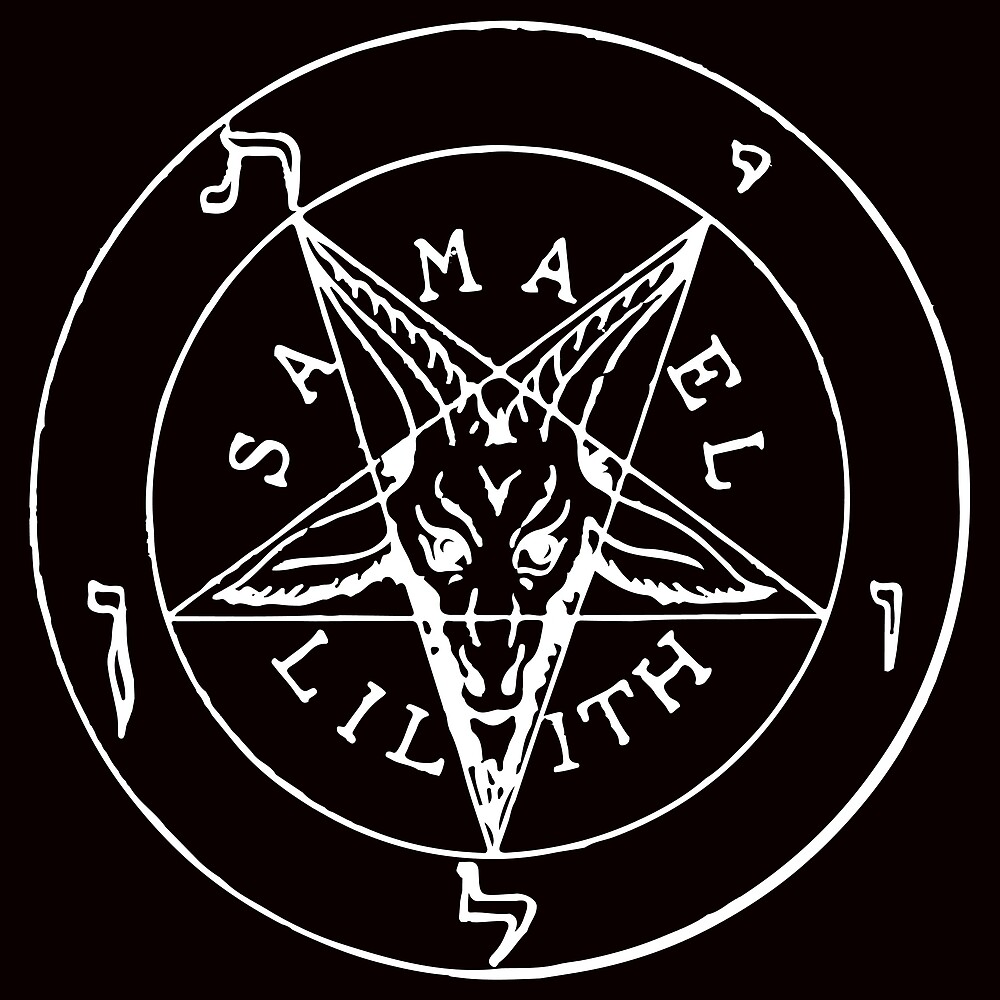
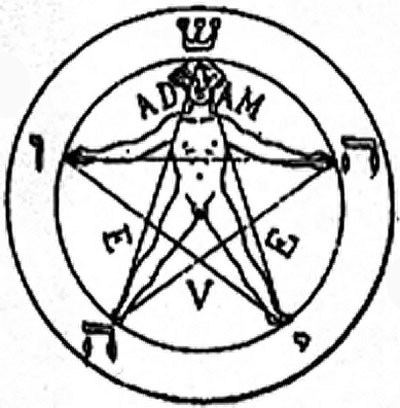
A lot as been written about the difference in symbolism between the upright and the inverted pentagram. I’m not going to go into it here, but if you take a look at these two classic diagrams, you’ll start to get the idea:

Facing east, we trace an inverted pentagram and vibrate “Helel!” Helel means “shining one.” It is taken from “Helel Ben Sahar,” a phrase appearing in Isaiah 14:12, which means “shining one, son of the dawn” and which was subsequently translated as “Lucifer, son of the morning.” It’s an epithet for Lucifer as the Morningstar appearing in the East.

Facing North, we trace our inverted pentagram and vibrate “Samael!” Samael is a Hebrew and Kabbalistic name for Satan. It means “blind god” or “venom of god.” In this lore, he is said to come from the North.

Facing West, we make our inverted pentagram and vibrate “Mastema!” Mastema is an epithet for Satan from the Book of Jubilees. It means “hostility.” In this version of the story, Satan falls into the sea. West is generally associated with water and the ocean.

Facing south, we make our inverted pentagram and vibrate “Azazel!” Azazel is the scapegoat who is sent out into the wilderness. I associate him with the desert, and thus with fire and the direction of the South.

3. Calling on the Consorts

The classic right-hand path version of this ritual involves calling on the four archangels. I most emphatically say “fuck those guys.” But I have four good friends too, and they are the four consorts of Lucifer. So I decided to call on them.

Assigning the consorts to directions and elements is… not an exact science. There is not a one-to-one correspondence between the consorts of Satan and the four classical elements. I could have positioned them differently in this ritual, using different logic. But I’ll explain why I did what I did.

Agrat bat Mahlat goes before me, towards the East, because she is the youngest of the consorts and thus best represents the way forward, the future, and the dawn. As the “rooftop dancer,” she also is strongly associated with air (as are many of the others as well, but never-mind).

Na’amah goes behind me and to the West because she is associated with the story of the flood, and thus with water. Also, I trust her to have my back (but that goes for all of them, so, meh).

Eisheth Zenunium goes North and to my left as the consort of Samael known as “The Northern One” and the source of the Left Emanation. North also corresponds to Earth, Eisheth Zenunim is a death goddess among other things, we get buried in the Earth when we die. (She’s honestly more associated with fire than any other element, though. Whoops.)

Lilith the younger goes South and to my right because I associate her with deserts and their fiery winds, and thus the South. (She could easily go with any of the other directions and elements, but, alas, I had to make a choice).

4. Final notes

We then visualize a flaming pentagram on the floor that we are standing in the middle of. The two upper points of the star, pointing forward on either side of our feet, give it the feel of a cockpit somehow. This symbolizes the downward direction and protects you from below. It also gives you the feeling of having drawn a visible circle on the floor, which makes circle casting feel stronger in my opinion.

“In the column shines the Morningstar” is, once again, a call to both Lucifer and to one’s Higher Self simultaneously to invest you with magical power as magician and living God. Repeating the Klipotic cross reinforces this. It also protects you from above and within.

Finally, “BE IT SO!” is what Milton has Satan say when he arrives in Hell, and I like to use it to end my rituals. The loud clap combines sound banishing with the visualization of exploding darklight. Like lightning and thunder, right?

I hope this explanation is helpful and makes sense.

Invocation of the Four Consorts

MATERIALS:

  • Four tarot cards to represent the queens
  • Consort incense ash (i.e. ash from incense burned in honor of the consorts)
  • Bells (Air/Fire)
  • Roses (Earth/Air)
  • Rose Water (Earth/Water)
  • Annointed candle (Fire/Water)
  • Pretty makeup brush for chrisms (optional)

The tarot cards are placed towards the four directions, along with the ritual elements: Items for Agrat and Air/Fire (bells and Queen of Cups) to the Southeast, for Lilith and Fire/Water (Candle and Queen of Wands) to the Southwest, for Naamah and Water/Earth to the Northwest (Queen of Pentacles and Rose Water), for Eisheth Zenunim and Earth/Air to the Northeast (Roses). Incense ash sits in the center. 

The celebrant begins facing Southeast. 

CELEBRANT: Hail to Agrat Bat Mahlat! Child of hope, creator and destroyer of illusions, conveyor and healer of disease! Reveal the truth to us, and send confusion to our enemies!

ALL: Renich viasa Agrat tasa lirach!

Celebrant rings the bell and then turns clockwise to the Southwest. 

CELEBRANT: Hail to Lilith, first of women, first human to rebel! Hail to thee who art two in one, male and female, adopter of stillbirths, avenger of the abused! Guard our bodies from those who would destroy them! Guard our freedom from those who would steal it away! Protect all women, and all gender outcasts and outlaws everywhere!

ALL: Renich viasa avage Lillith lirach!

Celebrant lights the candle, and then turns Northwest. 

CELEBRANT: Hail to Naamah, whose beauty makes angels fall! Hail Naamah, thief of knowledge, Queen of divination, mistress of seduction, and revolutionary whore! Grant us the insight to see what we need, and the ingenuity to obtain it! Grant us your clever artifice that we may gain wealth, wisdom and liberty!

ALL: Alora vefa an ca Naamah!

Celebrant sprinkles water around from his fingertips, then turns Northeast. 

CELEBRANT: Hail to Eisheth Zenunim, Mystery Babalon, mother of abominations, mother of death and mother of us all! Hail to thee Lady Satan, fallen angel of Liberty! May your poisoned sword cut down the tyrants! May your kisses, sweet as roses, comfort the bereaved! Let us return to you with joy, but not before our hour!

ALL: Lirach tasa Eisheth ayer!

The celebrant deeply inhales the scent of the rose. 

The celebrant turns to face the congregation and may then slip into a state of possession by one or all of these deities. The channel may now beckon the congregants forward, one by one, to receive benediction in the form of an inverted cross drawn in incense ash on their brow using the makeup brush. Congregants may request benediction from one of the four specifically. 

When all have received benediction, all join hands and pronounce:

ALL: Be it so, nema!