
Lord, what fools these mortals be!
– Puck, from Wm. Shakespeare’s A Midsummer Night’s Dream, Act III, Scene 2, line 117.
[Shit] on one end, jokes the other,” said Bluebell. “I used to roll a joke along the ground and we both followed it. That was how we kept going.”
-Bluebell the rabbit, from Richard Adams’ Watership Down, Chapter 21 “For El-ahrairah to Cry”
“And Frith called after him, ‘El-ahrairah, your people cannot rule the world, for I will not have it so. All the world will be your enemy, Prince with a Thousand Enemies, and whenever they catch you, they will kill you. But first they must catch you, digger, listener, runner, prince with the swift warning. Be cunning and full of tricks and your people shall never be destroyed.’”
-Dandelion the rabbit, from Richard Adams’ Watership Down, Chapter 6 “The Story of the Blessing of El-ahrairah”
In Norse mythology, there is a tale of the jotun turned goddess Skadi and her vengeance against the gods in Asgard. The gods were responsible for killing her father, Thiazi, and in recompense, the gods agreed to let her marry one of them. Judging by the beauty of their feet, she ended up picking Njord, god of the sea, as her husband. She set another task before the gods as part of her appeasement: they had to make her laugh, something she thought was impossible. Some stories say the gods tried many things, but none of them worked until Loki, god of mischief (and one of the reasons Skadi’s father died) tied their testicles to a goat’s beard and left themselves thus until Loki’s cries of pain and the bleats of the goat made Skadi finally laugh.
Jesters were employed by royal families or even just wealthy nobles to entertain and mock and sing songs. There was a certain immunity to consequences that jesters enjoyed called “jester’s privilege,” wherein a jester could mock and speak freely without any punitive actions taken against them. Aztec, Chinese, Spanish, Japanese, Roman, German, English, Welsh, Polish, and many other cultures throughout history employed the services of jesters (or their equivalent). At times, jesters were used in battle to convey messages or rally troops; and in Japan, taikomochi (a sort of male geisha) were even required to fight in battle alongside their daimyōs in the 16th century.
“Okay cool, fun facts, great stuff Terry, but what the fuck does that have to do with literally anything about mass today?”
Glad you asked, because here we go.
There is a particular sacredness in the profaning of that which we hold in high esteem. A jester’s belled cap and little staff were quite literally a parody of the royal crown and scepter. A joke is an equalizer, a way to dropkick the mighty off their high horses and say, “You are no better than me, and any pretense which states otherwise is patently false.” The Aesop fable of the emperor’s new clothes comes to mind, how only a child could tell that the emperor was naked, and everyone else just pretended that the kingdom hadn’t been swindled all to fuck.
The incredible thing about trickery is that it has always been a double-edged sword. The reason Skadi swore vengeance on the gods and the reason they were required to appease her was that the gods had murdered her father, Thiazi. But why had the gods done that? Because Thiazi had tricked Loki into letting the goddess Idunn be kidnapped and taken away by Thiazi. The goddess Idunn grew the golden apples that kept the gods young. Deprived of their eternal youth, the gods demanded that Loki bring Idunn back, which he did, transforming her into a nut and flying back as a falcon due to a shape-changing feather cloak. Thiazi chased after them in the form of an eagle, but the gods lit a fire under Thiazi’s tailfeathers until Thiazi fell to the ground, where he was surrounded and killed.
…that was a lot, huh.
“Cool story bro, what is the point of it?” I am getting there, I promise.
The pieces of this little thing that I have been wanting to write for a good long while have been floating around in my head, never quite gathering together enough to form a complete set of puzzle pieces, much less puzzle pieces that would connect into anything that makes sense. But let me try to form them into a cohesive whole all the same.
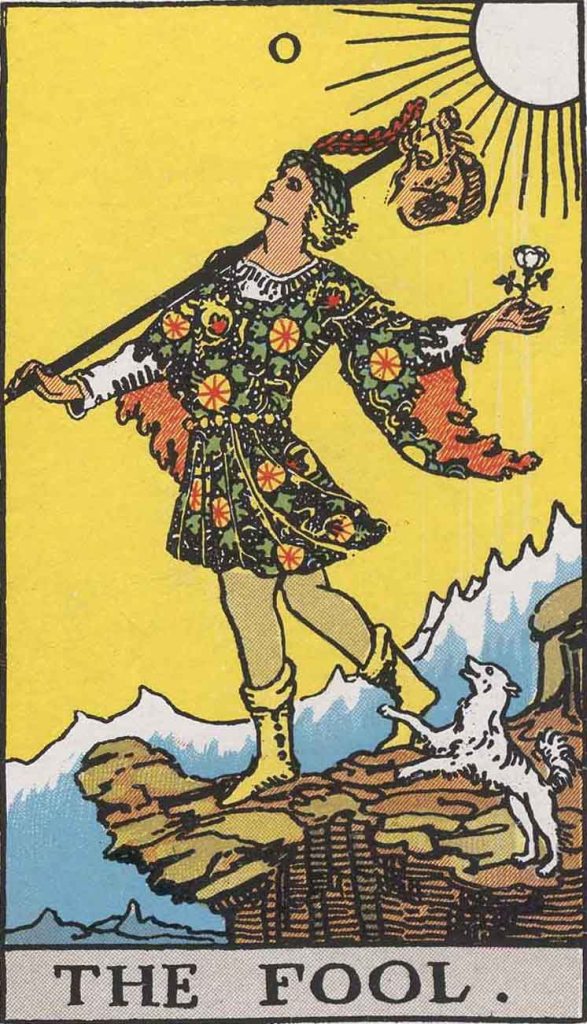
The Fool as a tarot card emphasizes a purity of spirit, a naivete that in my opinion can only come from beginning a journey with perhaps not enough preparation. Or perhaps an understanding that no preparation will fully encompass every obstacle in the journey to come, so why overburden yourself? Pack light, pack essentials, and go forth willing and able to accept the lessons of the cards to come. It seems decidedly unwise, until you look at it long enough. Likewise, having someone who can openly and freely mock the most powerful people in the land seems absolutely mental, seems absurd, until you realize how important that ability is, and how powerful a weapon a jest can be if wielded correctly. Richard Spencer being punched in the face mid-interview has become a meme, and the man himself has become a moot point. How many times has a Weird Al parody become more prominent than the original song it is mocking? I know every word of “The Saga Begins.” I know very few of the words to “American Pie.” Admittedly, I am a Star Wars fan, but the point remains: mockery holds power, and tricks hold the ability to create and destroy simultaneously.
So. How do we handle this power? How do we tap into both of these things, knowing that they can be used to create chaos and destroy systems, as well as create unnecessary pain and heartbreak? Comedians have been utilizing jokes to punch down on queer folks, folks of color, disabled folks, and so many other marginalized groups for a very long time. They still do, frequently and often, and often badly (seriously Ricky Gervais? You haven’t been funny for years now, learn how to tell a joke instead of fucking being one). Currently indicted by a New York grand jury for his crimes, Donald Trump famously mocked a disabled reporter. And yet from parodies often comes such incredible art and sensitivity and kindness as to be baffling. Young Frankenstein springs to mind immediately, not only for its sympathetic portrayal of the monster, but also for its hilarity and poignantly pointed poking fun at horror movie tropes in Hollywood. Space Balls, Monty Python and the Holy Grail, and Galaxy Quest are beloved films for a reason. And dare I say that The Velocipastor is also of the same breed as the aforementioned films, since it loves its source materials to the point of relentless, perfect mockery. If any of you have siblings, you will know what I mean when I say that I am the only one allowed to make fun of my brothers and sister, and I am also the only one allowed to die defending them from harm. It is a similar love that drives the best parodies into perfection. If Weird Al did not love music, he would not have created “My Bologna” or “Amish Paradise” or “White & Nerdy” or “Pretty Fly for a Rabbi.”
In short, the only way to handle the power that mockery gives, the only way to harness the destructive creativity that the best tricks can pull off? Is love. And that sounds cheesy as all get out, and I know it. But if I didn’t care about Star Wars, I wouldn’t have anything actually funny to say about that pointy-eared green fuck (know what you did, you do, Master Yoda). If I didn’t care about Lord of the Rings, I would not goof about never accepting a mushroom dish from a Sackville-Baggins. If I didn’t care about my little sister, I wouldn’t call her a tiny nerd who looks like she could be blown away by a weak fart. Loki, for all their flaws and eccentricities, cares deeply about his children and the world, and even the gods, antagonistic though they may be. El-ahrairah, jokester and thief who flouts the will of the gods and lives to tell the tale, would not have gone to see the Black Rabbit of Inlé and suffered the loss of his ears, whiskers, and tail if he did not care deeply about alleviating his people’s suffering from a plague. The entire plot of Singin’ in the Rain would not have happened if Don Lockwood did not care deeply about his films and about music and about how Lina Lamont got Kathy Selden fired. The entire TV show Leverage would not have happened if, on some level, these con artists, hackers, hitters, and thieves didn’t already care or come to care about themselves and other people.
You have to care about things. Trans people are the only people who can actually tell good jokes about gender, because we actively care about it! And if you don’t care, your jokes will fall flat, your humor will turn sour and painful, and the only tricks you will be able to pull off will be harmful to yourselves and to each other. So on this, the day we celebrate tricksters and fools and jokes and shenanigans, remember why we make ‘em laugh. Remember why we pull off heists. Because we care. And what is more Satanic than giving a damn? Thank you.
 Church of the Morningstar