Arjuna’s Arrows

The Bhagavad Gita is the most famous segment of the Hindu epic the Mahabharata. It is a dialogue between Arjuna, a warrior prince and a great archer, and Krishna, an incarnation of Vishnu in disguise as Arjuna’s chariot driver. 

The conversation takes place before a climactic battle. The entire epic story of the Mahabharata concerns the conflict between the Pandavas– Arjuna and his brothers– and other members of their extended family. At the beginning of the Bhagavad Gita, the lines of battle have been drawn up. Arjuna and his brothers are about to go into war against their own relatives. Arjuna, contemplating this, is filled with guilt and pity. He throws down his bow and refuses to fight. 

Krishna reveals his divinity to Arjuna, and enlightens Arjuna through his explanations of the workings of the universe, and most specifically by revealing Karma Yoga, or the yoga of action. Krishna explains that renouncing worldly activity and becoming an ascetic hermit is not the only way to attain moksha, which means spiritual liberation. Liberation can be achieved while remaining engaged in worldly affairs, through the practice of non-attachment. 

Non-attachment is the recognition of the impermanence of all things, and the release of one’s desire for things to be unchanging. Most importantly, in the case of Karma yoga, it is the ability to release the results of one’s actions. Krishna says:

“But when a man has found delight and satisfaction and peace in the Atman (the divine Self), then he is no longer obliged to perform any kind of action. He has nothing to gain in this world by action, and nothing to lose by refraining from action. He is independent of everybody and everything. Do your duty, always; but without attachment. That is how a man reaches the ultimate Truth; by working without anxiety about results.”

Bhagavad Gita translated by Swami Prabhavananda and Christopher Isherwood, pgs. 46-47

I used to have big problems with the Bhagavad Gita. Back when I was a baby pacifist, I thought Arjuna should have stuck to his guns and refused to fight his family, no matter what Krishna told him. I also have previously resisted the concept of non-attachment. I wanted a passionate engagement in life. I wanted to love and hate and feel, to fully experience each and every moment. 

But a funny thing happened to me recently. It coincided with my reading of the Bhagavad Gita, as well as my increasingly serious Yoga practice, several workings of ritual magic, and some drastic improvements in my mental health. I cannot attribute this change to any one factor. But no matter what brought it on– I achieved non-attachment. 

It wasn’t at all what I expected. 

“Non-attachment is not detachment,” my yoga teacher Ros told me. It turns out she is right. 

Non-attachment is not dissociation. It is not dispassion. It is not a lack of caring or the absence of love. It is not an emotionless state. And, as Krishna explained to Arjuna, it is not inaction or passivity. What it is, as best as I can explain, is… a quiet strength. An assurance. An acceptance of the changing nature of things. Seeing through illusions, neurosis, and the lies my mentally ill brain tells me. 

Aleister Crowley channeled these words in The Book of the Law: “For pure will, unassuaged of purpose, delivered from the lust of result, is all ways perfect.” I’ve always liked that line, but now I think I really understand it. It echoes the Gita– probably not coincidentally, Crowley definitely read it in some translation. 

“You can only do what you can, and leave the rest in God’s hands,” my twelve-step sponsors have always told me. “You can only control your own actions. Not the outcome. Certainly not other people’s reactions.” 

Will is closely related to action. It is the power, the desire, behind action. So how can you have a powerful will that motivates you to act, and yet not be attached to the outcome? In trying to answer this question, I finally understood why Arjuna is an archer. The archer takes careful aim. He draws the bowstring back with all his might. The drawing back of the bowstring and the aiming of the bow is will. The release is action. But once action is taken, once he lets the arrow fly, the results are literally out of his hands. He may hit his target. Or the enemy may dodge out of the way. Or an innocent bystander may wander into his arrow’s path. Or a powerful gust of wind may come up and blow it off course. 

All actions are like this. We can aim at our goals, we can focus on them with all our hearts and souls. We can plot a trajectory with skill and wisdom. But once action is taken, once the arrow flies, the results are no longer up to us. And all the anxiety in the world will not change that. 

Non-attachment, then, is letting the arrow fly. It’s letting our dreams and aspirations take off and then fall where they may. It is a whole-hearted acceptance that we can only do so much, that outcomes are not in our control. 

While the fact that Arjuna is an archer is very profound, I think it’s also fascinating that Krishna is a charioteer. The tarot card The Chariot represents the effective harnessing of will and drive, and yet it portrays a charioteer who drives without reins. The lack of reins, symbolizing the non-attachment of the driver, is paradoxically what gives his will its momentum, its effectiveness, its power. 

Non-attachment is a surrender that makes you more powerful. Ultimately, what non-attachment gives you is the freedom to truly make choices. How? Let me try to explain.

Lucifer as the serpent of Eden gives us the fruit that makes us ‘as gods, knowing good and evil.’ He introduces us to the full, truthful experience of the universe– right and wrong, pleasure and pain, life and death. The illusion that everything is safe and orderly and under God’s control is shattered. When we eat the fruit of knowledge, we accept reality, and in doing so, become freed from illusions, and therefore free to choose. 

Good and evil. We will know it all. We will experience it all. And we will commit both good and evil in our lives. All of this is part of what the Serpent is telling us. And he is telling us that when we know both good and evil, we may choose between them freely, with open eyes. 

My experience of non-attachment has manifested as a new freedom from the scripts written by my traumas and mental illnesses. I have realized that I actually don’t have to do anything unless I choose to. Sometimes the choice is very obvious– yes, I will work to earn money because, as much as capitalism sucks, I want to stay alive. There are constraints on our choices, but I have realized there are fewer constraints than I thought. I don’t have to exhaust myself in people-pleasing. I don’t have to try to control and micro-manage others. I can just make decisions about my own actions based on what truly matters to me, and if people are disappointed or upset, that may not actually be my problem. 

I am not advocating flagrantly being an asshole, or not considering how my actions affect others. I am talking about decisions made freely, without a false sense of pressure. Without guilt, anxiety, and neurosis running the show. Acting not from obligation or a sense of convention, but based purely on what I deeply feel is right and important. 

When I first achieved non-attachment I realized that I had not truly chosen to do all the worst things I have ever done. When I look back at my life, I realize that the times when I have hurt others worse have almost all been in moments of flailing in fear, in rage. Moments of replaying past traumas and projecting them onto innocent people. That’s not an excuse. It’s not an abdication of responsibility. Quite the opposite. I realized, with a shock, that I would actually feel better and cleaner about those harms I had committed if I had at least chosen them. “I didn’t mean to” no longer feels like an excuse. “I didn’t mean to” scares me much more than meaning to!  After all, if you didn’t mean to do harm, it’s much harder to figure out how to stop! 

I wasn’t making true choices. I would frankly rather choose evil than commit it unconsciously, because at least that would mean I was free to choose good.

Non-attachment gives me back that choice. 

Non-attachment and compassion are often mentioned in the same breath, especially within Buddhism. They are not contradictory. In fact, a certain degree of non-attachment actually facilitates empathy, because it frees us from anxiety about what other people will think of us, and lets us focus on them without ego-driven self-interest about how we come across. 

I feel like in order to explain this fully, I will have to give an example. 

Let’s say your friend and chariot-driver Krishna invited you, Arjuna, to come hang out. But you, Arjuna, have a bad cold. You feel too guilty to cancel and are worried that Krishna will think you are a flake, so you go hang out anyway. In fact, Krishna cares about you and would much rather you take care of yourself. His divinity prevents him from catching your cold in spite of his incarnate state, but he doesn’t enjoy watching you cough and sneeze and snot everywhere. In your efforts to people-please and self-deny, you have successfully lost sight of what your friend would actually prefer. Instead of being truly considerate of him, you are preoccupied by trying to control what he thinks of you and how he feels about you, which, of course, are out of your hands. 

With non-attachment, you would be able to simply cancel on Krishna because that is clearly the sensible thing to do, and let what he feels about it be his problem. 

Another example: you have an important presentation to give tomorrow. You have prepared for it to the best of your ability. It is now bedtime. You try to sleep but you cannot because you are so anxious about the presentation. Of course your anxiety does nothing to improve the outcome. In fact, it keeps you awake all night. Your presentation goes extremely poorly because, even though you were prepared, you did not sleep. 

Non-attachment is the ability to prepare, say to yourself “I have done all I can” and then just forget about it until tomorrow, because you realize that worrying about things is useless and does not positively influence reality. Yet we all do this all the time! We often feel guilty if we don’t worry and agonize! It’s almost as if we truly believe that our anxiety will protect us and help things work out for the best. 

As should be clear from this example, sometimes non-attachment cannot be achieved through meditation and spiritual work alone. Sometimes appropriate psychiatric medication is also required. 

Non-attachment is fundamentally a recognition of what one does and does not control. The AA serenity prayer goes “God, grant me the serenity to accept the things I cannot change, the courage to change the things I can, and the wisdom to know the difference.” We cannot control other people. We cannot control time and aging and death and bad luck. We can only control our own actions, and sometimes not even that. When we are caught up in loops of trauma and anxiety and obligation– in short, in negative attachment– we are driven by those loops, not truly able to make our own choices. We react. We do not act. Non-attachment in Karma yoga is a pure focus on what we do control. The drawing back of the bowstring. The aiming of the arrow. The moment of release. 

Non-attachment is sometimes explained as releasing impermanent things. It is poorly understood as refusing to love people who will age and die, refusing to invest in a life that will end. Krishna tells Arjuna to be indifferent to both pleasure and pain, but non-attachment does not feel like indifference to me. It is the embrace of impermanence. It is the love of change and chaos. Pain is accepted as the price of pleasure. Pain is revered as part of movement, growth, entropy, change, and all the other things that make existence precious and life worth living. 

Nietzsche has a concept called eternal recurrence. It started as a thought experiment, articulated in section 341 of his (hilariously named) book The Gay Science

“What if some day or night a demon were to steal after you into your loneliest loneliness, and say to you, “This life as you now live it and have lived it, you will have to live once more and innumerable times more; and there will be nothing new in it, but every pain and every joy and every thought and sigh and everything unutterably small or great in your life will have to return to you, all in the same succession and sequence” … Would you not throw yourself down and gnash your teeth and curse the demon who spoke thus? Or have you once experienced a tremendous moment when you would have answered him: “You are a god and never have I heard anything more divine.”

Nietzsche’s challenge is to embrace the good in one’s life so fully, so passionately, that you would also embrace the bad just to experience the good again. This might seem like the opposite of non-attachment– it might appear to be radical attachment– but it works out to the same thing, which is complete acceptance of existence as it is. This acceptance is not passive. It’s not an excuse to abandon the struggle, or to stop trying to make the world a better place. No, it’s about taking both our successes and our failures, our agonies and our ecstasies, as they come. Loving life so completely that we even come to terms with the bad in it. 

I cannot claim to have remained in a perfect state of non-attachment since having this revelation. It has, however, become a baseline for me. A safe home to return to. When I find myself growing agitated or feel my thoughts spinning out of control, I take a deep breath and ask myself a few questions:

Am I trying to control outcomes or other people?

Am I clinging to something I need to release?

Am I doing this thing right now because I truly choose to do so, or am I running on autopilot, letting myself be controlled by anxiety, obligation, and fear of what others will think of me?

Am I doing what I think is right, or only what will cause other people to think I am a good person?

Is this my true will?

Is my authentic self making a choice, or is trauma taking the reins?

Can I release the result of this action?

Can I accept this painful moment as part of a life that has also included great joy?

Like most spiritual revelations, this cannot be transmitted merely by talking about it. I’d heard about non-attachment for years before it clicked for me. And when it came to me it was as my own version of it, one deeply influenced by questions of will and choice and passion and intensity of experience, all things that are important to me. It’s not something that can be explained, it has to be felt. 

I do not preach non-attachment. I am not sure it is something that everyone needs. I don’t really believe in universal spiritual principles. But I do pray for you all, on this day, that you find some version of the clarity and freedom that Arjuna and his arrows have given me. 

Gender Apocalypse Now!

Final paper for my special reading course on Aleister Crowley. Enjoy!

GENDER APOCALYPSE NOW! TRANSCENDENTALISM, TRANSHUMANISM, & TRANSGENDERISM IN THE AEON OF HORUS

In 1964, artist/occultist Marjorie Cameron and filmmaker/occultist Kenneth Anger were cohabitating in Los Angeles, California. Marjorie Cameron was a bisexual female; Kenneth Anger was a gay male. The pair decided to embark on a new magical and artistic project: becoming each other. Cameron started taking testosterone, Kenneth got on estrogen, and despite their seemingly incompatible genders and sexualities, they began a sexual relationship. The experiment was short-lived and soon abandoned. Kenneth left for New York, leaving Cameron to mourn by wearing his leather pants, as if still trying to meld with him.[1]

Decades later, another pair of strange soulmates, musician/magician Genesis P. Orridge and dominatrix Lady Jaye, would attempt and complete the same project, using hormones and surgeries to become as nearly identical as possible. This endeavor was inspired by both their transcendent love for one another—their desire to become one being—and by their shared vision of new kinds of gender. “Some people feel they’re a woman trapped in a man’s body,” Genesis said. “We just feel trapped in a body. What we’re talking about is an idealized future where male and female become irrelevant.”[2]

What these two couples had in common was a post-Crowleyan approach to gender, sexuality, art, and occultism that has at its heart the veneration of the divine androgyne as the harbinger and archetype of a radical new era.

This paper will explore the signs of Crowley’s androgynous and cataclysmic Aeon of Horus. I write this more as an organic intellectual than as a traditional scholar, although the mask of the academic is one that I often wear well. This paper needs to be more personal and authentic. Here is a meditation on gender, transcendence, love, and apocalypse as manifest in occultism, science fiction, rock n’ roll, and society.

It is also a litany to my magickal ancestors and the gender outlaws whose lives and adventures inform mine. In Thelemic terms, one might call these saints, who poured out their life’s blood into the cup of Babalon, from which I drink to become myself.

This is the chronicle of the transhumanist and gender-transcending magickal current that Aleister Crowley unleashed on the earth. What started as a whisper, heard by only a few, has multiplied by its echoes to turn into a deafening roar.

Continue reading

Beelzebub Gnosis Confirmed

Have you ever seen the acronyms UPG, SPG, or VPG? They stand for “unverified personal gnosis,” “shared personal gnosis,” or “verified personal gnosis.” They are popular in the pagan/magic community.

My circle has long had an SPG that summoning Beelzebub tends to cause an insect infestation and thus is best done outdoors. One of my friends warned me about this after experiencing a massive swarm of flies in his house after I working. I tried to follow his advice but still ended up with a huge ant invasion on the day I planned to enter Harab Zereq, Beelzebub’s Klipa. Other friends and acquaintances of mine have also experienced lots of bugs turning up with Beelzebub.

But today I learned that somebody else had the same experience.

Who?

ALEISTER FUCKING CROWLEY.

From his autohagiography:

We had resumed Magical work, in a desultory way, on finding that Mathers was attacking us. He succeeded in killing most of the dogs. (At this time I kept a pack of bloodhounds and went man-hunting over the moors.) The servants too were constantly being made ill, one in one way, and one in another. We therefore employed the appropriate talismans from The Book of the Sacred Magic of Abra-Melin against him, evoking Beelzebub and his forty-nine servitors…. As to this perfume of The Book of the Law, “let it be laid before me, and kept thick with perfumes of your orison: it shall become full of beetles as it were and creeping things sacred unto me.” One day, to my amazement, having gone into the bathroom to bathe, I discovered a beetle. As I have said, I take no interest in natural history and know nothing of it. But this beetle attracted my attention at once. I had never seen anything like it before. It was about an inch and a half long and had a single horn nearly as long as itself. The horn ended in a small sphere suggestive of an eye. From the moment, for about a fortnight, there was an absolute plague of these beetles. They were not merely in the house, they were on the rocks, in the gardens, by the sacred spring, everywhere! But I never saw one outside the estate. I sent a specimen to London by the experts were unable to identify the species.”

I think we can call that SPG verified now.

I had never read this passage before today. It was crazy to see.

The Current of the Morningstar

This is a paper I wrote in response to some Temple of Set Materials, including “Black Magic,” “The Diabolicon,” and “The Book of Coming Forth by Night,” all by Michael Aquino.

It was a good opportunity for me to define my Satanic philosophy in contrast to some other forms of Satanism.

And yes, it is long.

Enjoy.


The Current of the Morningstar

In co-founding Church of the Morningstar, I had no desire to reinvent the wheel. I was aware that various Satanisms were already extant. Upon investigating as many of them as I could find, I concluded that none satisfied me. No existing Satanic organization adequately reflected the radical leftist current that was spreading among unaffiliated Luciferians and Satanists; a current of which I was part, and which I believed (and still believe) to be the genuine current of the Devil’s party. I created Church of the Morningstar to be a haven for those to whom left-hand meant left-wing and Lucifer meant liberty for all, not a few. This current is not new. It flowed through the so-called Romantic Satanists (Blake, Byron, Shelley et al) [1] and early anarchists like Proudhon and Bakunin,[2] through the decadents,[3] and from thence through Crowley. This liberatory Luciferian current became corrupted by LaVey, who lacked both the passion and inclination to understand it. Aquino’s interpretation was more intelligent and benefitted from a turn back towards Crowley, but still fell short. We at Morningstar do owe Aquino a debt for continuing the left-handed development of Thelema—and for making a reality of theistic Satanism. Unfortunately, the Setian strain remains steeped in neoliberal ideology which guarantees that it shall never blaze with true revolutionary hellfire. It has nevertheless proven useful for me to engage dialectically with Aquino’s ideas in order to refine my own.


Continue reading

Aiwass Gnosis

Last night was my first time acting as deacon in a Thelemic Gnostic mass.

It was a wonderful experience: the priest and priestess I got to work with are a couple of my favorite people, and, even better, are each other’s favorite people. Their love really adds a lot to their masses.

I wasn’t sure what it would be like, going in, but I was confident. I’d studied the ritual quite extensively and I got a good run through in beforehand. I did quite well I think, didn’t miss a cue the whole time.

But with all this worry about the lines and the gestures and “when do I walk where,” I didn’t have much time to think about what the spiritual dimension might feel like. I was taken a bit off guard.

I’m a Luciferian/Satanist first, a Thelemite second. I hadn’t given a lot of thought to Aiwass, other than to conclude (based on Crowley’s own words) that he is indeed Lucifer. But I know that there are different aspects of Lucifer with different names: Samael the Black feels very different than Helel, for instance. I should’ve known that Aiwass would also feel different.

But then again, how was I supposed to know I would end up channeling him the whole time?!

Pretty much as soon as I started my work, I felt myself becoming like a stone angel on a cathedral wall— upright, watchful, compassionate, stern, yet filled with a calm, quiet delight. It was my task to minister. I was suddenly filled with the knowledge of what that meant, with the dignity and purpose of my office. It was mine… to serve.

To serve? Was this really Lucifer, the proud rebel who spits “non serviam?” Yes, it was! I knew it was. In fact I could still feel his subversive agenda coursing through my veins, my heart thrumming with his revolutionary purpose.

After all, this was no Christian mass, no devotion to the Demiurge! It is not inaccurate to call a Thelemic mass “black” or “Satanic,” at least not in my opinion. After all, the Gnostic Mass has its influences from La-Bas, as surely as a naked priestess sits upon the altar! More importantly, it is a mass that aims to elevate humans to godhood— and that is what I understand as the agenda of Lucifer.

“Thou shalt be as gods, knowing good and evil.” The serpent did not lie.

And suddenly I understood. Lucifer is sometimes confusingly described as a servant of and friend to God. Aiwass is a name for such a manifestation: Melek Taus, the Peacock angel, beloved of divinity. But there is no god but man!

Doors of gnosis unlocked before me. Lucifer/Aiwass does indeed serve and adore God— not the Demiurge, not the God of Christ, but the godhood of every human individual! Turning away from the false God Jehovah, he became a devotee of the godhood of Eve and all of her children!

Lucifer is also indeed the enemy of humanity— not of what is best in us, but what is worse. He is the destroyer of our ignorance, our mediocrity, our delusions. He worships what is divine in us, curses that which is unworthy of our own sacred natures.

Minister of Hoor-paar-kraat indeed!

No wonder his agenda in that room was so crystal clear. No wonder he did not mind bowing or kneeling in adoration. No wonder it was such delight to pour the communion wine!

And as each communicant declared, “there is no part of me that is not of the Gods!” I swelled with pride and love. Or perhaps, more accurately— he did.

I want to learn the priest role eventually but honestly I feel as if I have found my niche for now. I want to explore this Aiwass gnosis more.

My Commentary on Liber OZ

Liber OZ is my favorite work by Aleister Crowley. It is a “book” which is actually only a single page.

A lot has been written about OZ, and you can find some good links on it here, here, here and here. Since all of Crowley’s works are dense, esoteric and self-referential– even this deceptively monosyllabic and straightforward pamphlet!– I won’t pretend to have successfully unpacked what the self-styled Great Beast intended by it.

Instead, this is my personal commentary on Liber OZ and how I use it in my life and practice– also how I personally deal with some of its more unlovely aspects.

Liber LXXVII

OZ
“the law of
the strong:
this is our law
and the joy
of the world.”
         —AL. II. 21.
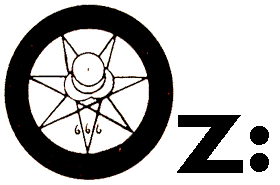
Right off the bat we have a shit-ton to unpack. The symbol inside the O of Oz is Crowley’s Mark of the Beast sigil combined with a downward pointing septagram. Interesting to combine the numerals 666 with a star of 7 points, 7 being a number associated with the Christian God. I’m sure there’s some deep Kabbalistic meaning in that that I’m missing.

“Oz” has multiple meanings. One of them is “might” or “strength.” Another is “refuge.” Another is “she-goat.” Hail.

This is said to be “the law of the strong.” Is that some Nietzschean Ubermensch bullshit I smell? (It smells like Axe body spray, for the record.) Probably, yeah, but once you read the rest of the document it makes sense outside of that context as well.

This is a set of principles for self-governing, self-willed individuals. A blueprint for spiritual and literal anarchism. Making your own decisions and living by your own Will does take a certain type of strength… not necessarily brute, stereotypically masculine strength, although that can come in handy. More like the type of Strength shown on the Rider-Waite Smith tarot card, in which a woman calms a lion. 93 is the numerological equivalent of the words “Thelema” and “Agape,” Will and Love in Greek. What more perfect image of Love and Will, and Love Under Will, could there be than the Lady and the Lion?

You’ll need a type of strength that is resilient and compassionate to live by this law… a strength that weathers storms. Remember that Crowley’s magical name was “Perdurabo”– I endure. Not conquer, not dominate. Endure.

“Do what thou wilt shall be the whole of the Law.”

AL. I. 40.

 OK, so let’s get this out of the way– “do what thou wilt” does not mean “do what you want.” There’s this idea of the True Will, one’s own deepest purpose. Thelema means finding and pursuing that Will with singular, passionate focus.

(A.L. stands for Liber AL vel Legis, The Book of the Law, for those who are wondering what those little citations are.)

“thou hast no right but to do thy will. Do that, and no
other shall say nay.” —AL. I. 42–3.

OK, so in the context of “Will” not meaning “want,” this makes a lot more sense. “You have no right but to do whatever you want” is a paradoxical and content-free statement. “You have no right but to fulfill your singular purpose, and from this right all your other rights derive” is something we can work with.

“Every man and every woman is a star.” —AL. I. 3.

Yeah, yeah, gender binary, BUT… what Crowley is saying here is that every single human is a unique and sacred entity with their own Will, which they have the absolute right to carry out. (Crowley’s relationship to gender wasn’t really binary anyway, as we’ll see later.)

So, ya know. Doing your Will is great and all, but everyone else has a right to do theirs, too. You’re not better than anyone else, and you don’t get to step on other people’s Wills.

There is no god but man.

Honestly I have no idea. Crowley’s theism versus his atheism is a tangled question that I do not have the time for right now. He seems to have gone back and forth on it.

But, for our purposes, I think it’s safe to assume that at least part of what Crowley is trying to say is this: there is no God more important than human Will that should be obeyed in its place.

OK! Here comes the good stuff.

A final note before I unpack the below– Crowley can be interpreted as very left-wing, or very right-wing. As far as I can tell, this is largely in the eye of the interpreter’s own politics. I’m a big lefty, so I’m gonna take Crowley to a straight-up Marxist-Anarchist place. Die mad about it.

1.

Man has the right to live by his own law—
to live in the way that he wills to do:

Anarchism! Couldn’t be stated more simply than that.

to work as he will:

People should be able to do the work that they love, that fulfills their purpose, as opposed to being obliged to labor for survival.

to play as he will:

Human adults have a right to play and enjoyment, rather than the dour drudgery required by capitalism.

to rest as he will:

You have a right to rest. To sleep. To take a break. Screw what your boss says.

You may be noticing by now that this document offers no way of ensuring that these rights will be respected, or that you will be able to practice them without reprisal. But I think it’s important to simply enumerate them nonetheless. Those of us raised in late capitalism with the Protestant Work Ethic are all too prone to feelings of crushing guilt over rest and play. But these are things to which you have a right.

to die when and how he will.

Interesting little plug for the right to die and assisted suicide.

2.

Man has the right to eat what he will:

1. Food is a human right and 2. what your diet consists of should be your decision. Second part may not sound that radical, but compared to the dietary restrictions of some religions, it kind of is.

to drink what he will:

1. Water is a human right! In this age of water privatization and the Flint water crisis, it bears repeating! 2. Again, you can drink whatever the hell you Will. (Doesn’t really excuse alcoholism, in my opinion, since being controlled by an addiction hardly counts as following your True Will.)

to dwell where he will:

This implies the right to housing, and also, coming up…

to move as he will on the face of the earth.

…the right to immigration! Borders should be open, humans should be able to travel freely, move freely, settle freely.

3.

Man has the right to think what he will:
to speak what he will:
to write what he will:
to draw, paint, carve, etch, mould, build as he will:

Basic, classic, freedom of expression stuff.

to dress as he will.

Oh hey. Crowley said ‘trans rights now!’ I love the fact that this is included under freedom of expression.

For people who think that extending this to cross-gender expressions is something Crowley never intended, I invite you to consider that his first boyfriend, Herbert Charles Jerome Pollitt, was a talented female impersonator. Also, Crowley speaks at length about his own androgynous nature in his autohagiography. Some say he was given to cross-dressing himself. In relation to Pollitt, Crowley even said “I lived with Pollitt as his wife for some six months and he made a poet out of me.” Crowley was no stranger to genderfuckery.

4.

Man has the right to love as he will:—
“take your fill and will of love as ye will,
when, where, and with whom ye will.” —AL. I. 51.

See above. One of the most widely known facts about Crowley is his libertine polymorphous sexuality. Thelema has also always been associated with free love. This line should absolutely and explicitly be understood as advocating for queer rights, non-monogamy, every manner of kink, and pretty much every permutation of sexuality one can imagine– as long as it is consensual. “Love under Will,” after all.

5.

Man has the right to kill those who would thwart
these rights.

Crowley called this “the safeguard tyrannicide.” This doesn’t necessarily mean you have a right to kill somebody who doesn’t like your dress. It does mean that it is moral to assassinate people in power who interfere with basic human rights.

“the slaves shall serve.” —AL. II. 58.

Ugh. For me, this is the most distasteful and alienating line in the whole thing. But it isn’t without value even so.

I think this means that some people’s Will is to obey rather than to seek freedom. This should not be taken as victim-blaming– I don’t think literal slaves “Will” to be slaves! I think Crowley is trying to say that some people Will to live under what Nietzsche (and occasionally Crowley) would term the “Slave God.” This is sort of indisputable: we see these conventional and conservative personality types all around us.

Specifically, Crowley probably means “Christians gonna Christian”– there is every reason, given his Nietzschean influence, to assume that “slaves” primarily means “Christians” in this context.

So I actually think this is a badly worded statement of compassion. Some people Will to serve. And so, serve they shall. Their right to pursue their Will is as sacred as any other person’s, and should not be interfered with. 

In a sense, this is a warning that not everyone is going to be a Thelemite, and that trying to convert everyone is a bad idea. Equally, people who Will to serve should not be denigrated by being accused of false consciousness. They should be left alone, to do their Wills. Every man and every woman is still a star. That was never contradicted.

“Love is the law, love under will.” —AL. I. 57.

There ya have it. Boom.

Now will someone please tell me where to find Will? I’m supposed to get under him apparently. It’s the Law.

Mystery Babalon

Below I share my final paper from a class last semester. My final grade was 93. I could wish it was higher, but really, what could be more perfect?

Lately I’ve been saying that Thelema is Satanic, or at least that Crowley intended it to be so (although do what thou wilt, obvs). This paper may shed light on my argument and sources.


MYSTERY BABALON: CROWLEY AND THE “WOMAN OF WHOREDOM”

by Antichristos

In his book Qabalah, Qliphoth and Goetic Magic Thomas Karlsson makes a bold assertion: that Crowley’s Babalon is identical with the Jewish demoness Eisheth Zenunim, also known as Lilith the Elder.[1] This was the first time I had seen anyone else make a connection between Babalon and Eisheth Zenunim, a connection I had long been trying to prove. Despite the massive potential ramifications of this assertion, Karlsson makes the statement as a throwaway, citing only a single, inconclusive text in its support: namely, a brief paragraph in The Kabbalah Unveiled by S.L. Mathers.[2] However, these tiny breadcrumbs dropped by Karlsson and Mathers revealed a hidden path of research, seemingly almost completely untrodden, which I have followed to its conclusion. At its end, I have found Babalon unveiled, and the face behind the face is indeed that of Eisheth Zenunim, whose name means Wife of Harlotry, and who is the twin and consort of Samael, the Devil.  This discovery reveals that the Satanic and klipotic currents in Thelema are stronger and more foundational than the contemporary Ordo Templi Orientis would perhaps like to acknowledge.

Before I begin, I would like to make a few notes on my perspective and methodology. As a theistic Satanist, ceremonial magician and priest of Lucifer, I write from a profoundly emic standpoint. I consider myself to have a personal relationship with Eisheth Zenunim, as well as several of the other demons who will be discussed. I also base my personal theology strongly on the “Tree of Death” or “Tree of Knowledge,” the inverse of the Kabbalistic “Tree of Life.” My understanding of this “Tree” will be crucial to this paper. My biases are obvious. In my defense, I formed my beliefs through the study of the very materials that are referenced herein. As a Luciferian who strongly values knowledge and critical thought as a matter of religious conviction, it is inevitable that my spiritual formation should dovetail with my academic formation. I flatter myself that my beliefs are informed by my studies at least as much as my studies are informed by my beliefs. Furthermore, if not for my idiosyncratic esoteric interests, I would never have made the connections that I outline below. Very few practitioners are aware of Eisheth Zenunim, and those who are tend to conflate her with the younger Lilith (as will be discussed). An interest in the Tree of Klipot is practically a pre-requisite for discovering her existence at all. Klipotic work is a niche within a niche, an obscure and esoteric corner of the already understudied field of Satanism. This being the case, it is highly unlikely that etic scholars will concern themselves with it any time soon.

As to methodology, this paper is essentially an attempt to retrace Crowley’s steps. I have read some of what he has written on these topics (due to time constraints and Crowley’s prolific output I don’t dare claim to have read more than ‘some’), but I am also trying to read what he read. I believe that Crowley must have been familiar with a certain passage of the Zohar, and that this passage is the key to understanding Babalon, her nature, and her iconography.

I am also unavoidably influenced by Kabbalistic methods of textual interpretation, specifically the PARDES system, and the connections that can be made via games of sephirotic and klipotic attribution. This may cause my paper to seemingly veer between the academic and the mystical; but in all fairness, Crowley employed these methods extensively himself, and familiarity with them is essential to understanding his logic.

A case in point: in his introduction to The Eye in the Triangle by Israel Regardie, Robert Anton Wilson recounts an elaborate Kabbalistic joke that Crowley made at his own expense. In The Book of Lies, Crowley referred to Frater Perdurabo (himself) as “nothing but an EYE.” An excursion through the footnotes leads to the Kabbalistic tables in Liber 777, which eventually reveal that by “eye” he means the Eye of Hoor, and that the Eye of Hoor refers to the anus.[3] Aside from being quite funny, this anecdote exemplifies the sort of intertextual Easter-egg hunts that are necessary to understand Crowley. My research for this paper has followed a very similar trajectory, from text to footnotes to the tables of 777, to a much more illuminating conclusion.

With questions of prejudice and methodology acknowledged, I think it best to introduce our twin Goddesses, Babalon and Eisheth Zenunim, before attempting to demonstrate their identity with one another. Without first defining each of them as individuals, the implications of their entanglement cannot be appreciated.

Babalon is the most central and most notorious of all the Goddesses of Thelema.  At first glance, she is seemingly drawn from a single, exoteric source: The Book of Revelations. The text describing the Great Whore of the apocalypse is brief but rich in symbolism: she rides on a beast “having seven heads and ten horns,”[4] she is “drunken with the blood of saints,”[5] and is “arrayed in purple and scarlet.”[6] The text of Revelations goes on to explain that the vision of the Great Whore represents a “great city,”[7] Babylon (itself most likely an allegory for Rome). Crowley takes the exoteric meaning and makes it esoteric, rendering pshat into sod as it were, by literalizing Babylon still further, making her not a city, but a goddess and a personality.

As rich as the text of Revelations is, and neat as this rhetorical trick of Crowley’s may be, Crowley being Crowley could never have been satisfied with drawing on a single source for something so lofty as his construction of the divine feminine—especially not a source so quotidian as the Bible! After all, he was the Great Beast, destined for spiritual union with the Great Whore. She could not remain a sketch, she had to be given flesh. In imagining Babalon, Crowley probably drew from many sources and inspirations, but we know that one of them was Kabbalah. He attributes her to the sephira of Binah,[8] which is “understanding” and is generally considered the first emanation of the divine feminine. We also know that he drew upon the work of John Dee while constructing Babalon. The unique spelling of her name is inspired by Enochian wordplay—Babalon means “wicked” in Enochian, and Babalond means “harlot.”[9] The spelling “Babalon” was allegedly revealed to Crowley during his Kabbalistic/Enochian workings with Victor Neuberg, as documented in The Vision and the Voice. In a footnote, Crowley breaks down the name Babalon still further to mean “gates of God,”[10] referring to her position as Binah directly on the other side of the Abyss, and thus as the entrance to the supernal triangle of Binah, Chokmah and Keter.

We will return to Babalon shortly, but now we must introduce our other principle character, Eisheth Zenunim. She is introduced memorably in the Zohar as “a serpent,” a “wife of harlotry,” “the End of All Flesh” and “the end of days.” The Zohar tells us also that:

“A deep mystery is found in the strength of Isaac’s light OF HOLINESS, and from the dregs of wine, WHICH ARE KLIPOT. One shape emerged FROM BOTH, made of GOOD AND EVIL, male and female, as one. It is red as a rose and extends to many sides and paths, HAVING MANY ASPECTS. The male is called ‘Samael’ and the female is always included within him.”[11]

From this we can see that Eisheth Zenunim and Samael are in fact a single entity or principle. They are created as one, androgynous and co-equal. Further text makes it explicit that what is being described is a dark mirror of divinity: just as God emanates in male and female aspects through the Tree of Life, the principles that oppose him on the sitra achra (other side) emanate likewise through the Tree of Death.

Isaac Luria is thought to have been first to propose an “inverse tree” of klipot[12] that precisely mirror the sephiroth, and western esotericists, particularly of the Golden Dawn, expanded upon his system. In the layout of this inverse tree, Eisheth Zenunim, first emanation of the infernal feminine, resides in Satarial, the klipotic equivalent of Binah—occupying the same space as Babalon, but on the sitra achra.[13]

Anybody who has even a passing familiarity with Jewish demonology and the left-hand path should be wondering at this point if Eisheth Zenunim is the same as Lilith. In answer: she is and she isn’t. Eisheth Zenunim is a primeval Lilith, who must be distinguished from Lilith, first wife of Adam. While that Lilith was created co-equal with Adam from the same dust as he, as seen in the Alphabet of Ben Sirach,[14] Eisheth Zenunim is older, made from the same stuff as Samael. She is the twin of the Devil himself, or perhaps more accurately, the female half of Satan or the Beast. She is Binah to Samael’s Chokmah (or more precisely, Satarial to his Ghogiel). They are united in the dark side of Keter, which is called Thaumiel or “Twins of God.”[15] This klipa represents cosmic duality and individuation, whereas Keter represents unity and subordination in the oneness of God. Meanwhile, Adam’s ex-wife Lilith rules the lower klipa of Gamaliel, which is equivalent to the sephira Yesod.[16] Some left-hand path practitioners, taking their cue from Rabbi ha-Kohen, distinguish between these two as Lilith the Elder and Lilith the Younger, or Lilith the Matron and Lilith the Maiden.[17] For our purposes we shall refer to the elder as Eisheth Zenunim and the younger as Lilith, simply because the younger lacks a convenient alternate appellation.

Speaking of Rabbi ha-Kohen, an origin story for Eisheth Zenunim is found in his “Treatise on the Left Emanation.” Rabbi ha-Kohen describes Eisheth Zenunim/the elder Lilith as the cause of the war in heaven and the rebellion of the angels. He states that, like Adam and Eve, Samael and Lilith were born as one. He distinguishes between the elder and younger Lilith, as aforementioned, and refers to Eisheth Zenunim as Lilith the Matron, Eve the Matron, and “the Northern One.” He credits her and the war she incited with causing the partial collapse of the “throne of glory.”[18] This could be a reference to the fall of the pseudo-sephira Daath into the Abyss—the “throne of glory” may be construed as Tiphereth, which once would have been in the empty space where Daath is now hidden. Yesod would have been in the place of Tiphereth, and Malkuth in the place of Yesod. Some believe this is the original perfect, symmetrical and unfallen state of the Tree of Life.[19] Since Eisheth Zenunim is also called a “serpent” and is Kabbalistically considered the snake of Eden, this would make her almost single-handedly responsible for every fall: the fall of the angels, the fall of man, and the fall of Malkuth away from the rest of the sephiroth. In other words, Eisheth Zenunim is the primordial catalyst of rebellion and upheaval.

Now that we have established the separate identities of Babalon and Eisheth Zenunim, we may begin to consider the connections between them, and even the possibility that these two are one. To do this, we must first return to the Zohar. Here Eisheth Zenunim is described in terms which must seem familiar to anyone who has read Revelations. As mentioned before, she is called the “End of all Flesh” and the “end of days,” an easy parallel with the whore of the apocalypse. She is described as clad in purple and richly bejeweled, with red hair and a beautiful face. “On her neck hang all the powers of Eastern lands… her speech as smooth as oil; and her lips as beautiful and red as a rose… she is sweeter than all that is sweet in the world.” She is described, like Babylon the Great, as seducing men with wine and fornication. Like Babylon, she is a richly adorned harlot bedazzled with the attributes of sovereignty, wielding the power to bring men and nations to their knees. And like Babylon in Revelations, she brings destruction in her wake: once she has lulled her victim into sleep with wine and rutting, she takes off her ornaments, clothes herself in flames, and returns wielding an envenomed sword with which to end his life.[20]

There are many echoes of this passage in Crowley’s writing about Babalon, particularly in The Vision and the Voice. This was a mystical odyssey of epic proportions, in which Crowley traveled through the Enochian Aethyrs (and the sephiroth as well) in his quest to cross the Abyss (Daath) and attain the grade of Magus through spiritual/sexual union with Babalon. Crowley’s experiences often seemed to flicker between the light and dark sides of the tree, between sephiroth and klipot, demonic and divine. Demonic experiences seem to have increased rather than decreased during his ascent. Crowley himself implied that dualities such as “divine” and “infernal” had lost meaning for him after he crossed the Abyss.[21]

Babalon perfectly embodies that flickering duality. Like the Bible’s Babylon, she has her chalice filled with the blood of the saints, but she also has many attributes not mentioned in the Bible. Of these, red roses are prominent—indeed, the rose of the rosy-cross itself symbolizes Babalon to Crowley. While the Babylon of Revelations carries no roses, the Zohar’s Eisheth Zenunim is heavily associated with the flower. Her lips and hair are both called “red as a rose.” Indeed, in the same portion, the Tree of Klipot itself is described thus: “It is red as a rose and extends to many sides and paths, HAVING MANY ASPECTS.”[22] This image is strongly reminiscent of some of Crowley’s visions, particularly in the 15th Aethyr: “Now it is clear what she has woven in her dance; it is the Crimson Rose of 49 Petals, and the Pillars are the Cross with which it is conjoined. And between the pillars shoot out rays of pure green fire; and now all the pillars are golden.”[23]

Yet even more striking is Babalon’s “vesture of flame.” While the comparison of a woman or goddess to a red rose is facile and springs swiftly the mind of the most amateur poet, the idea of a dress made of fire takes a bit more imagination. The Babylon of Revelations does not wear one, but Eisheth Zenunim certainly does. In an interesting inversion, Crowley’s Babalon gathers up “every soul that is pure” into her burning garment, while Eisheth Zenunim clothes herself in fire in order to reap the souls of fools and the impure. But inversions and counter-readings were certainly not beyond Crowley, who, after all, had essentially turned the villains of Revelations into heroes.

The most important attribute that Babalon seems to borrow from Eisheth Zenunim is her sword. “Girt with a sword,” Babalon becomes phallically empowered. The blade of Eisheth Zenunim is even more suggestive, dripping “bitter drops” of venom as if oozing sexual fluid. This is not the only respect in which Eisheth Zenunim represents the phallic feminine—she is also the serpent of Eden. Furthermore, in the Kabbalistic text Emek HaMelekh (“Valley of the King”) of Naftali Hertz ben Yaakov Elchanan, Samael is described as castrated, and Lilith/Eisheth Zenunim is said to be in possession of a “blind serpent” which enables their coupling.[24] Make of that what you will.

This could all be coincidence, I suppose. However, the case is strengthened when one examines the sephirotic and klipotic attributions of Babalon and of Eisheth Zenunim. Crowley attributes Babalon to the sephira of Binah. Eisheth Zenunim is attributed to the equivalent klipa, that of Satarial. Carrying this game of attributions further, we see that Chaos is attributed to Chokmah and The Beast to Keter. Meanwhile, Samael rules Ghogiel, and Satan rules Thaumiel, the equivalent klipot of Chokmah and Keter respectively. Thus Babalon and Chaos join to become the androgynous Beast, or Baphomet, the highest of emanations, the crown. Similarly, Eisheth Zenunim and Samael, in their sexual union, become Satan or Baphomet. In each of these cases, we see the divine androgyne emanating down into masculine and feminine aspects, and being reformed again in their sexual coupling.

Understanding these Kabbalistic attributions also helps to explain the odd episode of Chaos’ incest with his daughter in the 4th Aethyr. If Chaos and Babalon are coequal, emanated from the Beast, they are essentially born from each other. Babalon would be both mother and daughter to Chaos. Alternatively, one could look upon the daughter as Lilith the Younger, and Babalon as Lilith the Elder, Eisheth Zenunim. Indeed, in a footnote on the 3rd Aethyr, Crowley says: “Here also is a mystery of mysteries. Lilith is truly Babalon.” In the prior footnote he attributes Lilith to Malkuth, and in the next footnote connects Babalon to Binah.[25] This fits perfectly into the traditional Kabbalistic schema wherein Malkuth is a lower reflection of the divine feminine Binah. All of this makes even more sense if Chaos is accepted to be Samael, for Samael copulates with both Eisheth Zenunim, Lilith the Matron, who is Binah/Satarial, and with Lilith the Maiden, who is attributed to Yesod or to Malkuth (or rather their klipotic equivalents, Gamaliel and Nahemoth).

One might defend Babalon, Chaos and even the Beast from charges of deviltry by pointing out that they reside on the tree of the sephiroth, not the tree of the klipot. However, as Crowley intimated, the light and dark sides had become undifferentiated for him once he crossed the Abyss. He also makes this remark in the 3rd Aethyr:

“It is only in the first three Aethyrs that we find the pure essence, for all the other Aethyrs are but as Malkuth to complete these three triads, as hath before been said. And this being the second reflection, therefore is it the palace of two hundred and eighty judgments. For all these paths are in the course of the Flaming Sword from the side of Severity.”

According to some traditions, all the klipot originally emanated out of the sephira of Gevurah (Severity) on the left side of the Tree of Life[26] (which is why the sitra achra is sometimes called the “left emanation”). Arguably, Crowley has here admitted that he has crossed to the left side!

Furthermore, there exists an additional Thelemic-Kabbalistic trinity which seems much more firmly aligned with the sephira and the light—that of Nuit as Binah, Hadit as Chokmah, and Ra-Hoor-Khuit as Keter. Thus, one could argue that the sephirotic version of the triad is Nuit, Hadit and Ra-Hoor-Khuit, and that Babalon, Chaos and the Beast are their klipotic equivalents, bringing them one step closer to explicit identification with Eisheth Zenunim, Samael, and Satan.

This would be interesting enough as a Kabbalistic game, however, I happen to have some textual evidence that Crowley himself connected Babalon with Eisheth Zenunim. In the first place, it would be odd to think that Crowley had never seen the above passage of the Zohar. He studied Kabbalah extensively. Further increasing the likelihood that Crowley had been exposed to the figure of Eisheth Zenunim, we have his mentor Samuel Liddell Mathers to thank for this passage in The Kabbalah Unveiled:

“Their prince is Samael, SMAL, the angel of poison and of death. His wife is the harlot, or woman of whoredom, AShTh ZNVNIM, Isheth Zenunim; and united they are called the beast, CHIVA, Chioa. Thus the infernal trinity is completed, which is, so to speak, the averse and caricature of the supernal Creative One. Samael is considered to be identical with Satan.”[27]

Here we have a klipotic triad that functions in precisely the same way as Chaos, Babalon and the Beast, and it even has a Beast at the top. It would be preposterous to think that Crowley was never exposed to this passage. Any reference to a “Beast” would have surely caught his eye, as he had identified with the Beast of Revelations since childhood.[28] Additionally, at the time when Crowley was hobnobbing most with Mathers, he was “meddling with the Goetia” (in the words of Allan Bennett).[29] Of course he would’ve given the brief segment on demonology in his mentor’s book more than a passing glance! The Kabbalah Unveiled was published in 1887, and Crowley joined the Golden Dawn in 1898, more than ten years later. He had ample time to read The Kabbalah Unveiled, and in fact quoted it extensively in his own Kabbalistic writings, chiefly Gematria[30]. He also included it in the curriculum for the A.A.

(Playing with gematria, I noticed that Mather’s spelling, AShTh ZNVNIM, has a numerical sum of 154, only two less than the value of Babalon. If one adds a couple of A’s for the missing vowels, AShaTh ZaNVNIM, it can be made to add to 156. This is a heinous misspelling in the name of numerology, but Crowley was far from being above such linguistic mutilations. I don’t think it’s too far-fetched to speculate that he would have noticed this.)

A table in Liber 777 further proves that Crowley was perfectly familiar with Eisheth Zenunim. In English, he attributes Thaumiel as “Satan and Moloch,” which is how Mathers and the Golden Dawn understood Thaumiel. But Crowley includes Hebrew characters below, and they do not translate as Moloch. אשת זנונים is “wife of harlotry,” Eisheth Zenunim.[31] Why this bait and switch? It would be tempting to assume that Crowley wanted to keep his Satanic influences esoteric, but this would seem odd for a man who called himself “The Great Beast 666.”

We have firmly established that Crowley was aware of the mostly forgotten demon goddess Eisheth Zenunim, but we have not yet shown he identified her with Babalon. Proof of this does exist, however, and to find it we must turn to Liber Samekh. In this ritual he addresses Babalon as “BABALON-BAL-BIN-ABAFT,” which he translates to “Babalon! Thou Woman of Whoredom.” “Woman of Whoredom” is, of course, a direct translation of Eisheth Zenunim. There is no chance that this is accidental.[32]

Our case is very strong, but we must make it stronger yet, and I believe we can. To truly, forcefully identify Babalon with Eisheth Zenunim, it is crucial that we establish Chaos/Hadit as Samael/Lucifer. Eisheth Zenunim and Samael were created as one, after all, and reunite as Thaumiel/Baphomet/Satan. It is impossible for one to be present without the other.

It turns out that establishing the Satanic identity of Chaos/Hadit is a simple task. Crowley was not the least bit shy about it. Liber Samekh, the same text which gives us our most positive identification of Eisheth Zenunim with Babalon, presents us with rich and explicit evidence for Hadit/Chaos as Satan. Here are just a few lines:

“O Lion-Serpent Sun,

The Beast that whirlest forth, a thunder-bolt, begetter of Life!

Thou that flowest! Thou that goest!

Thou Satan-Sun Hadith that goest without Will!”

The name Satan appears in the ritual a total of eight times, each time repeated with reverent love and adoration. Additionally, there are many other references to the Devil in Liber Samekh as the lion-serpent, as the goat, the sun, the snake, and Hadit.[33]

If we use Liber Samekh to intertextually examine the Creed of the Gnostic Mass, we find that “Chaos” is identified as the “Father of Life,” and “the sole viceregent of the Sun upon Earth.” Baphomet is called “the Serpent and the Lion.”[34] Is the Satan of Liber Samekh then Chaos or Baphomet? Kabbalistically, of course, he is both—and Babalon to boot! If one understands how supernal triads work, then the blurring of the one into the other is not the least bit surprising.

The Biblical references in these passages are obviously Satanic, but are worth briefly exploring for additional emphasis. Satan falls “like a lightning-bolt from Heaven,”[35] he walks about as a “roaring lion,”[36] and as for the serpent, this is clearly the serpent of Genesis 3 and of Revelations. The goat is the goat of Azazel.[37]

Further on in Liber Samekh, we see Babalon addressed thus: “Hail, sister and bride of ON, of the God that is all and is none, by the Power of Eleven!”[38] We have already discussed how Eisheth Zenunim is both twin and consort of Samael. The key thing to focus on now is the number eleven. Crowley makes much of these digits: The Book of Lies states “Eleven is the great number of Magick.”[39] Yet how can this be, since ten is the number of the sephiroth? The answer is that while the sephiroth are ten, the klipot are eleven—either because Daath is counted among them, or because Thaumiel counts as two rather than one. This is more evidence that Crowley’s supernal triangle is klipotic, not sephirotic, in nature.

Crowley himself was not shy about the Satanic elements of his religion. They are absolutely exoteric. Crowley presented openly as the Great Beast 666, explicitly identifying himself with the Antichrist. He received The Book of the Law from Aiwass, which is another name for Melek Taus, the Peacock Angel of the Yazidis, yet another name for whom is Azazel. In “Magic in Theory and Practice” Crowley makes no bones about Aiwass’ identity:

“The Devil” is, historically, the God of any people that one personally dislikes. This has led to so much confusion of thought that THE BEAST 666 has preferred to let names stand as they are, and to proclaim simply that AIWAZ, the solar-phallic-hermetic “Lucifer” is His own Holy Guardian Angel, and “The Devil” SATAN or HADIT of our particular unit of the Starry Universe.[40]

In conclusion, we are left with this question to ponder: since Crowley was willing to be open about the diabolical nature of Chaos/Hadit, why might he have been so relatively cagey about the demoness behind Babalon? After all, Babalon is already the whore of the apocalypse, a reviled villainess in The Book of Revelations. What could Crowley possibly have had to lose by making her demonic provenance fully exoteric? Why would he hide Eisheth Zenunim’s name in Liber 777, writing “Moloch” in English and allowing the demoness to be found only by those who could read Hebrew?

I cannot give a definitive answer to this question. I can, however, speculate. Crowley may have felt a certain degree of possessiveness towards Babalon. After all, he had to cross the Abyss and battle Choronzon in order to know her embrace. While he seems to have enjoyed revealing his own identification with the Beast, he may have been understandably protective towards his mystical consort and beloved. The klipa over which Eisheth Zenunim presides, Satarial, is known as “the veiled ones” or “the concealment of God.” Perhaps Crowley simply respected his beloved Goddess far too much to pull her veil and show her true face.


BIBLIOGRAPHY

Apiryon, Helena, and Tau Apiryon. “The Creed of the Gnostic Catholic Church: An Examination.” Hermetic.com. Accessed May 13, 2019.

https://hermetic.com/sabazius/creed_egc.
Crowley, Aleister. “11: The Glow Worm.” In The Book of Lies, 1. N.p.: http://www.bibliotecapleyades.net, n.d.

https://www.bibliotecapleyades.net/crowley/lies/14.htm.


Crowley, Aleister. The Confessions of Aleister Crowley: An Autohagiography. 5th ed. N.p.: Penguin, 1989.


Crowley, Aleister. Liber 777. The Esoteric Library,

https://www.ordoaa.com.br/arquivos/ht/libri/Liber_777.pdf.


Crowley, Aleister. Magick in Theory and Practice. Paris: Lecram Press, 1930.


Crowley, Aleister. The Vision and the Voice.  Sacred-Texts.com,

https://www.sacred-texts.com/oto/418/aetyr12.htm.


Ha-Kohen, Rabbi Isaac Ben Jacob, and Dan. “Treatise on the Left Emanation.” In The Early Kabbalah, edited by Joseph Dan. Translated by Ronald C. Kiener, 173. New York, NY: Paulist Press, 1986.


Karlsson, Thomas. Qabalah, Qliphoth and Goetic Magic. Jacksonville, OR: Ajna, 2009.


Mathers, Samuel Liddell MacGregor. The Kabbalah Unveiled. Leeds, England: Celephais Press, 2003.


Regardie, Israel, Robert Anton Wilson, and Christopher S. Hyatt. The Eye in the Triangle. 2nd ed. Tempe, AZ: First Falcon Press Printing, 2013.


Scholem, Gershom. Major Trends in Jewish Mysticism. New York: Schocken Books, 1995.


Zohar.com. “Samael and the Wife of Harlotry.” Accessed May 13, 2019.

http://www.zohar.com/vayetze/samael-and-wife-harlotry.


[1] Karlsson Thomas, Qabalah, Qliphoth and Goetic Magic (Jacksonville, OR: Ajna, 2009), 69.

[2] Samuel Liddell MacGregor Mathers, The Kabbalah Unveiled (Leeds, England: Celephais Press, 2003), 30.

[3] Israel Regardie, Robert Anton Wilson, and Christopher S. Hyatt, The Eye in the Triangle, 2nd ed. (Tempe, AZ: First Falcon Press Printing, 2013), 14-15.

[4] Revelation 17:3 (KJV)

[5] Revelation 17:6 (KJV)

[6] Revelation 17:4 (KJV)

[7] Revelation 17:18 (KJV)

[8] Aleister Crowley, Liber 777 (n.p.: The Esoteric Library, n.d.), 12,

https://www.ordoaa.com.br/arquivos/ht/libri/Liber_777.pdf.

[9] Thelemapedia, s.v. “Babalon,” accessed May 13, 2019,

http://www.thelemapedia.org/index.php/Babalon#Etymology.

[10] Aleister Crowley, The Vision and the Voice (Sacred-Texts.com), 12 Aethyr

https://www.sacred-texts.com/oto/418/aetyr12.htm.

[11] “Samael and the Wife of Harlotry,” Zohar.com, accessed May 13, 2019, http://www.zohar.com/vayetze/samael-and-wife-harlotry.

[12] Gershom Scholem, Major Trends in Jewish Mysticism (New York: Schocken Books, 1995), 267.

[13] Crowley, Liber 777, 23.

[14] “Alphabet of Ben Sira 78: Lilith,” Jewish Women’s Archive, accessed May 13, 2019, https://jwa.org/media/alphabet-of-ben-sira-78-lilith.

[15] Karlsson, 136

[16] Karlsson, 116

[17] Rabbi Isaac Ben Jacob Ha-Kohen, “Treatise on the Left Emanation,” in The Early Kabbalah, ed. Joseph Dan, trans. Ronald C. Kiener (New York, NY: Paulist Press, 1986), 175.

[18] Ha-Kohen, 173.

[19] Karlsson, 39-43

[20] “Samael and the Wife of Harlotry,” Zohar.com

[21] Crowley, The Vision and the Voice, 5th Aethyr

[22] “Samael and the Wife of Harlotry,” Zohar.com

[23] Crowley, The Vision and the Voice, 15th Aethyr

[24] “Kabbala: Lilith, Samael and Blindragon,” jewishchristianlit.com, accessed May 13, 2019,

http://jewishchristianlit.com/Topics/Lilith/lilsam.html.

Unfortunately, it is nearly impossible to access even portions of this text in English and this site was the only source available under my time constraints.

[25] Crowley, The Vision and the Voice, 3rd Aethyr

[26] Karlsson, 54-58

[27] Mathers, The Kabbalah Unveiled, 30

[28] Aleister Crowley, The Confessions of Aleister Crowley: An Autohagiography, 5th ed. (Penguin, 1989), 44.

[29] Crowley, The Confessions, 178.

[30] wikipedia, s.v. “777 and Other Qabalistic Writings of Aleister Crowley,” accessed May 13, 2019, https://en.wikipedia.org/wiki/777_and_Other_Qabalistic_Writings_of_Aleister_Crowley#Gematria.

[31] Crowley, Liber 777, 23.

[32] Aleister Crowley, “Liber Samekh,” in Magick in Theory and Practice (Paris: Lecram Press, 1930), 248.

[33] Crowley, “Liber Samekh,” 247.

[34] Helena Apiryon and Tau Apiryon, “The Creed of the Gnostic Catholic Church: An Examination,” Hermetic.com, accessed May 13, 2019, https://hermetic.com/sabazius/creed_egc.

[35] Luke 10:18 (KJV)

[36] Peter 5:8 (KJV)

[37] Leviticus 16:8 (KJV)

[38] Crowley, “Liber Samekh,” 248.

[39] Aleister Crowley, “11: The Glow Worm,” in The Book of Lies (n.p.: http://www.bibliotecapleyades.net, n.d.), 1, https://www.bibliotecapleyades.net/crowley/lies/14.htm.

[40] Crowley, Magick in Theory and Practice, 172.

Saying Will

OK, so, if you haven’t already noticed, I have become a reluctant Thelemite in addition to a Satanist. Satanism is primary for me– I far prefer to call upon Eisheth Zenunim, Lucifer and Baphomet to Nuit, Hadit and Ra-Hoor-Khuit– but I am finding a lot of Thelemic methods and ritual to be very useful and powerful, and enjoy the Thelemic anarcho-communist community I have recently found. In fact, I am currently learning the Gnostic Mass– primarily Deacon and Priest roles, but the Temple I frequent encourages gender-bent masses and someday I hope to serve as Priestess as well.

But Gnostic Mass aside, here is a much simpler ritual. It’s sort of the Thelemite equivalent of saying grace before meals. And I really fucking like it. So here you go. (Taken from here.)

The Common Form

Leader: (knocks 3-5-3) Do what thou wilt shall be the whole of the Law.
All: What is thy will?
Leader: It is my will to eat and to drink.
All: To what end?
Leader: That I may fortify my body thereby.
All: To what end?
Leader: That I may accomplish the Great Work.
All: Love is the law, love under will.
Leader: (knocks once) Fall to!

An Alternate Method

When all present are familiar with the ritual, it is possible to have the leader ask the questions and the participants give the answers:

Leader: (knocks 3-5-3)
All: Do what thou wilt shall be the whole of the Law.
Leader: What is thy will?
All: It is my will to eat and to drink.
Leader: To what end?
All: That I may fortify my body thereby.
Leader: To what end?
All: That I may accomplish the Great Work.
All: Love is the law, love under will.
Leader: (knocks once) Fall to!