I am ahead of the game, so, time to get into alternate questions again.
How do you feel about the religious texts of the Abrahamic faiths? Do you use it as part of your path?
“The devil can cite scripture for his purpose.” – Shakespeare, The Merchant of Venice
I love reading the Bible. I love Apocrypha and Pseudepigrapha even more. The Bible is like the Hollywood release, Apocrypha and Pseudepigrapha are like deleted scenes and blooper reels that didn’t make the cut.
OK, that’s not a perfect metaphor, and I am being quite facetious.
My point is, Abrahamic scripture can be fun!
So far, I mostly stick to the Hebrew and Christian Bible, and to Hebrew and Christian Apocrypha, because I am a Luciferian. The passages that inspired the creation of the Lucifer myth can be found in the Bible and in Jewish and Chrstian apocrypha.
The Quran, however, is post-Lucifer. I view Iblis as a very different entity. I respect him, but I also don’t fuck with him, because I am pretty sure he doesn’t like humans at all. I want to read the Quran eventually, because I live in an Islamophobic society and I feel it is my duty to get educated. However, I don’t think the Quran will be able to contribute to my understanding of Lucifer, because he just isn’t in it.
Reading Jewish and Christian sacred texts from a Luciferian perspective is like a treasure hunt for me, like a puzzle or a game. I dig through these dense texts, which are fundamentally hostile to my beliefs and sometimes feel fundamentally hostile to my very being, and I find passages that I can interpret heretically. So far I have engaged with, and written in some detail, about:
I want to produce a lot more writing in this vein! A lot of Luciferians are understandably squicked by engaging with these texts, especially those of us who survived a damaging Christian upbringing. So I see my engagement with them, and analysis of them, as a gift that I can give back to my community– as long as people understand, of course, that these interpretations are my own, are super heretical, and are absolutely up for debate.
My goal is to make these texts more accessible to Luciferians by opening them up to detailed Luciferian interpretation. I want to do this because, like it or not, the origins of Lucifer are to be found in the Bible. We don’t have to all base our view of Lucifer on the Bible, of course, but I think it’s good to know our origins.
We are spiritual and intellectual descendants of heretics who engaged deeply with these scriptures. And, real talk– a lot of people burned for daring to interpret the Bible differently than the Church did. I am grateful that, in this day and age, nobody is stopping me from reading the Bible myself, and coming to my own conclusions.
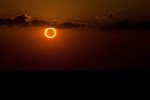
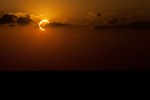
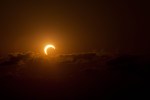
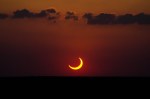
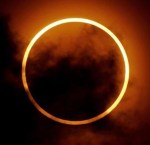
A ‘Ring of Fire’ solar eclipse is a rare phenomenon that occurs when the moon’s orbit is at its apogee: the part of its orbit farthest away from the Earth. Because the moon is so far away, it seems smaller than normal to the human eye. The result is that the moon doesn’t entirely block out our view of the sun, but leaves an “annulus,” or ring of sunlight glowing around it. Hence the term “annular” eclipse rather than a “total” eclipse.
Do you believe in hell? What kind of place do you think it is?
I mean, yes and no. Do I believe there’s a pit of eternal torment into which I will be casts for being trans and queer and enjoying porn and worshipping demons? Not so much.
Do I believe there’s a realm ruled by Lucifer where TBUT’s presence is withdrawn (because he literally thinks his absence is severe torture)? Yes, I do.
I think it’s…free. Do as thou wilt, you’re fucking dead anyway. Look how you want, be who you want, play with impulses and fantasies you couldn’t while living. I’m not saying it’s necessarily a nice place, I picture it looking a lot like the surface of Mars. But…it’s a place where I can be me. A place where the constraints fall away. Have an orgy, find out what it feels like to jump off a thousand foot cliff without a parachute, read all the books I’m sure have been written there in the millennia it’s been operating, try substances that get demons drunk or high, hell, kick it with the infernal host, sources of wisdom beyond human understanding. Hunt down humans with similar interests and hang out. Eat if you want to or don’t, you’re fucking dead. Sleep if you want to or don’t, you’re fucking dead. Pick up a project or laze around if you want, you- well you get the point.
And somewhere, in the bowels of the place, is a little bitty door. And if you get tired of the party, or bored, or just want to try something new, you step through that door and wake up screaming cold and 30 seconds old, ready to try again in a new flesh vessel. Of course, TBUT doesn’t forgive, so you’ll probably end up downstairs again, but…you’ll be coming home again. Where they’ll boop you on the third eye, remind you of all your past lives, and welcome you with a drink, a smoke, and a leer.
Hell is the ultimate dive bar. And I can’t wait to get home to it.
Look this isn’t how I picture it, but this is awesome. And also…
This post is to answer the question proposed by the title. I, along with many other witches, have done spells that had no effect or even backfired. Sometimes (most of the time) it can be quite frustrating.
If a spell backfired or did nothing, ask yourself:
Did I really want to do this spell?
Was I actively trying to perform the spell?
Was the intent of the spell clear in my mind, or was I distracted?
Did I have enough energy at the time to perform the spell?
If the answer to all of those questions was yes, you may want to evaluate whether or not some other force could be interfering with your spell, be it another witch, a spirit, or something else.
One more thing! If you’re having a divination session and the answers start to become inconsistent and, well, wrong, it does not mean all the previous answers were wrong. I tend to think like that sometimes, when in reality I’ve just used up too much energy on the other answers.
This has been a semi-positive ramble about inconsistency and failure in witchcraft so there
Doing two questions today because one of my answers is going to be extremely short.
6. Do you meditate?
Yes.
Usually a couple of times a week.
Not often enough.
7. Have you given an oath to Lucifer/Devil…why or why not?
I kind of did… by accident?
While I was agnostic, I got the sigil of Lucifer tattooed on the back of my neck.
When I became theistic and started trying to communicate with Lucifer, the tattooed sigil developed a habit of… activating. It’s hard to describe what that feels like– shivers like fever chills in the back of the neck, but it almost feels like they are actually outlining the sigil, tracing the shape of the tattoo.
This was… an unintended consequence.
Since marking myself like this wasn’t done in a theistic spirit or as an intentional oath, I don’t think Lucifer would consider me bound by it if I ever wanted to leave this path. But I don’t anticipate wanting to leave this path, and I do feel bound by it, voluntarily.
The wild is an integral part of who we are as children. Without pausing to consider what or where or how, we gather herbs and flowers, old apples and rose hips, shiny pebbles and dead spiders, poems, tears and raindrops, putting each treasured thing into the cauldron of our souls. We stir our bucket of mud as if it were, every one, a bucket of chocolate cake to be mixed for the baking. Little witches, hag children, we dance our wildness, not afraid of not knowing.
To summarize, counter-myth serves the opposite function of “ordinary” myth, subverting instead of supporting dominant discourse on how the social order should be organized. Undermining the authority of hegemonic mythical narratives by presenting conflicting alternative versions is never an end unto itself. Like counter-discourses in general, the counter-myth is always intended to cause some sort of social change, a shift in power structures (be they in a delimited context of religious institutions, or in the wider society which is affected by these institutions).
So you’re new to paganism and/or Witchcraft and have picked up a few books to start learning! Way to go! But before you open the first page, you should know that you will need to read every book critically by analyzing the validity of the material and discerning what is useful and congruent with your truth from what is false, stolen or otherwise a flat-out lie. As a beginner, this can be extremely difficult. In addition, you may run into baffling information in books; information that either challenge your inner ethics or challenge the ethics of books previously written by the same author. How do you know what to believe or do? Here are some tips to get you started!
1. Keep in mind the time period in which the book was written.
While the older pagan and witchcraft books can be wonderful resources, they can also be chocked full of problematic terms and actions, including racism, misogyny, LGBTQ+ phobia and appropriation. Some newer books even struggle with these points as these are often based on the older material. Getting a firm grasp on the publishing date and the circumstances around that date can give you a better insight to the content of that book.
2. Keep in mind who wrote the book you’re reading.
Authors are biased. Authors lie. Any one book claiming to be the book for paganism or Witchcraft is lying. You may find that the author has lied about his or her lineage or history to gain relevance in the community. You may find that certain authors have choice words about other religions or other sects of paganism or Witchcraft, considering them to not be valid. These biased opinions will heavily flavor the rest of the text. Unfortunately, all of these are incredibly common issues.
3. Books are written to be sold.
Even the most seemingly-specific books are generalized in a way that they can fit many situations so more copies can be sold. There’s nothing particularly wrong with that as it’s clearly reached you in some way. However, finding intensive, specific information may require some digging of your own. Also stemming from the idea that a book is written with the intention of being sold comes everything from above; the interests in the time period, the author fluffing their resume to seem more knowledgeable and important, and so on. Simply keep this in mind as you read.
4. If you find an author you like who has written a series of books, you may find that their beliefs evolve and change throughout the series.
Just as your beliefs will evolve and change the more you read and learn, many authors will do the same within their writings. You may find that you like the way they grow. You may find that you don’t, and that’s okay too.
5. It’s okay to grow away from an author or a book you previously loved.
Whether that author’s views have changed over the course of their books or whether your own views have changed doesn’t matter. If source material no longer serves you or interest you, it’s time to move on. Don’t get caught up on one particular book or author that you feel has to be your permanent mentor. It’s okay to move on.
6. Always pair your reading with historical text and scientific fact.
Authors make mistakes. A lot. It’s your responsibility to discern these mistakes from useful information. The easiest topic to point out are herb correspondences. Before putting any herbs in your body, do your research to insure they aren’t poisonous, even if the author says they aren’t. If you want to know the true history of Witchcraft, your better resources are historical texts. While historical texts can have their own problems, they tend to be more reliable in that area. You’ll find that many books cover the European and State-side witch trails with blatant misinformation.
7. Be acutely aware of authors who steal from other cultures.
Things like smudging, karma, voodoo, ohms, chakras, spirit animals, totems, dream catchers and so forth are appropriated from the cultures and/or closed religions they came from. Smudging is a lot more than just waving a bundle of burning sage in the air; it is a complex ceremony only available to the Native American tribes who practice it. You are not technically smudging when you do this. A better term is “smoke cleansing.” It doesn’t make smoke any less valid; it just isn’t what you might think. And this is just the tip of the iceberg. Learning to separate what is viable and accessible to you based on your culture is incredibly important so that you don’t trivialize the historical oppression of closed religions and cultures.
8. Witchcraft and Wicca are not interchangeable terms.
But you’ll find that many authors do swap them. Wicca and Witchcraft are not the same thing. Wicca is a religion that may or may not incorporate elements of Witchcraft within it. Witchcraft is the practice of manipulating energy for a certain cause. These are incredibly short, broad definitions that do not cover the totality of what each word means. In fact, if you’re more experienced, you may disagree with them. However, they do help to discern the difference, which is important if you’re a beginner learning to read books with a critical eye.
9. Wiccan beliefs do not apply to all pagans or witches.
Wicca surged in popularity in the 70s and 80s as authors began writing about self-initiation, breaking away from the traditional closed initiatory religion it was. Often, someone will assume if you’re pagan or a witch, you must be Wiccan. While that’s a common stereotyping issue from outside the community, you’d be surprised how much it happens within the community as well. Authors will often assume that everyone follows the Threefold Law or the Rede, both of which are Wiccan beliefs. These do not apply to all religions falling under the Paganism umbrella, nor does it apply to all witches. These aren’t the only examples you’ll run across where Wiccan beliefs are considered widespread Witchcraft or pagan beliefs, so keep an eye out.
10. There are witches and pagans that believe the devil is real and cursing is okay.
AND THIS IS VALID. The most common combating statement I hear pagans and witches say to outsiders is “Witches don’t believe in the devil and they don’t hex or curse.” That’s a broad statement that is totally untrue. Many lineages, paths, traditions and denominations believe in the devil, Satan, Lucifer or the Witch’s Devil, all of which are sometimes considered different entities depending on the path. There are many witches and pagans that are “Curse Positive,” or “Curse Neutral” rather than “Curse Negative.” That means that they’re at least open to the idea of curses as a necessary balance of their beliefs. All of this doesn’t mean that you have to believe in the devil or cursing; as I stated in my 10 Common Misconceptions post, your personal ethics should always be your number one rule. It just means that you should recognize that these beliefs definitely exist out there. Just because you don’t agree with them doesn’t invalidate those beliefs or the books they come from.
11. Be wary of online sources, particularly blogs. These are opinions, not fact.
Says the blog writer. But seriously, while blogs and other online sources can be great resources on modern witchcraft, we have all the same biases and fallacies any author can have. Our blogs are opinions, our personal take on our beliefs. That means, just like any other book, you should read them with a discerning eye. Of course, you also may find that online resources can be some of the most relateable, well-researched sources because of the access we now have to all variety of texts, including scientific and historical. But for every good, well-researched blog, there’s a similarly biased, judgmental, misinformed blog that seems just as great as the other one. Be careful.
12. Books do not cover everything. Real life experience is needed.
You cannot get everything you need to learn out of a book. Sometimes, it takes trial and error. For example, if you’re learning tarot, you’ll find that your connection with the cards may produce interpretations that differ or completely contrast what a tarot book would tell you. By drawing daily cards and working with your tarot deck often, you can begin to understand your own personal interpretations better. Doing the work and getting results that lead to your own answers is something you cannot get out of just reading books.
13. Finally, just because a book, website or author has a lot of problems doesn’t mean there isn’t valid information to be had once you sort through the muck.
This is why it’s so important to sharpen your critical eye. For example, if you’re traveling down the Wiccan path, you’ll likely read Gardner and Buckland. Both authors have immense issues with resume fluffing, blatant historical lies and scientific fallacies. That doesn’t mean you shouldn’t read their work. Gardner created British Traditional Wicca and Buckland furthered it. If you’re going down the Wiccan path, it’s not just a good idea to read their work – it’s almost essential. There is an immense amount of useful information to be had if you learn how to read with a critical eye and recognize information that is biased, false or misinformed. The same goes for all denominations of paganism and all practices of Witchcraft.
Number thirteen on this list highlights the reason critical reading is so important to your path. Unfortunately, the best way to learn how to sort misinformation from useful information is to, of course, read. So get out there, check out a book from your library, buy one from your local metaphysical store or download one for your electronic device and give it a shot! Good luck!





 Church of the Morningstar