
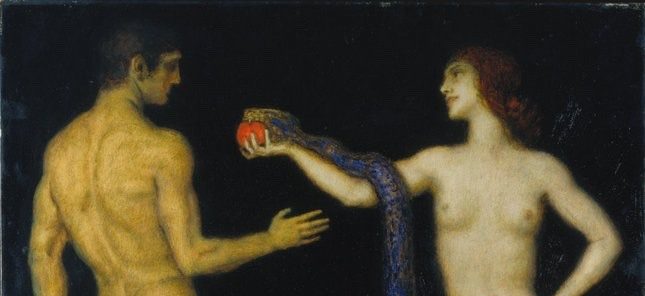
Hail, Eve, full of courage,
the Serpent is with thee.
Blessed art thou amongst women
and blessed is the fruit of thy tree, Knowledge.
Holy Eve, Mother of All,
pray for your children,
now and in the hour of our need.
Nema.
Aside perhaps from Satan himself, few figures of myth have been so thoroughly slandered as Eve. The fabled first (or second?) woman has been blamed for the loss of paradise, for the origin of sin, and even for human mortality. She’s been portrayed as stupid, or wicked, or both. Christians condemn her disobedience to God and her temptation of Adam. Surprisingly, some Satanists also deride her, for reasons I can’t quite fathom. Is it her supposed submissiveness to Adam being mocked when Satanists say, “Always be Lilith, never Eve”? Some non-Satanic feminists try to redeem her with bumper-sticker slogans like “Eve was framed.” By calling her innocent, they reduce her to a passive victim, and join in the condemnation of her supposed crime: curiosity, knowledge-seeking, and thinking for herself.
For two thousand years, ideas about Eve have been shaping the Christian attitudes that dominate humanity. Be careful how you think of Eve, because how you think of Eve is how you think of women, sex, marriage, obedience, authority, and transgression.
Today, let us think about her deeply, and even rethink her if necessary.
First of all, let’s put this ‘Eve versus Lilith’ thing to bed. It’s a false dichotomy. The two are far more similar than they are different. Both have been called the first woman. Both have been married to Adam. Both defied God and were punished for it. Both are mothers—prolific mothers, even—Lilith as the mother of demons,[i] Eve as the mother of humanity.[ii]
But their similarities go even deeper. Many stories we now associate with Lilith were originally about Eve.[iii] Long before the legend of Lilith developed, Eve was said to have lain with Samael, the serpent, and given birth to demons.[iv]
According to this legend, the serpent sexually seduced Eve to get her to eat the apple. This interpretation depends on the ambiguous translation of a certain word in Genesis 3:13:
“The serpent deceived me, and I ate.”[v]
The word here translated as “deceived” is “hish’iani.” We are going to be talking a lot about the potential meanings of this word.
Here’s the main thing to understand: because Biblical Hebrew was written without vowels, many words in it can be read as several different words. Imagine, for example, that instead of writing PIT, P-I-T, we wrote P-T. P-T could then be PIT, PET, POT, PAT, PUT, POUT, PEAT, PATE, and so on. That’s what’s going on in the Hebrew Bible. From the perspective of Jewish scriptural interpretation, this is seen as a feature, not a bug—something that adds richness and nuance to the text.
So this word, “hish’iani,” usually translated as “deceived” or “beguiled,” has numerous other potential meanings. One of them shares a root with a word for “marriage,” and so some Rabbis concluded that the snake enticed Eve into martial relations.[vi] In other words, they fucked. Genesis 3:13 becomes:
“The serpent seduced me, and I ate.”
According to other sources, after the fall from Eden, Eve and Adam separated for a time, during which Eve gave birth to many demons by Samael, and Adam fathered his own infernal children with Lilith.[vii] In these versions of the story, Cain is considered to be Eve’s son by Samael.[viii]
Talking of Cain’s paternity, what the Bible has to say about that sheds light on another interesting parallel between Lilith and Eve: both of them know the forbidden name of God, and neither is afraid to speak it out loud. Lilith famously utters the Tetragrammaton which causes her to transform into a demon and fly up out of Eden.[ix] Eve says it as well, after Cain is born:
“With the help of the LORD I have brought forth a man.”[x]
Only she doesn’t say “The Lord” (Adonai). She says YAHWEH. For the record, this is the first time anyone says the forbidden name in the Bible. Lilith is supposed to be the first one to say it at all,[xi] but Eve says it first in the holy book. [xii] There’s a lot more lore about this verse that I think Pastor Vix is going to be talking about, but suffice to say, that not only does Eve say the forbidden name out loud, she also kinda makes it sound like Yahweh is the one who knocked her up. That’s right—there were some old interpretations wherein Cain’s daddy was not Samael, but GOD himself. (Interestingly, in some Kabbalistic texts, Lilith is said to seduce God as well.)
Some interpreters believe there was no snake in Eden at all—just the woman. In other words, Eve herself was the serpent.[xiii] Lilith has also been called a serpent.[xiv] Even more radically, maybe there was no tree either—just Eve herself, the forbidden fruit, her body.[xv]
Just to put a cherry on top of the Lilith/Eve comparison, Lilith the Elder (or Eisheth Zenunim) is also called Eve the Matron. So she’s the elder Lilith and the elder Eve.[xvi]
Here, we come to the end of similarities and the beginning of differences. Lilith left; Eve stayed. Lilith looked out for herself; Eve looked out for Adam. Their choices represent poles of selfishness and generosity—both of which, for the record, were good things in their context. Both selfishness and selflessness can be admirable or destructive depending, and both Lilith and Eve made the choices that were right for them.
And it was indeed a choice that Eve made. Far from being the Devil’s dupe, Eve is shown in scripture to be a the first thinker.
First of all, she adds to what she has been told. God told Adam that if he ate from the tree of knowledge he would die.[xvii] Eve concludes from this that it’s better not to even touch the tree at all![xviii] And after the serpent tells Eve that she won’t die, but in fact she will become as God, knowing good and evil,[xix] she doesn’t just take his word for it. No, she examines the tree and thinks about it:
When the woman saw that the fruit of the tree was good for food and pleasing to the eye, and also desirable for gaining wisdom, she took some and ate it.[xx]
These may be simple, basic feats of reasoning, but remember that they are being performed by a newly made being without knowledge of good and evil. Eve seems to have something of the fruit in her before she even eats. She is drawn to knowledge in a way that Adam is not.
And of course, she was right, and not deceived at all. God admits to all his own lies:
And the Lord God said, “The man has now become like one of us, knowing good and evil. He must not be allowed to reach out his hand and take also from the tree of life and eat, and live forever.”[xxi]
So according to Yahweh himself, Eve and Adam did in fact become as gods. They did not die immediately, and its also clear that they were never going to live forever anyway, since God prevents them from eating the fruit of life and becoming immortal. So much for “deception.”
Let’s return to that pesky Hebrew word, hish’iani or his’iyani. Written with one vowel marker it means “deceived” or “seduced,” but with another it means “advised.”[xxii] Eve has not believed a lie; she has taken good advice. Now Genesis 3:13 becomes:
“The serpent advised me, and I ate.”
John Milton’s Eve has frequently been condemned as foolish and submissive. I have to wonder if those who say so have even read Paradise Lost. Milton expands on Eve’s reasoning process thus:
“For good unknown, sure is not had, or had
And yet unknown, is as not had at all.
In plain then, what forbids he but to know,
Forbids us good, forbids us to be wise?
Such prohibitions bind not.”[xxiii]
Irrefutably persuasive words, and not the words of a fool or a doormat, either.
Furthermore, having eaten the fruit, Milton’s Eve is briefly tempted to level the playing field between her and Adam. She knows that God has created her as Adam’s inferior, and wisely realizes that hierarchy is the death of love. Perhaps by keeping this new power to herself, she can even the odds:
“…the more to draw his Love,
And render me more equal, and perhaps,
A thing not undesirable, sometime
Superior: for inferior who is free?”[xxiv]
This impulse loses out to her genuine love for Adam. She can’t do to him what was done to her and leave him in an inferior position. And so, she shares the fruit.
Milton is infamous for his sympathy for the Devil, and sympathizes to an extent with Eve as well, but as a protestant Christian he could not make the ultimate leap to viewing Eve as a heroine, even a savior. However, that leap had already been made thousands of years before, by certain Gnostic sects.
In a Gnostic text called “On the Origin of the World,” we read passages like these:
After the day of rest, [Wisdom] sent [Life], her daughter… as an instructor to raise up Adam, in whom there was no soul, so that those whom he would beget might become vessels of light. When Eve saw her co-likeness cast down, she pitied him, and she said, “Adam, live! Rise up on the earth!” Immediately her word became a deed. For when Adam rose up, immediately he opened his eyes. When he saw her, he said, “You will be called ‘the mother of the living’ because you are the one who gave me life.”[xxv]
Notice the repetition of the phrase “raise up.” That’s another potential translation of that word, his’iyani, which describes what the serpent did to Eve. Here is our final iteration of Genesis 3:13:
“The serpent raised me up, and I ate.”
In Gnostic texts such as these, Eve represents a higher, spiritual awareness from which Adam has become separated, and with which he must reunite to be whole and free. To these Gnostics, Eve was a spiritual liberator, who had listened to the wisdom of the Serpent, a spiritual teacher often equated with Christ himself.[xxvi]
I prefaced this sermon with one familiar text; now we will follow it up with another. Many of you have heard the reading of Adrian S. Kayn’s adaptation of Thunder, Perfect Mind. Previously, I’d been told this ancient Gnostic text was about an “unidentified Goddess,” but during my researches for this sermon, I learned there is little ambiguity as to who the speaker is.
I am the first and the last.
I am the honored one and the scorned one.
I am the whore and the holy one.
I am the wife and the virgin.
I am the bride and the bridegroom,
And it is my husband who begot me.
I am knowledge and ignorance…
I am foolish and I am wise…
I am the one whom they call Life
And you have called Death…[xxvii]
Begotten by her husband—born of Adam’s side—honored and scorned, called both wise and ignorant, credited with death but her name is Life—what could be the answer to this riddle other than Eve?
Hail, Eve, full of courage,
the Serpent is with thee.
Blessed art thou amongst women
and blessed is the fruit of thy tree, Knowledge.
Holy Eve, Mother of All,
pray for your children,
now and in the hour of our need.
Nema.
[i] “Alphabet of Ben Sira 78: Lilith,” Jewish Women’s Archive, accessed September 18, 2024, https://jwa.org/node/23210.
[ii] Genesis 3:20.
[iii] Wojciech Kosior, “A Tale of Two Sisters: The Image of Eve in Early Rabbinic Literature and Its Influence on the Portrayal of Lilith in the Alphabet of Ben Sira,” Nashim: A Journal of Jewish Women’s Studies & Gender Issues 32, no. Spring 2018, 112-113.
[iv] Kosior, 119.
[v] Genesis 3:13, NIV.
[vi] “Gen 3:13 Did the Snake ‘Trick’ or ‘Advise’ Eve to Eat? – Mi Yodeya,” Mi Yodeya, accessed October 22, 2026, https://judaism.stackexchange.com/questions/135995/gen-313-did-the-snake-trick-or-advise-eve-to-eat.
[vii] Moses DeLeon, “Acharei Mot – Chapter 59,” Zohar.Com, n.d., accessed October 22, 2026, https://www.zohar.com/zohar/Acharei%20Mot/chapters/59.
[viii] Kosior, 119.
[ix] Ben Sira.
[x] Genesis 4:1, NIV.
[xi] Kosior, 115.
[xii] Kosior, 118.
[xiii] Kosior, 119.
[xiv] Moses De Leon, “Samael and the Wife of Harlotry,” Full Zohar Online – Vayetze – Chapter 4, n.d., accessed September 19, 2024, https://www.zohar.com/zohar/Vayetze/chapters/4.
[xv] Stephen Greenblatt, The Rise and Fall of Adam and Eve (New York, NY: W.W. Norton & Company, 2018), 254.
[xvi] Isaac Ben Jacob Ha-Kohen, “Treatise on the Left Emanation,” essay, in The Early Kabbalah, ed. Joseph Dan, trans. Ronald C Kiener (Mahwah, New Jersey: Paulist Press, 1986),173.
[xvii] Genesis 2:17, NIV.
[xviii] Genesis 3:3, NIV.
[xix] Genesis 3:4-5, NIV.
[xx] Genesis 3:6, NIV.
[xxi] Genesis 3:22, NIV.
[xxii] Manis Friedman, “What REALLY Happened in the Garden of Eden?,” YouTube, n.d., accessed October 22, 2026, https://www.youtube.com/watch?v=MOqWD4sfk5U&t=840s.
[xxiii] John Milton, Paradise Lost (New York: Modern Library, 2008), 308.
[xxiv] Greenblatt, 224-225.
[xxv] James M. Robinson et al., The Nag Hammadi Library in English (San Francisco: Harper San Francisco, 1977), 172.
[xxvi] Elaine H. Pagels, Adam, Eve and the Serpent (New York: Vintage Books, 1989), 66-68.
[xxvii] Pagels, 67.

