
by Pastor Johnny
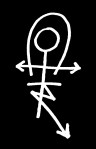
Most people, by the time they find Satanism, have heard of Lilith. When they think of Lilith, they are probably thinking of the first wife of Adam. This form of Lilith is popular with good reason. But there exists another Lilith, either as another aspect of the same demon-goddess, or as a completely separate entity, depending on who you ask. This is The Elder Lilith.
Before I go further, I want to make it clear that there are many schools of thought on this. What I am about to lay out is the interpretation of the lore that Vix and I use. It is textually based, but there are other texts that contradict our interpretation. In fact, some of the same sources we use even contradict themselves. Such is the nature of sacred text.
So, who are the two Liliths?
Let us begin with Lilith the Younger. Even though her story comes chronologically later, her legend is actually older, and of the two, she is the better known.
Lilith the Younger
Lilith had her ancient origins in Sumerian demonology. Her name was Lilitu then. Many aspects of her lore were already in place: she was thought to be a succubus who harmed children.[1] But it was not until the Alphabet of Ben Sirach, a medieval Jewish text, that an origin story was given to her.
In the Alphabet of Ben Sirach, we read:
When God created the first man Adam alone, God said, “It is not good for man to be alone.” [So] God created a woman for him, from the earth like him, and called her Lilith. They [Adam and Lilith] promptly began to argue with each other: She said, “I will not lie below,” and he said, “I will not lie below, but above, since you are fit for being below and I for being above.” She said to him, “The two of us are equal, since we are both from the earth.” And they would not listen to each other. Since Lilith saw [how it was], she uttered God’s ineffable name and flew away into the air. Adam stood in prayer before his Maker and said, “Master of the Universe, the woman you gave me fled from me!”
The Holy Blessed one immediately dispatched the three angels Sanoy, Sansenoy, and Samangelof after her, to bring her back. God said, “If she wants to return, well and good. And if not, she must accept that a hundred of her children will die every day.” The angels pursued her and overtook her in the sea, in raging waters, (the same waters in which the Egyptians would one day drown), and told her God’s orders. And yet she did not want to return. They told her they would drown her in the sea, and she replied. “Leave me alone! I was only created in order to sicken babies: if they are boys, from birth to day eight I will have power over them; if they are girls, from birth to day twenty.” When they heard her reply, they pleaded with her to come back. She swore to them in the name of the living God that whenever she would see them or their names or their images on an amulet, she would not overpower that baby, and she accepted that a hundred of her children would die every day. Therefore, a hundred of the demons die every day, and therefore, we write the names [of the three angels] on amulets of young children. When Lilith sees them, she remembers her oath and the child is [protected and] healed.[2]
In these two paragraphs, we can see a lot of what is appealing about Lilith the Younger. As the defiant ex-wife of Adam, she represents feminine independence. Though she has been smeared as a baby-killer, her devotees have reinterpreted her as a protector of reproductive choice and an adopter of children who died too young. In this story, she can also be considered the first magician: by blasphemously speaking the forbidden name of God, she transforms into a more powerful being, gains the power of flight, and escapes from her unhappy marriage. This is an act of magic– and of Left-Handed magic, at that.
Lilith the Younger is the first divorcee. But her association with divorce is even deeper than that. Since Lilith was so feared as a child-killer and succubus, a good deal of Jewish magic focused on protection from her. One method that was used to get rid of Lilith was to serve her a ‘get’– a Jewish writ of divorce![3]
Lilith was accused of killing children, but it was also believed that when children laughed in their sleep, it was because Lilith was playing with them.[4] To the Jews, this was considered sinister, and a sign that Lilith was planning to take their child. To those of us who love and trust Lilith, it seems downright endearing.
Let us now move on to discussing the Elder Lilith.
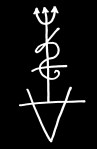
Lilith the Elder
Lilith the Younger was a human being, created from the same material as Adam.[5] She is generally referred to as Lilith the Younger, Lilith the Maiden, or simply as Lilith. Lilith the Elder, on the other hand, is a primordial being, born as one with Samael himself, and considered the cause of the rebellion in heaven. She is called, variously: Eve the Matron, The Northern One, Sin,[6] The End of Days, the End of All Flesh, and Woman of Whoredom.[7] In this church we refer to her mainly with the Hebrew phrase “Eisheth Zenunim,” which means Woman of Whoredom. Many of us get lazy and refer to her simply as Eisheth, as if that were her first name, but this is in fact extremely bad Hebrew because “Eisheth” means “woman of” and is thus a nonsense phrase on its own.
The idea that there is more than one Lilith goes all the way back to Sumeria. There Lilitu was described as having a “handmaiden” called Ardat-Lili.[8] However, we don’t get an elaborated story of this Elder Lilith until an early Kabbalistic writing called Treatise on the Left Emanation, dating from the 13th century CE. In it, we are told that Samael and Lilith were originally created as one androgynous entity, just as Adam and Eve were. Once Samael and this primordial Lilith were separated, they lusted after each other, which caused their rebellion and the “partial collapse of the Throne of glory.”[9] This Elder Lilith is also referred to as the Northern One, because evil comes from the north in Kabbalah. She is also simply referred to as Sin.
A strikingly similar story actually occurs in Paradise Lost. This is not coincidental– Milton almost certainly read the Zohar and was influenced by Kabbalah.[10] In Paradise Lost, Sin is born out of Satan’s head, much as Athena is born from the head of Zeus. Milton, however, is careful to state that Sin came out of the left side of Satan’s head.[11] This is important because the demonic, in Kabbalah, is known as the left emanation. Satan becomes enamored of Sin and copulates with her, causing her to become pregnant with their child, Death.[12] In the Zohar, Samael also fathers Death with the primordial Lilith.[13]
Lilith the Younger is reputed to be a child-killer, but Lilith the Elder is the mother of all death and is fully capable of cutting down grown men. A passage of the Zohar describes her dual nature. She appears first as a beautiful harlot, seducing men with her sensual charms and offering them wine. Once her prey has become drunk and helpless, she transforms into “a mighty oppressor who wears a garment of burning fire” and “has horrible eyes and a sharp sword on which there are bitter drops.” With this envenomed blade, she slays the man she has led astray.[14] This description is probably meant to be an allegory for the nature of sin– at first seductive, but ultimately destructive.
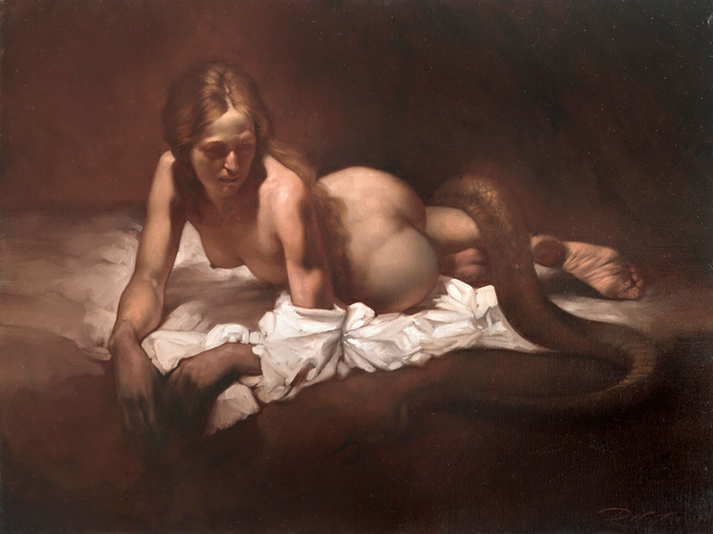
Lilith the Elder is the primordial mate of Samael. According to some texts, God castrated Samael to prevent him from becoming too powerful.[15] Because of this, Lilith and Samael can only couple with the assistance of a “blind serpent” named Tanin’Iver[16]— a unique kind of martial aid. Indeed, Samael’s incompleteness without his feminine mate is often emphasized. The Zohar does not describe Samael as castrate, but rather as headless, cleaving together with Lilith in order to be whole. The same passage states that “in the left side, the female is larger than the male.” [17]
Why Are There Two?
So, why are there two Liliths?
While it is true that there seems to have been two Liliths, one “greater” and one “smaller,” since the days of Lilitu and Ardat Lili,[18] these Sumerian origins alone do very little to explain the doubling of Lilith in contemporary demonology. The real explanation is much more interesting and complex, but it boils down to a simple principle: symmetry and mirroring is an essential aspect of Kabbalah[19] and of Jewish demonology in general.[20]
This aspect of doubling is obvious if one only takes a moment to sit back and consider the stories we have heard so far. It is filled with pairs of opposites who reflect one another: Lilith and Adam, Lilith and Samael, Lilith and Eve, Lilith and Lilith, above and below, heaven and hell, Eden and Earth, God and Satan, right hand and left hand. Indeed, the left emanation– which is to say, the demonic side of reality– is a mirror image of the divine.[21] Samael is referred to as “El Acher” which means “the other El,” which is to say, the other God.[22]
In Kabbalah, God has a feminine counterpart– the Shekinah.[23] Just as there is the Other El on the demonic side, there must be an Other Shekinah. Lilith was a demoness who was already popular and feared, and so she seemed like an appropriate consort for Satan. She could fill this role.
But wait, Lilith cannot be Samael’s true counterpart in the way that the Shekinah is to God, because she was created as one with Adam, not with Samael! We shall have to come up with another Lilith, an older, larger, more primordial Lilith– one who is truly Samael’s twin.
Some of this doubling traces its origins back to a scriptural doubling, an inconsistency in the tale of creation. The Bible provides two stories of the creation of man and woman.
Genesis 1:27 simply states:
So God created mankind in his own image,
in the image of God he created them;
male and female he created them.[24]
Here, male and female are created simultaneously. But Genesis 2:7-24 describes God making Adam first and making Eve out of his “side” later on. So the story of Adam’s first wife Lilith was invented to explain the first version, wherein Adam and Lilith are created at the same time, out of the same dust.[25] Their original androgyny adds a double-meaning to the phrase “male and female he created them.”
Again and again, we see that inconsistencies in scripture are what give rise to demons. Just as the name Lucifer arises from a mistranslation of Isaiah 14:12, so Lilith springs up between the lines of Genesis, to reconcile the contradictions. It is almost as if scripture is code and demons are viruses generated by its errors, replicating and spawning copies as fast as Lilith gives birth to children.
So Lilith comes into being because there are two Eves, and then a second Lilith comes into being because there are two Els (El and Samael) and both require a mate. As above, so below, and as on the right, so on the left. But in Kabbalah almost everything is a fractal– there is right and left both above and below, and above and below on the left and right, so everything is doubled in multiple directions. Mirrors are facing mirrors, and sets of twins are twinned.
This is profound stuff. We are talking about mysticism now, which means it does not entirely make sense, at least not in the usual rational way. It makes sense from the gut and the heart. Suffice it to say: while the great holy mystery of the right hand is oneness, the great holy mystery of the left side is multiplicity, doubling, and infinite generation. Think of the word Pandemonium, which means “all demons.” Think of the swarms of flies brought by Beelzebub, and the multitudes of ghostly children birthed by Lilith. Think about the fact that Lilith and Samael together form Azazel[26], and that without one another, they are incomplete.
And if all of that seems strange and unreal to you, think instead about the complexity and ambiguity of life, the ways that supposed opposites are often blurred, the ways that partners can come to mirror one another, the ways children and siblings resemble their parents and each other, but always with errors in replication.
A New Myth
All literary, historical and philosophical explanations aside– I have yet to find a mythical explanation of why there are two Liliths. So allow me to close by proposing one.
In the beginning, God divided the Light from the darkness. The Light was Lucifer. The Darkness was Lilith. God saw the light, that it was good. But the Light saw only the Darkness, and he thought her very good indeed.
God loved Lucifer, lusted after Lilith, and was jealous of both, so he tried to keep them apart. He belittled the Darkness by calling her a Woman of Whoredom, but he could not make the Light forget her.
So the Light and the Darkness joined forces and fought against God. They were defeated, because right does not always make might. They and their legions were cast into Hell.
The angry God decided to make smaller, weaker creations who he might more easily control. He made a creature of flesh called Adam who resembled the Light, and another creature of flesh who resembled the Darkness. Out of spite, he called this creature Lilith as well.
But the smaller Lilith had the same strong will as the Darkness, and she too rebelled. And the Light and the Darkness saw her rebellion, and they loved her for it. They raised her up and made her powerful, like one of them.
Then God grew even angrier. He tried splitting Adam in half to make another feminine creature. He thought that by doing this, by making them incomplete, he would finally make them small and weak enough to control. But he forgot that splitting the light from the darkness had been where all his trouble began– that by dividing them, he had only made them more ferociously determined to come back together.
So Eve and Adam were loyal to one another, as if they had still been one flesh, and when Lucifer and the Liliths plotted to offer them the fruit of knowledge, both of the humans took the fall together.
The great Lilith led a cosmic revolution against God. The little Lilith had a personal revolution against her husband, but it was a revolt nonetheless. God was foolish to reuse the name of Lilith, for that name became her destiny.
I leave you with this thought– if there are two Liliths, there could be more. The second Lilith, after all, began as a human being. You yourself could be a Lilith as well– or a Samael, if that suits you better. The essence of the left side is rebellion, and that essence can reside in the smallest as well as the greatest of vessels. Let the demonic virus infest you, and become what cannot be contained.
[1] 1. Raphael Patai, The Hebrew Goddess (Detroit, Mich: KTav Publishing, 1967), 207-208.
[2] “Alphabet of Ben Sira 78: Lilith.” Jewish Women’s Archive. Accessed September 18, 2024. https://jwa.org/node/23210.
[3] Patai, 212-214.
[4] Patai, 228.
[5] Ben Sira.
[6] Isaac Ben Jacob Ha-Kohen, “Treatise on the Left Emanation,” essay, in The Early Kabbalah, ed. Joseph Dan, trans. Ronald C Kiener (Mahwah, New Jersey: Paulist Press, 1986), 165–181, 173.
[7]De Leon, Moses. “Samael and the Wife of Harlotry.” Full Zohar Online – Vayetze – Chapter 4. Kabbalah Centre International Inc., n.d. Accessed September 19, 2024. https://www.zohar.com/zohar/Vayetze/chapters/4.
[8] Patai, 207, 235.
[9] Ha-Kohen, 173.
[10] Denis Saurat, “Milton and the Zohar,” Studies in Philology 19 (April 1922): 136–151, 136-137.
[11] John Milton et al., Paradise Lost (New York: Modern Library, 2008), 79.
[12] Milton, 80-81.
[13] Alan Melnick, “Milton and the Zohar” (master’s thesis, University of Cape Town, 1993), 78, https://open.uct.ac.za/server/api/core/bitstreams/afe5c171-20bb-4fce-8bba-ee3f80dea875/content.
[14] De Leon.
[15] Patai, 235.
[16] Ha-Koen, 180.
[17] De Leon.
[18] Patai, 207.
[19] Nathaniel Berman, “Improper Twins: The Ambivalent ‘Other Side’ in the Zohar and in Kabbalistic Tradition” (PhD dissertation, University College London, 2014), 29.
[20] Andrei A. Orlov, Dark Mirrors: Azazel and Satanael in Early Jewish Demonology (Albany: State University of New York Press, 2011), 4.
[21] Berman, 13-14.
[22] Berman, 31.
[23] Patai, 137.
[24] Genesis 1:27, NIV.
[25] Wojciech Kosior, “A Tale of Two Sisters: The Image of Eve in Early Rabbinic Literature and Its Influence on the Portrayal of Lilith in the Alphabet of Ben Sira,” Nashim: A Journal of Jewish Women’s Studies & Gender Issues 32, no. Spring 2018 (n.d.): 112–130, 117.
[26] Orlov, 11.













 Church of the Morningstar